Japan’s Kansai region features many of the most iconic places in the country. From the sprawling cityscape of Osaka and the quintessential cultural hub of Kyoto through to the intriguing 19th-century history of Kobe and the ancient sites of Nara, the region is filled to the brim with Japanese culture and history, almost serving as a microcosm of the country itself. Check out my Kansai travel experiences below!
Osaka, Nara, Ikaruga, Kyoto, Kobe
Located on the southern coast of central Honshu, the Kansai region is densely-populated. The region contains numerous former Japanese capitals, the most notable being Kyoto which served as the capital city for 1,000 years up until the mid-1800s. Having developed over time, the cities of Osaka, Nara, Kyoto and Kobe have each grown to the point that they essentially form an enormous urban area which is sometimes referred to as ‘Keihanshin’. With over 20 million inhabitants, this is one of the largest urban areas in the world, containing around 15% of Japan’s total population and second in size within the country only to Greater Tokyo.
The cities and settlements of Kansai are extremely well-linked by train and travel within them is fast, cheap and easy. It would theoretically be possible to just use one base in the region and visit the other cities on day trips, however if you have time I recommend staying overnight in the various different cities here, as there is so much to see and do in each of them. Kansai isn’t just a built-up area; there are plenty of rural, low-key places within the region that also have intriguing histories, such as the historic temple town of Ikaruga or the ancient capital site of Asuka – representing a totally different side of Japan.
Osaka
The beating heart of the Kansai region, Osaka sits in very close proximity to the other notable cities of Kobe, Nara and Kyoto. Although it’s technically the third most populous metropolitan area in Japan after Tokyo and Yokohama, Osaka realistically is the nation’s second most populous and influential city after Tokyo. Osaka also rivals Tokyo for gastronomy, history and for its glitzy entertainment districts.
The city is steeped in history, once functioning for a brief period as the capital (10 years in the 7th century), and boasts some of the largest burial mounds in the entire world, on par with the pyramids in Egypt. Most tourists have no idea about these magnificent kofun keyhole burial mounds in the Sakai district. Osaka Castle played a pivotal role in the establishment of the Tokugawa shogunate; the final episode of the Tokugawa ascension played out at this castle during the siege of 1614-15, when the Toyotomi clan were finally defeated and the son of Hideyoshi Toyotomi (great unifier of Japan) forced to commit seppuku, leaving Tokugawa as the undisputed leader. Now rebuilt, Osaka Castle is a major draw for tourists, who flock en-mass to capture photos of the reconstructed castle.
Osaka is a foodie paradise with street food options galore, like takoyaki (doughy balls with an octopus piece in the center and often smothered in mayo and rich tangy sauce), okonomiyaki (thick pancakes filled with meat and veg cooked in a local style) and Kushikatsu (deep-fried skewers of breaded meat or potato). Osakans are known for their Kuidaore (eat yourself to bankruptcy) – in other words, an excessive eating culture. Osaka is home to a plethora of Michelin star restaurants in direct competition with Tokyo. The saying goes that Osakans bankrupt themselves for food, while the Kyotoans do the same for clothing.
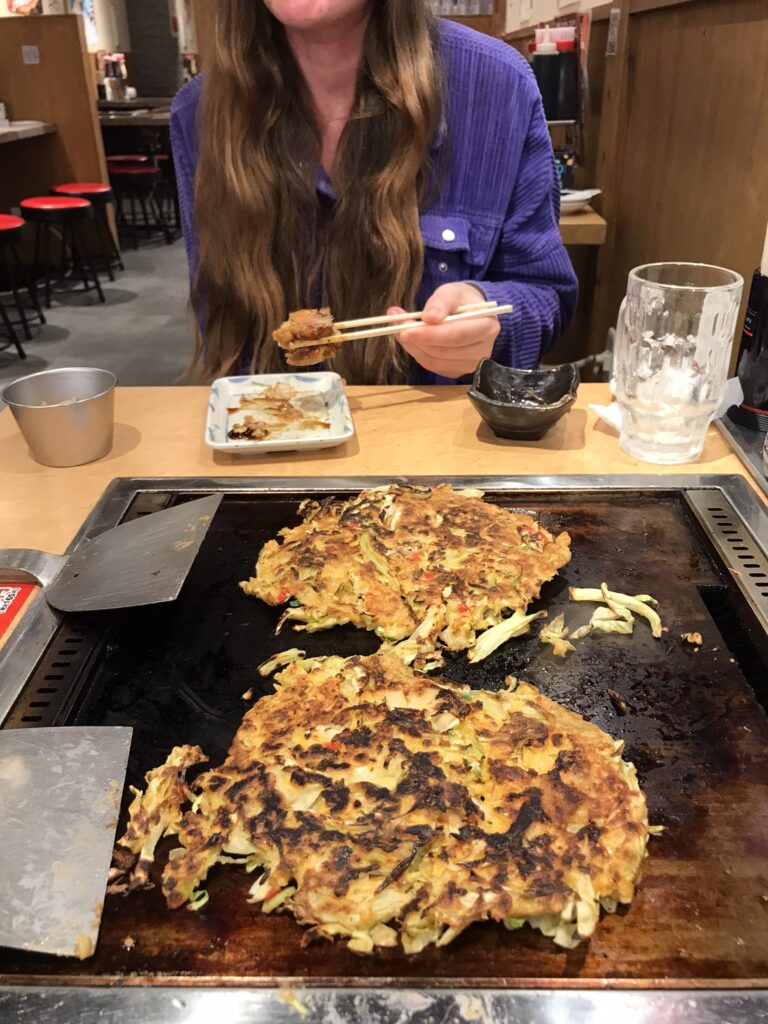
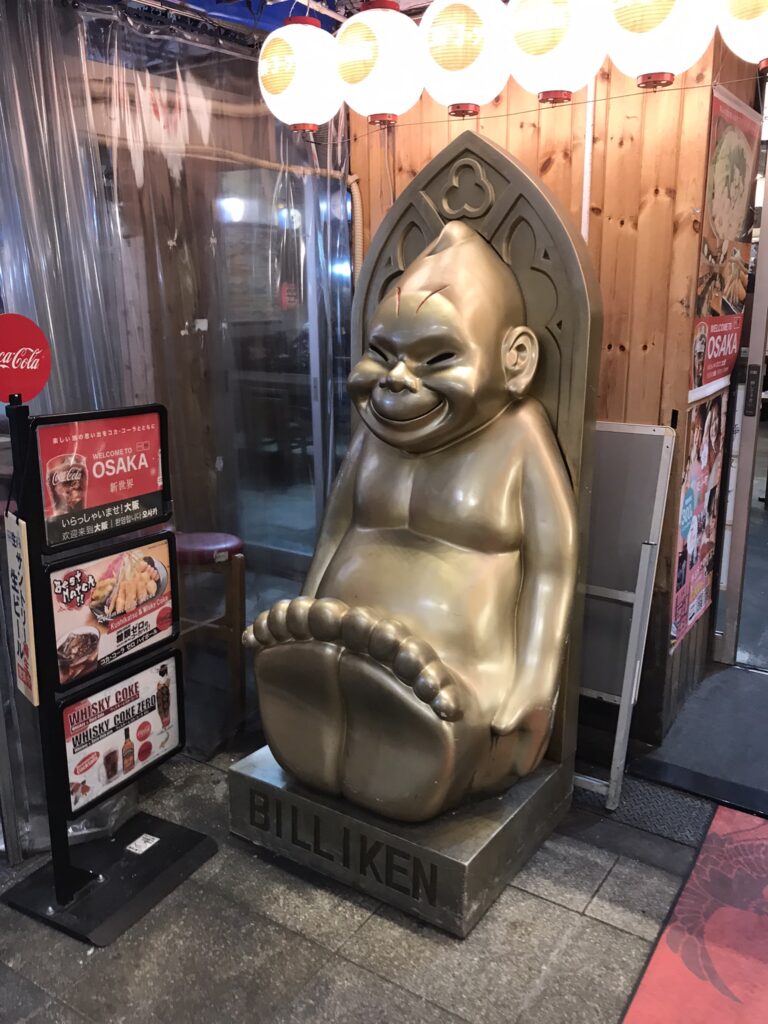
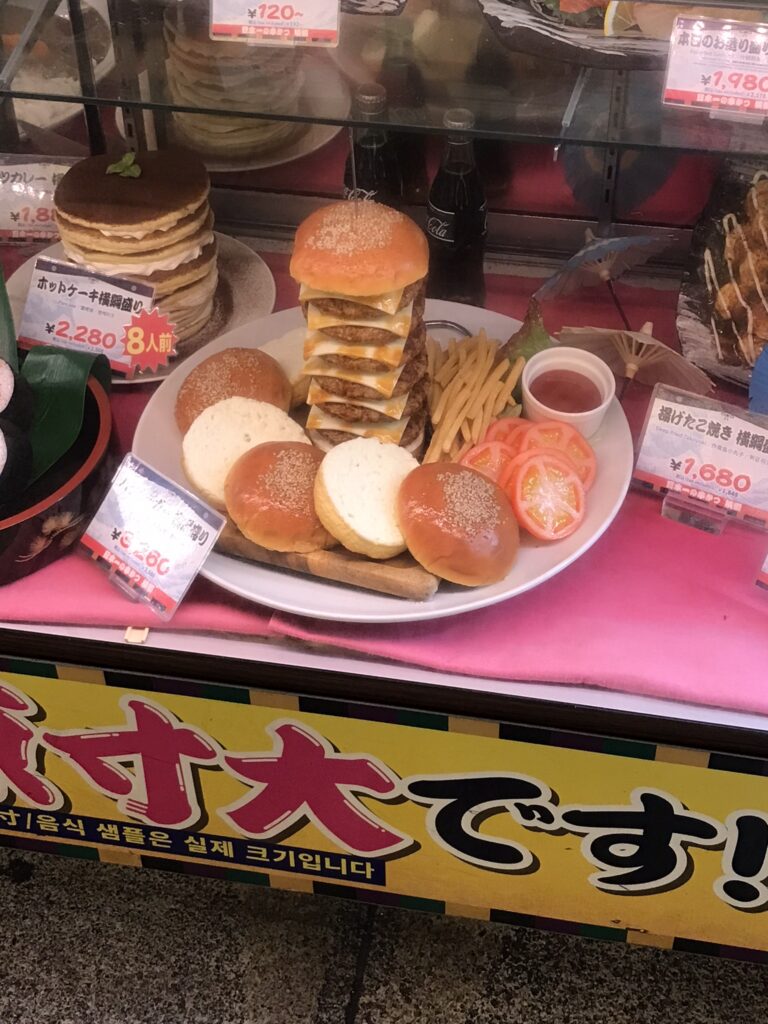
Okonomiyaki right off the grill, the famous Billiken and kuidaore (excessive eating) as it’s finest
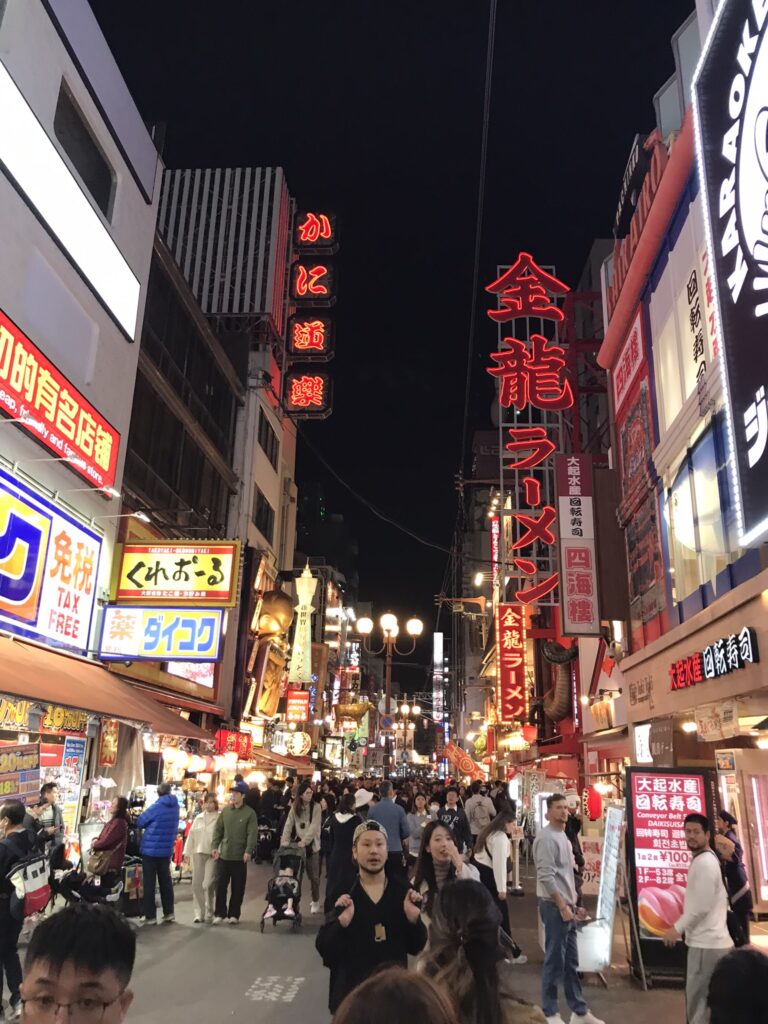
Osakans have a reputation for being bolder, brasher and less bothered by etiquette than their Japanese counterparts from other cities. Many well-known Japanese comedians hail from the city as a result. The bright lights of Dotonbori and Shinsekai are a playground after dark for those seeking it – a place of refuge from the daily 9-5 grind, putting Tokyo’s famously wild entertainment districts to shame. Around Shinsekai, you will surely spot the famous Billiken. An icon of Osaka, this smiling, chubby figure with large feet was created by an American art teacher in the 1900s and adopted as an unofficial mascot of the city – to residents of Osaka, it represents the God of Things as they Ought to Be.
Accommodation
HOTEL MYSTAYS Otemae – a budget hotel located a short 5-minute walk away from Osaka Castle. It has all the usual amenities: laundry facilities, microwave and vending machines near the lobby. The interior is slightly dated but you can’t complain for the low-cost and unbeatable location.
ABC Guesthouse (near Kansai Airport)- ideal for those with an early morning flight like us. Kansai Airport is located very far to the south of central Osaka, however from this accommodation it’s a short 15 minute trip to Kansai Airport on the metro. The property is split into separate apartments, these are spacious and very functional. A supermarket is just across the road as well.
Foodie Places
Boulangerie & Cafe Gout – a trendy bakery-cum-café located a short distance from the castle grounds, serving up a fantastic array of mouth-watering baked goods and sandwiches for those on the go. The tomato, mozzarella and pesto focaccia was an absolute dream. It was the kind of bakery where you can spend ages deciding what to get as everything looks so tempting.
Jinseiyumeji Tokumen – the best tsukemen place near Osaka Castle. The staff were very friendly and humble, even apologising when they accidently got our order wrong. One perk of this joint is that you can pick whether to have a small, medium or large serving for noodles without any additional cost. As budget-conscious travellers we always went big! The flavour of the rich broth was out of this world.
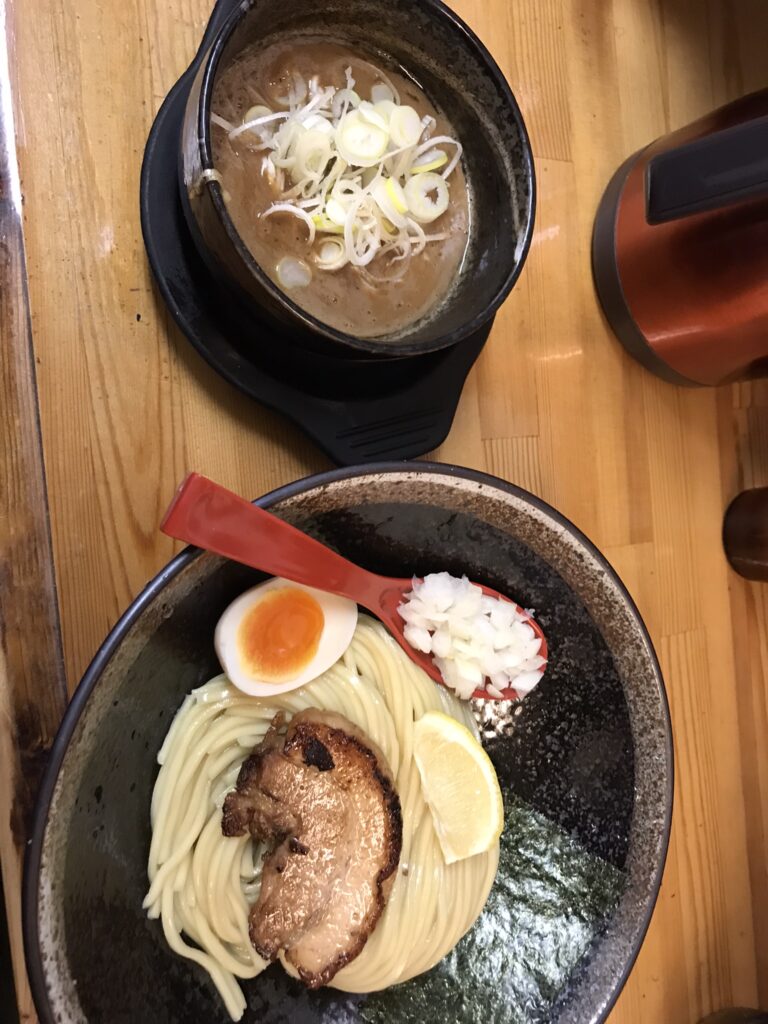
Jinseiyumeji Tokumen serves up incredible tsukemen near Osaka Castle
Ajinodaimaru Bekkan – located just off the main strip in the Shinsekai neighbourhood, this place specialises in okonomiyaki and was our first introduction to okonomiyaki in Japan. We were excited to try this popular thick pancake, which has many regional variants. It also happens to be a relatively inexpensive meal – on par with ramen. When we walked into this casual eatery, we had no idea we’d actually be the ones cooking it ourselves! After being seated and ordering regular pork okonomiyaki, we were handed a bowl of raw ingredients and instructed to follow the directions for cooking which we found on a card. The server assisted with turning on the griddle in the centre of the table.
After some slight apprehension, this turned out to be a really worthwhile activity – the instructions were pretty straightforward (except for the flipping aspect, but we quickly figured it out). It’s crazy to think that some tourists actually pay money for an okonomiyaki cookery lesson, while we paid only 1000 yen each to do it ourselves. The okonomiyaki pancake was super tasty and we were able to add various sauces to our hearts’ content.
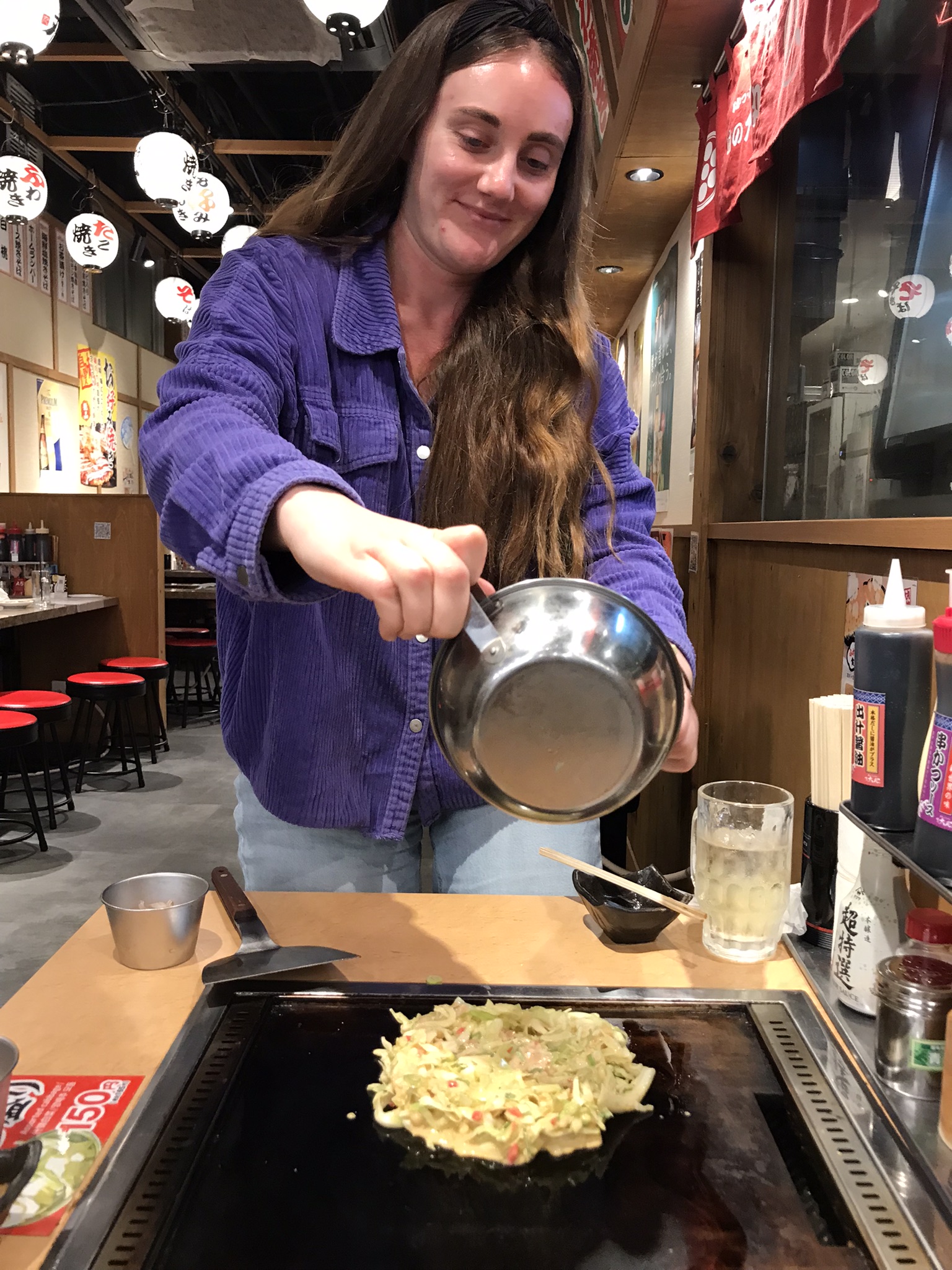
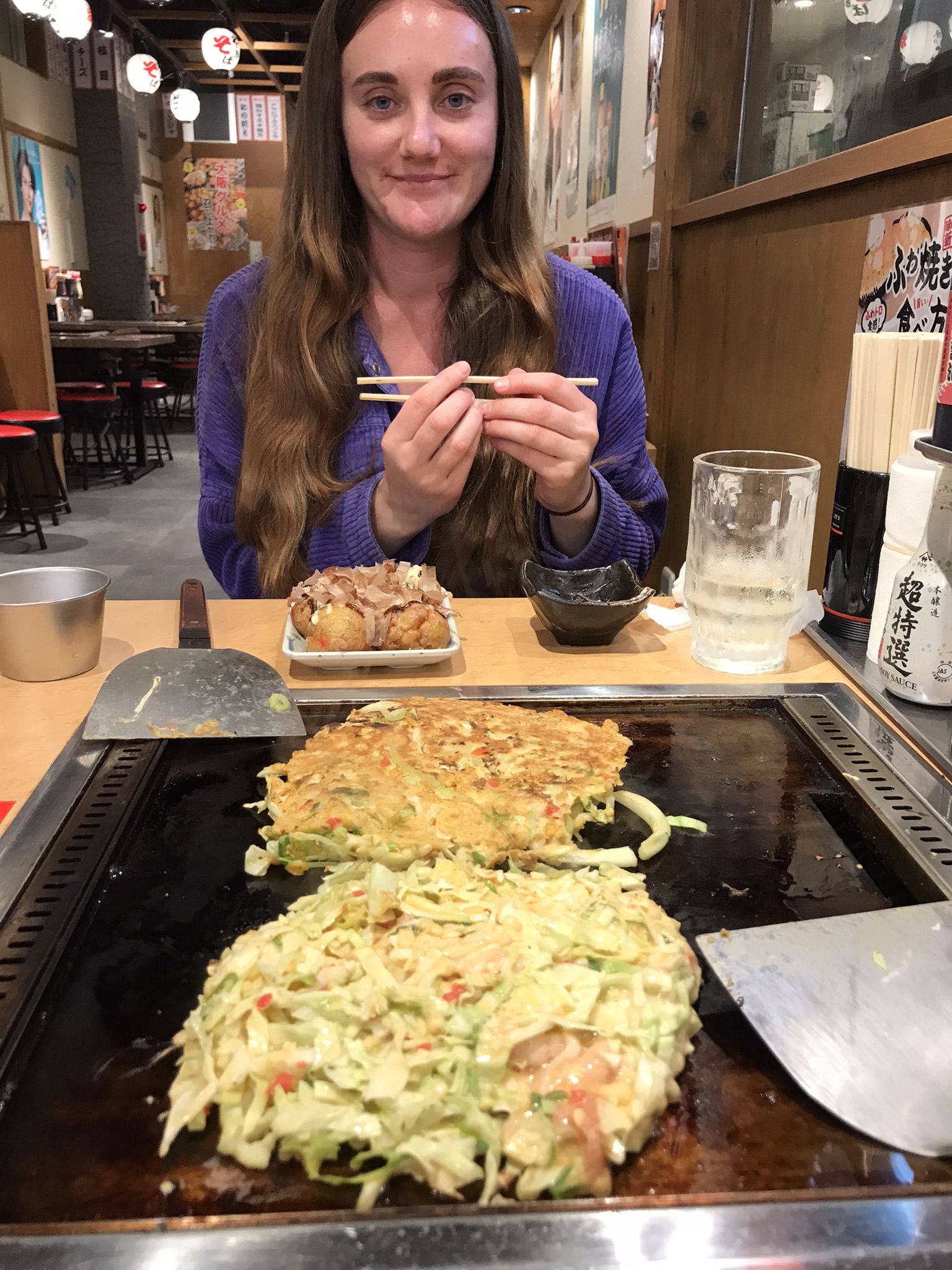
Grilling your own okonomiyaki is such an authentic and fun experience
Sushi Kyōmachibori Sato – featured in the Michelin guide, this gourmet sushi place is way above our usual budget but we ate here as a treat for my birthday and in order to try a fine dining sushi experience. This restaurant has a very intimate setting in a basement, but it also felt quite laid-back and not upper crust or unwelcoming/pretentious like many high-end sushi places – they aren’t going to kick you out for wearing trainers, although it’s still a super fancy place which requires a reservation in advance. We opted for the omakase 9 piece menu. Omakase essentially means that the chef selects and serves his own choice of sushi based on the fresh seafood which is available at the auction that day. The diner has no say in what is served, putting full faith in the chef. Because of this, we tried plenty of sushi that we wouldn’t usually have picked, including sea urchin and two types of eel.
Sushi is brought across one piece at a time. We saw the chefs placing the sushi straight onto the plate of the patrons who were sitting at the counter, although it was brought to us by a waiter as we were sitting at a table. We were worried beforehand that 9 pieces of sushi would not be enough and that we would still be hungry – we didn’t factor in that the menu also included a whole host of other items in addition to the 9 pieces of sushi. As well as the sushi, we were brought multiple pieces of sashimi, soup and even a strawberry mochi for dessert, all of which were included as part of the set omakase menu.
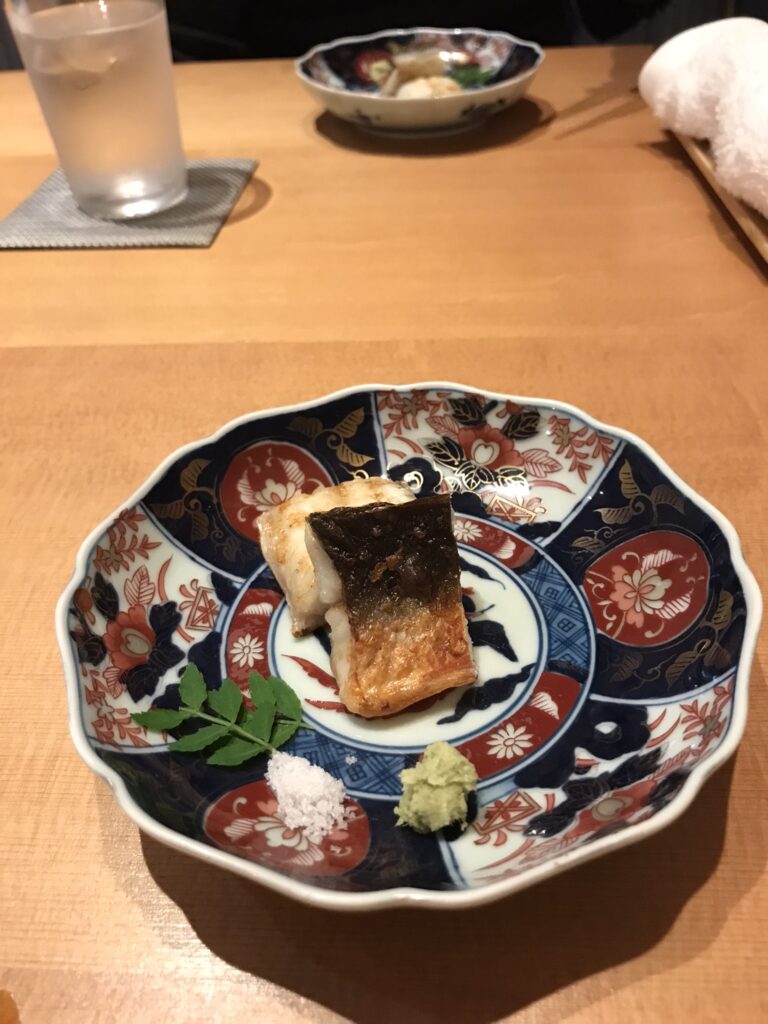
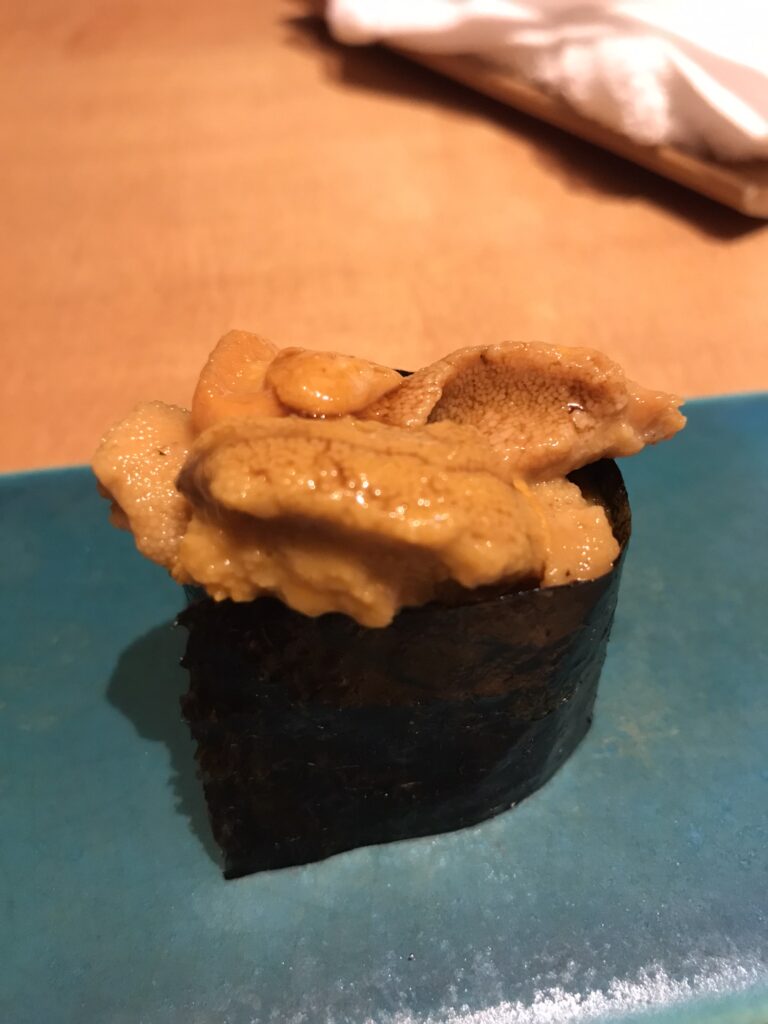
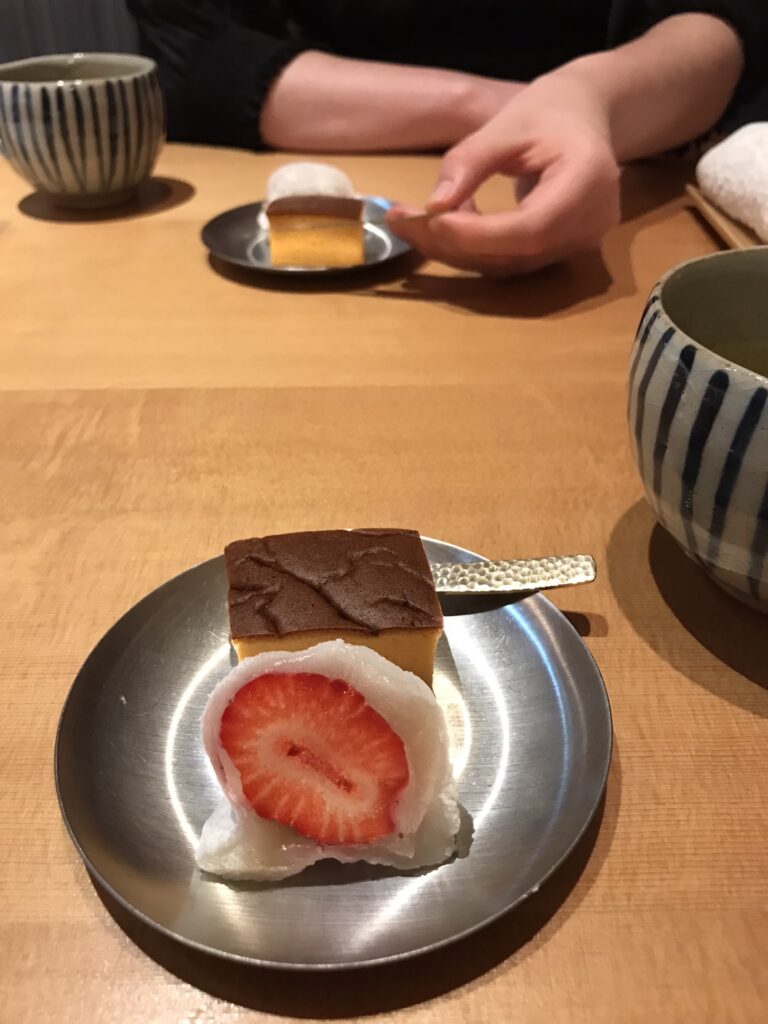
Just a couple of the numerous dishes that were served to us as part of the omakase meal at Sushi Kyōmachibori Sato
The experience at this restaurant was a really positive one for us, even as non-Japanese speakers, as the waiter was able to point at a card with English translations to explain to us what the various pieces of sushi were. It was fascinating for us to watch the sushi chefs in action, rolling the sushi in their hands. We also received a friendly goodbye from the sushi chefs – quite a personal touch.
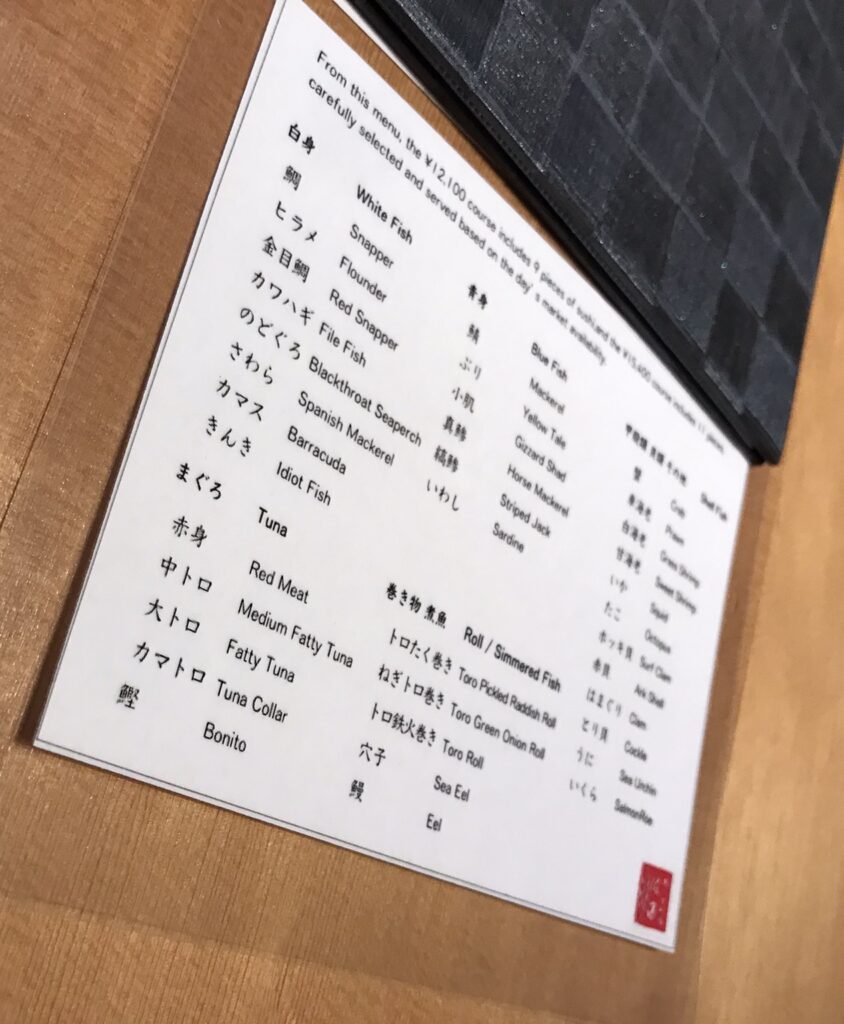
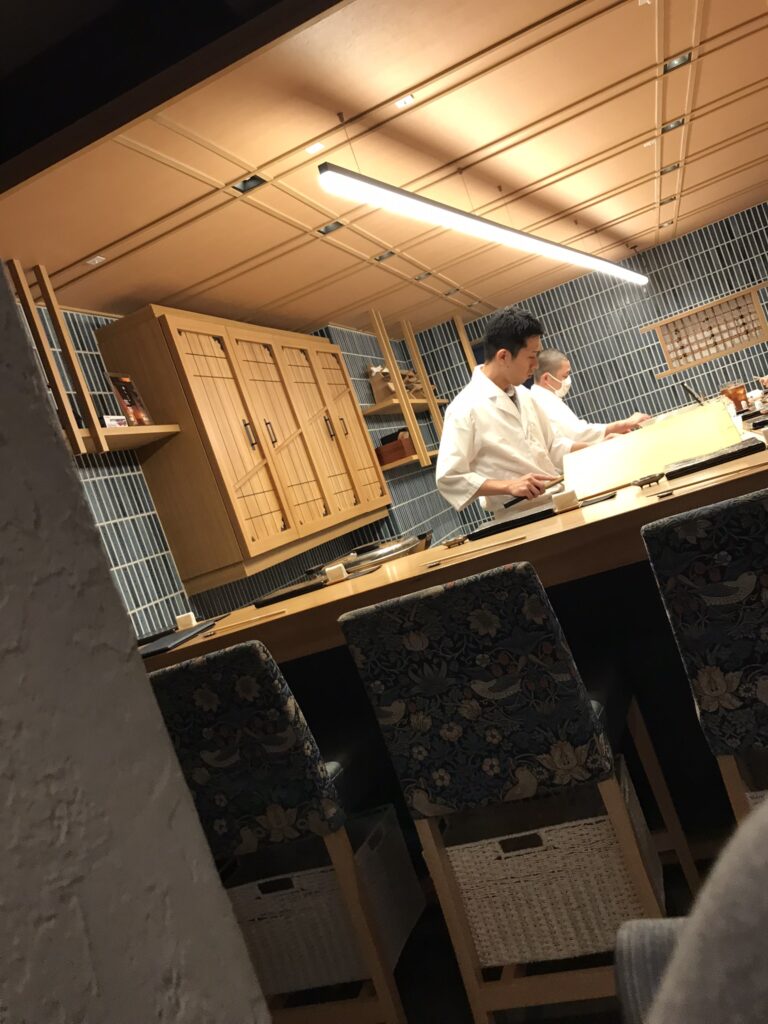
We were very intrigued by the ‘idiot fish’ on the list of possible dishes
The Butcher – if you’re craving a fatty American-style burger, this is the place for you. It’s in a really central location, not too far away from Dotonbori, Namba station, Nipponbashi and Kuromon Market.
Culmal – a cutesy little cupcake cafe located near to Osaka Castle. I indulged in a matcha oreo cupcake. There are gluten-free options too.
Activities
Osaka Castle Complex – although completely reconstructed, the original Osaka Castle was built by Hideyoshi Toyotomi in 1597, and was designed as the grandest castle of its era. A place of great historical significance, it was here that Ieyasu Tokugawa’s forces surrounded Toyotomi’s son in 1615, ending the Toyotomi line and establishing the dominance of the Tokugawa Shogunate which went on to rule Japan for almost 300 years. Destroyed in that siege, the castle was rebuilt in the 20th century and stands as a testament to the ambition of Toyotomi – a man, born of humble origins, who unified Japan and almost set up a dynasty. The castle is now a symbol of the city and one of the most spectacular and iconic castles in Japan, even if it is a modern reconstruction.
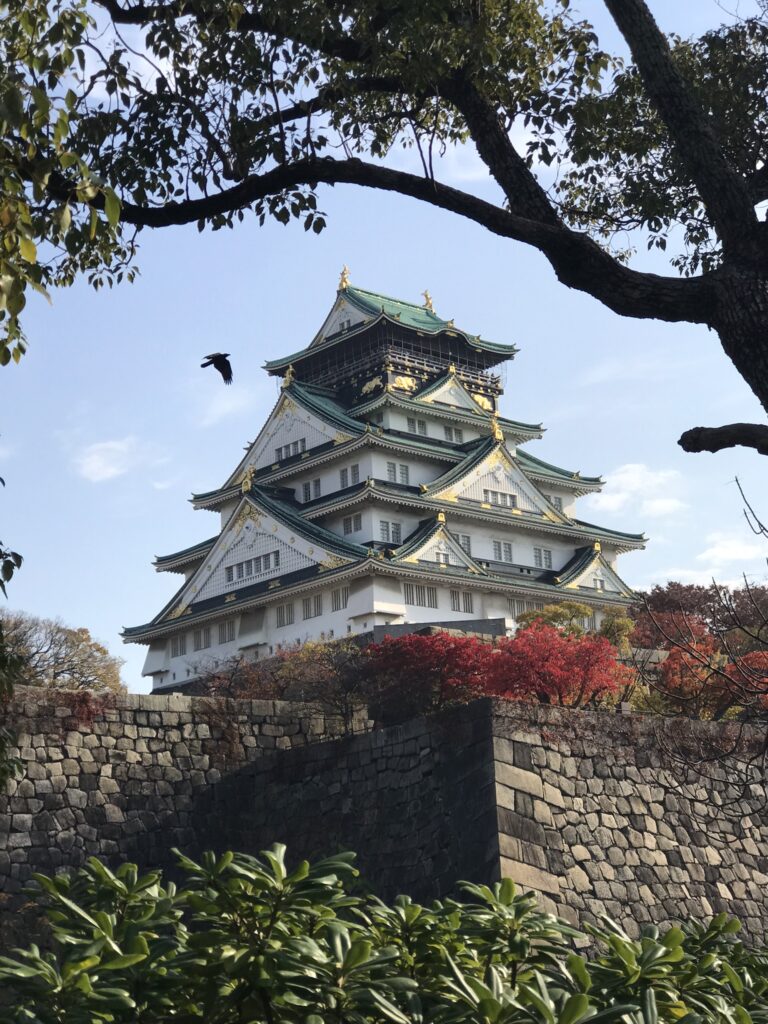
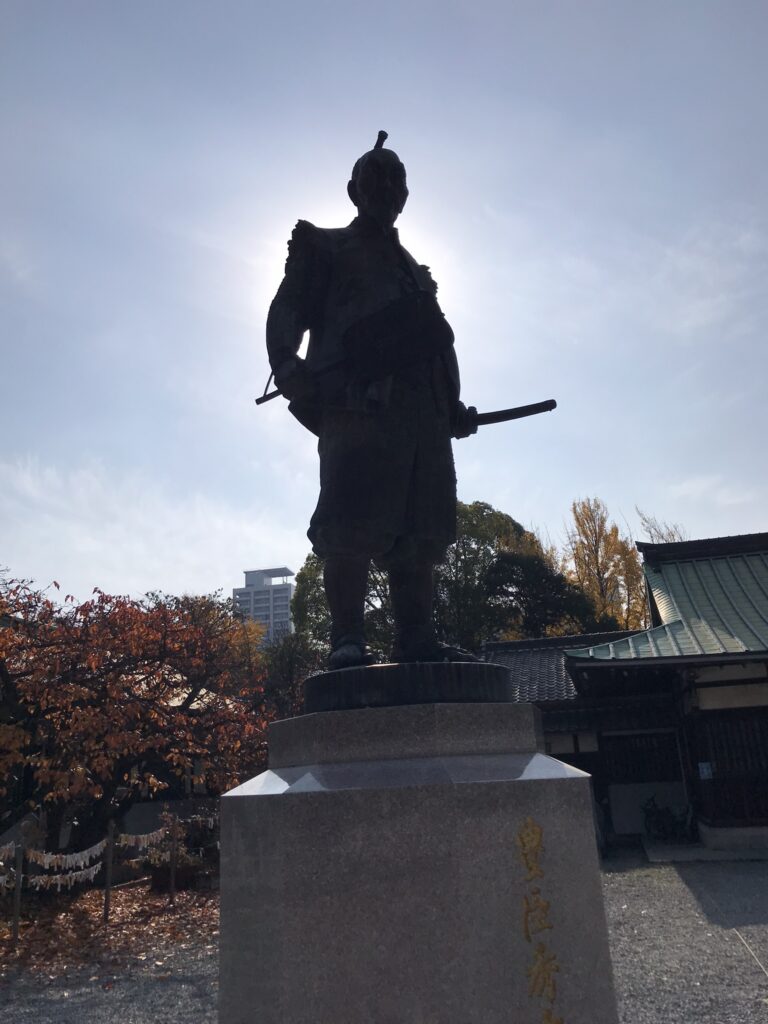
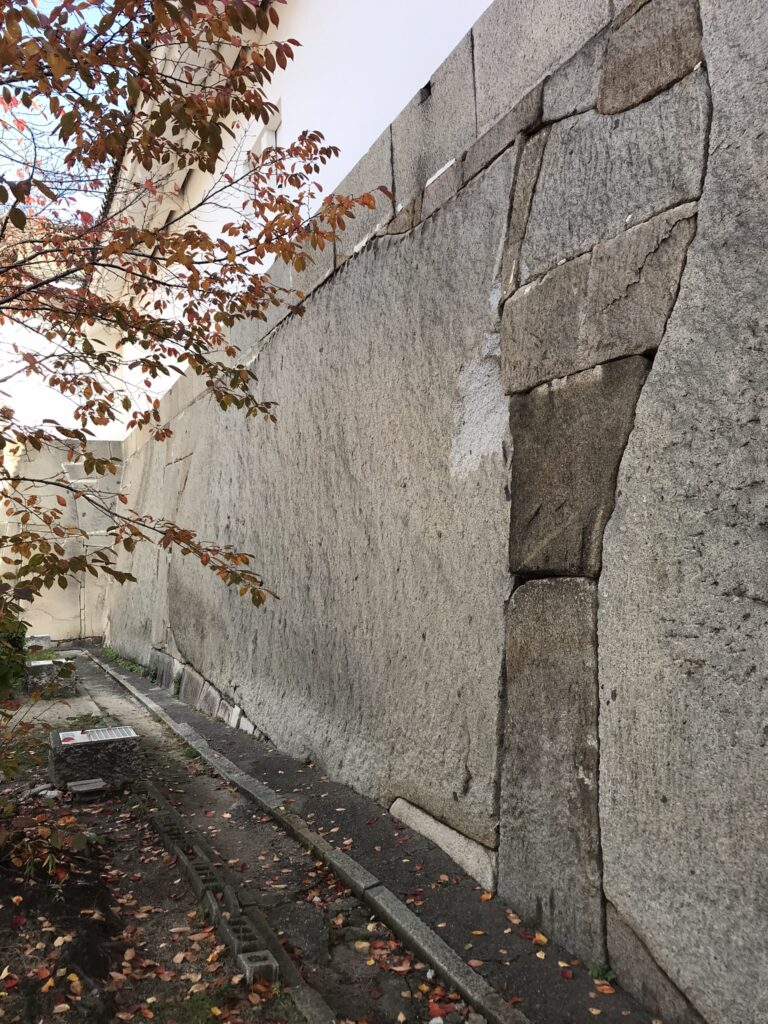
Osaka Castle from afar; the legendary warrior-leader who built the original castle, Hideyoshi Toyotomi, and some impressive sized slabs
The castle stands in the centre of a park with a huge moat and impressive stone walls, some of which are original. We were struck by the sheer size of the boulders used to construct the walls. The castle is a super popular tourist spot, it’s impossible to get away from the crowds here so expect some jostling and random people in your photos. The inside of the castle contains a museum. We decided against paying to go inside as the queue was off-putting and also because it’s not an original castle, unlike some we’d already visited (Matsumoto) and would visit in the future (Himeji). It’s completely free to wander the grounds and snap photos from various angles. A 20th century western-style building now occupies space in the uppermost tier (Hon-maru) – apparently it was an army barracks/office and has a few shops and restaurants.
A temple on the site, Hokoku-ji, is dedicated to Hideyoshi Toyotomi.
Osaka Museum of History – located close to Osaka Castle park, Japanese city museums usually tend to stick to a familiar format, but this was very different to any other similar museums we visited. The museum is located in a tower which overlooks Osaka Castle and the former site of Naniwa Palace. Visitors must first take the elevator to the top floor, and then work their way down via a series of escalators. The top floor features a reconstruction of a ceremony at Naniwa Palace, complete with lifesize figurines in the appropriate dress. There is a tonne of information here on Naniwa palace and the Kofun era history of Osaka, which is largely ignored by most external sources in favour of the most glamorous and well known feudal history. Subsequent levels in the museum focus on further aspects of Osaka’s history, culture and development in an equally immersive way, including a full-size replica of a 20th century street scene. We found the section about the bunraku puppets to be particularly interesting. There are also some great views over Osaka Castle – particularly resplendent around sunset. Outside is a recreation of a Kofun-era warehouse.
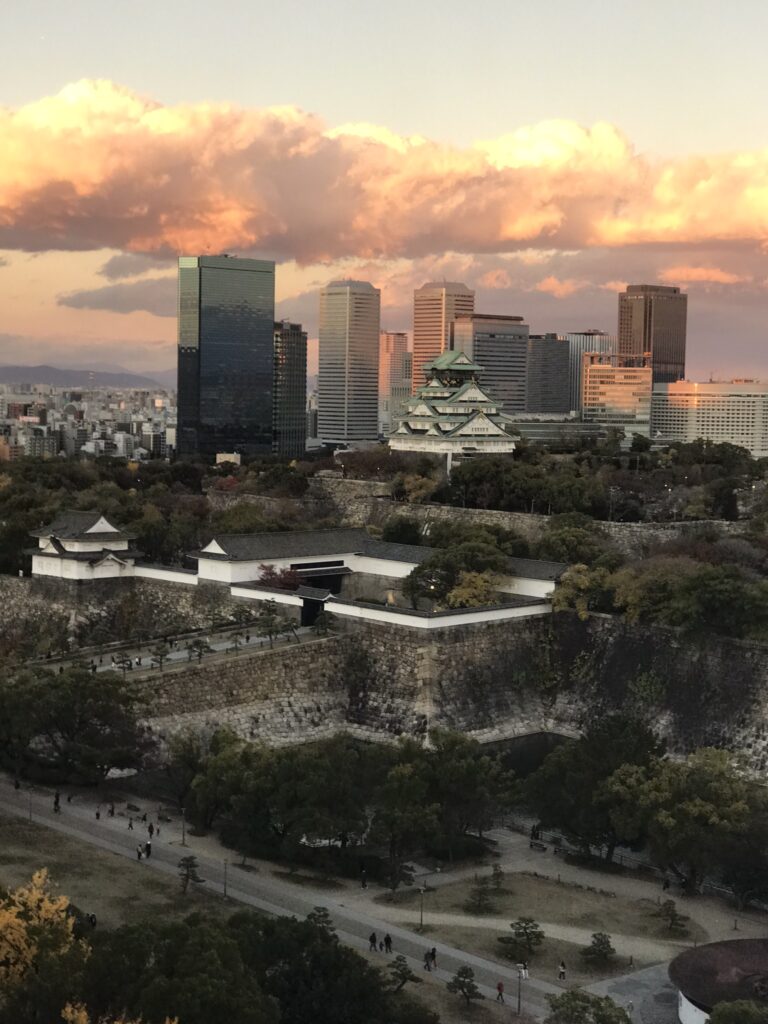
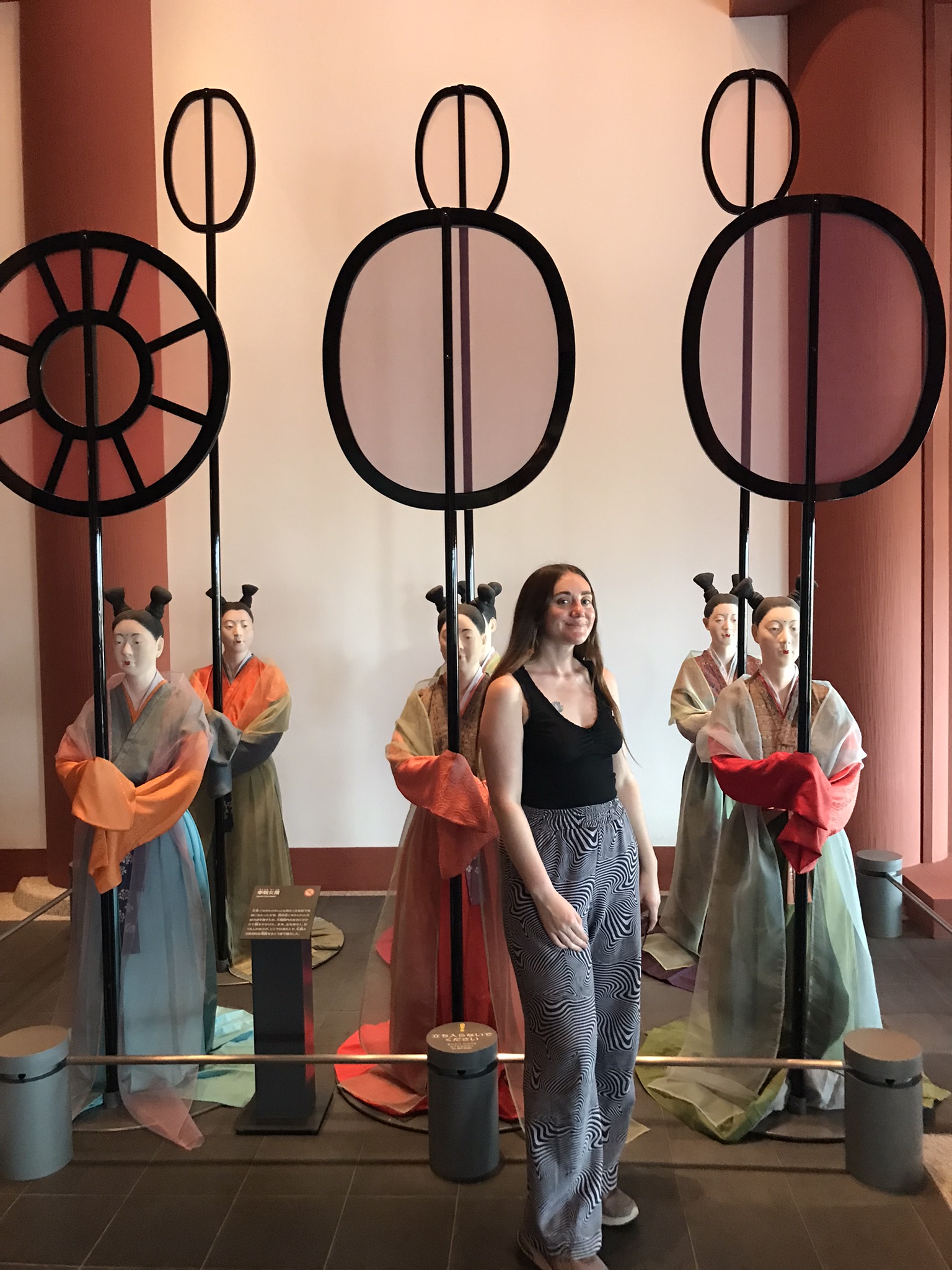
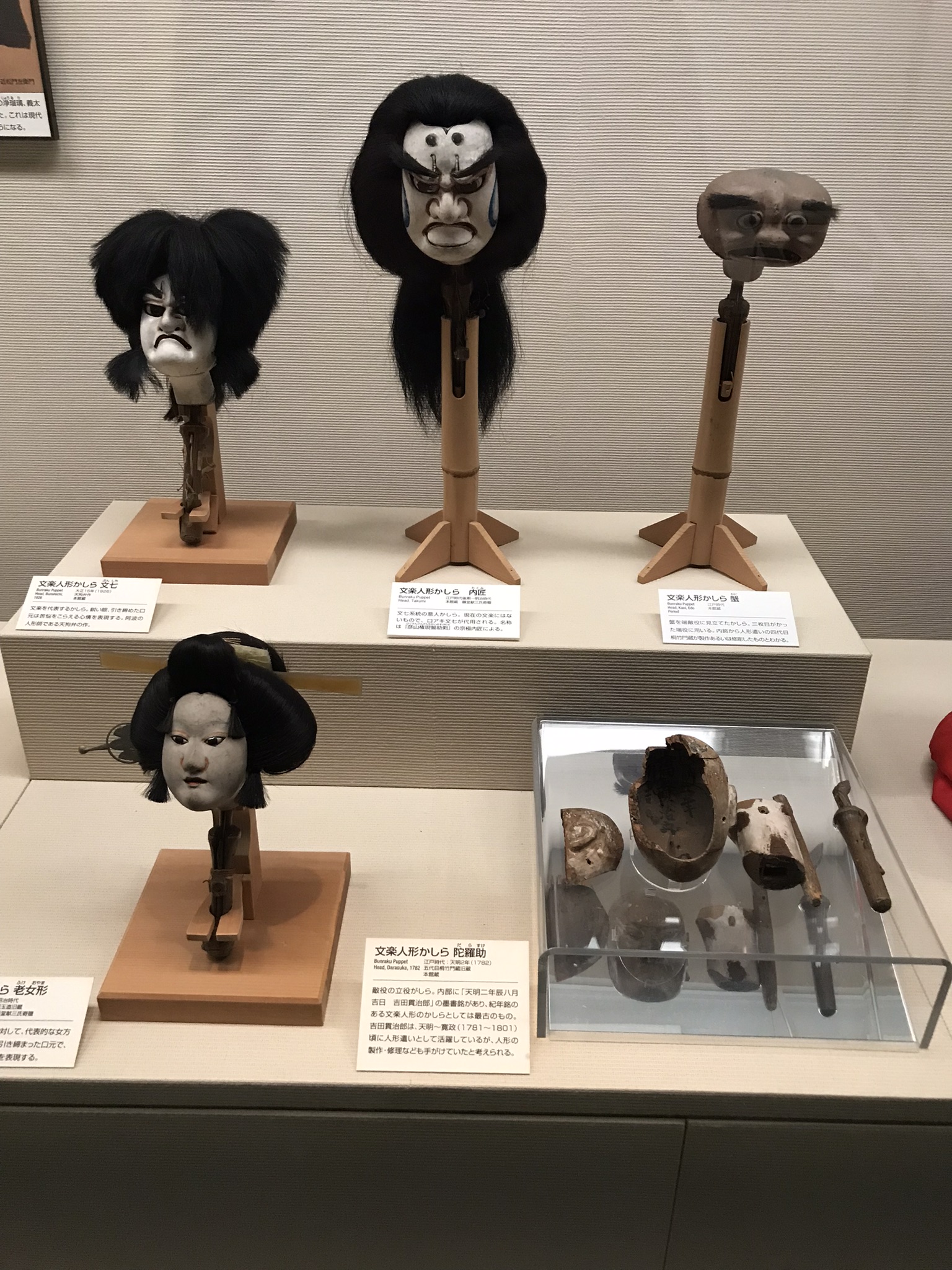
Highlights from the Osaka Museum of History
Naniwa Palace Site – located just to the southeast of Osaka Museum of History and south of Osaka Castle Park, this is the former site of Naniwa Palace, which functioned as the capital of Japan for a brief period in the 7th century. We didn’t really know anything about this before visiting Osaka Museum of History, but it’s a historically relevant spot that is ignored by most visitors to Osaka. I guess this is understandable as there is nothing left of the site today, just an empty lot with a small viewing platform that you can climb in order to get an idea of the scale of the palace complex. A busy highway cuts through the centre of the site.
Entertainment Districts of Dotonbori and Shinsekai – best appreciated after dark when the crowds converge and the neon street signs are switched on, prepare to be overwhelmed by the lights, noise and so many things all happening all at once.
Shinsekai: This entertainment area is on a smaller scale to Dotonbori, but is equally garish, featuring an old-fashioned covered shopping arcade crammed with tourist tat shops, capsule arcades and all other manner of places designed to lure in wide-eyed visitors with full wallets. The main drift is a narrow pedestrian street filled with eye-catching and mesmerising banners above restaurants and shooting arcades. The area is synonymous with the extremely unhealthy street food kushikatsu – breaded fried food served on skewers – with many hustlers trying to tempt in hungry tourists and business types. Apparently this snack goes well with beer!
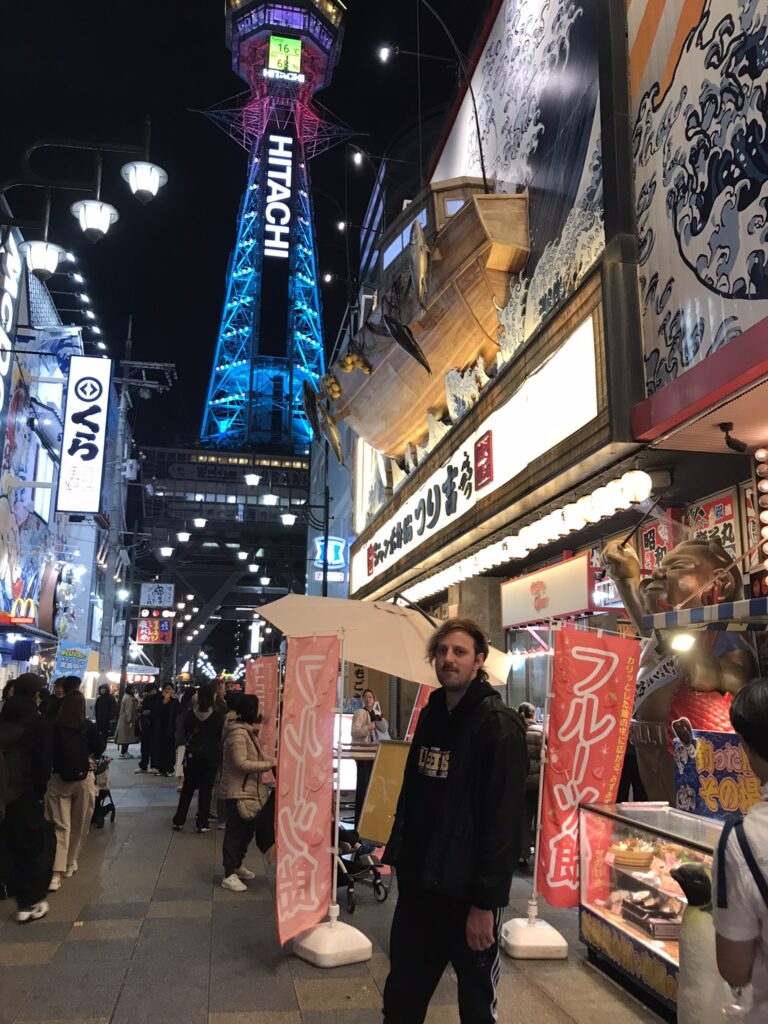
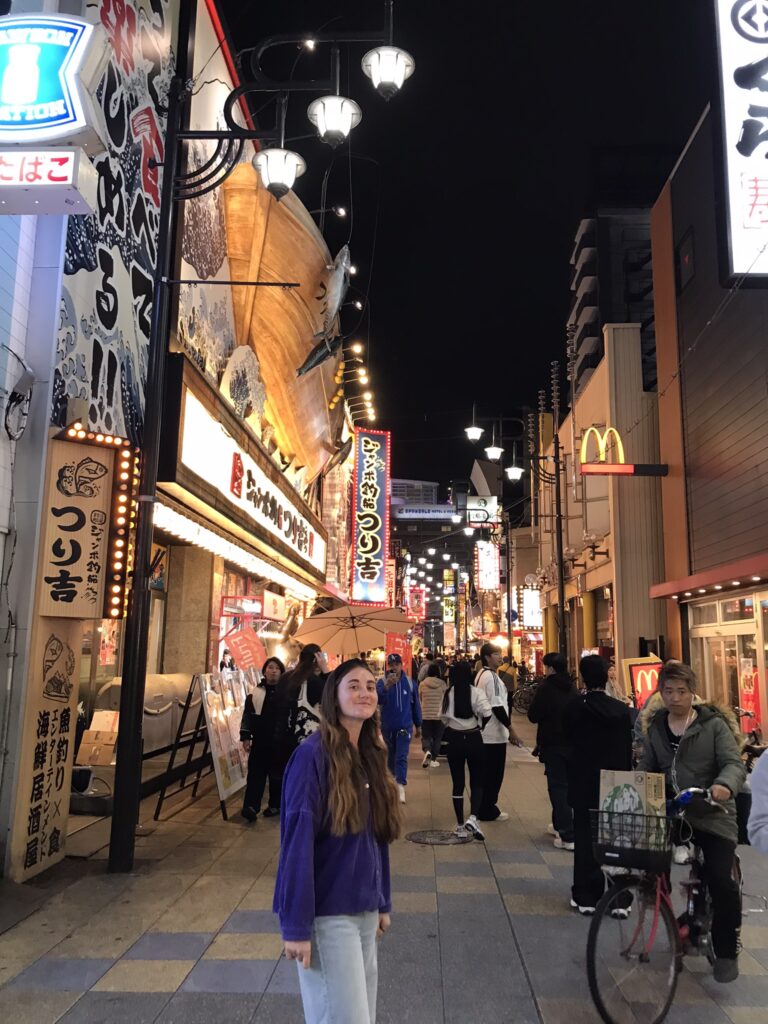
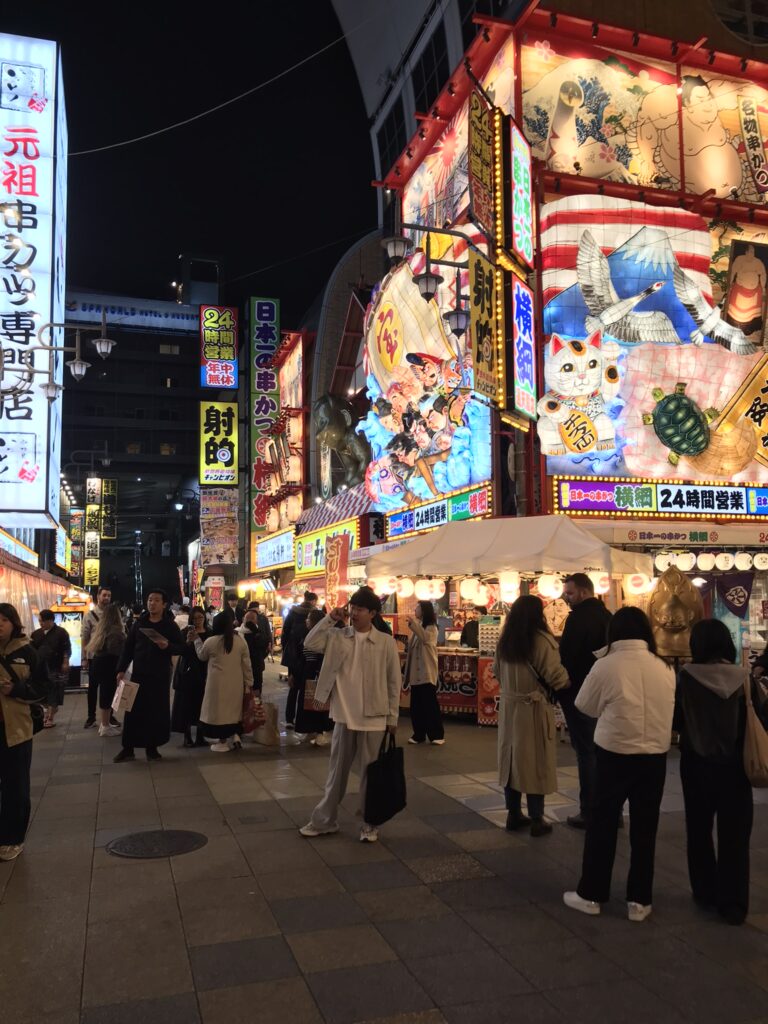
Shinsekai is all about the Showa-era vibes
The Tsutenkaku Tower is the main focal point of the area, often lit up in eye-catching colours; the architect took inspiration from the Eiffel Tower in Paris, adding to the Showa era vibes of the area. You can pay to go up the tower for a panoramic view, although we didn’t as we had just visited the free observation tower in Sekai. There also exists an onsen in this area called Radium Onsen that specialises in radioactive and electrified onsen pools – we were tempted to try it as they allow foreigners with tattoos, but we reconsidered after sobering up.
Dotonbori: like the entertainment districts in Tokyo but on steroids. This is by far the wildest and craziest place we visited in Japan. The crowds were insane. We found it worthwhile to slow down and try to take it all in. The main sights to see are Shinsaibashi-suji (a super busy shopping arcade, so busy in fact we got stuck in foot traffic at points), Ebisu-bashi (a bridge spanning the canal), the Glico Running Man sign (a much loved sign by locals, popular with the selfie-taking crowd), Hozen-ji (a tiny Buddhist shrine in the back alleys with a somewhat freaky moss-covered Buddha statue – locals tip water over it) and Triangle Park in Amerika Mura – where the cool underground kids hang out. Look out for Kuidaore Taro – a retro clown mascot which beats a drum and is symbolic of the area.
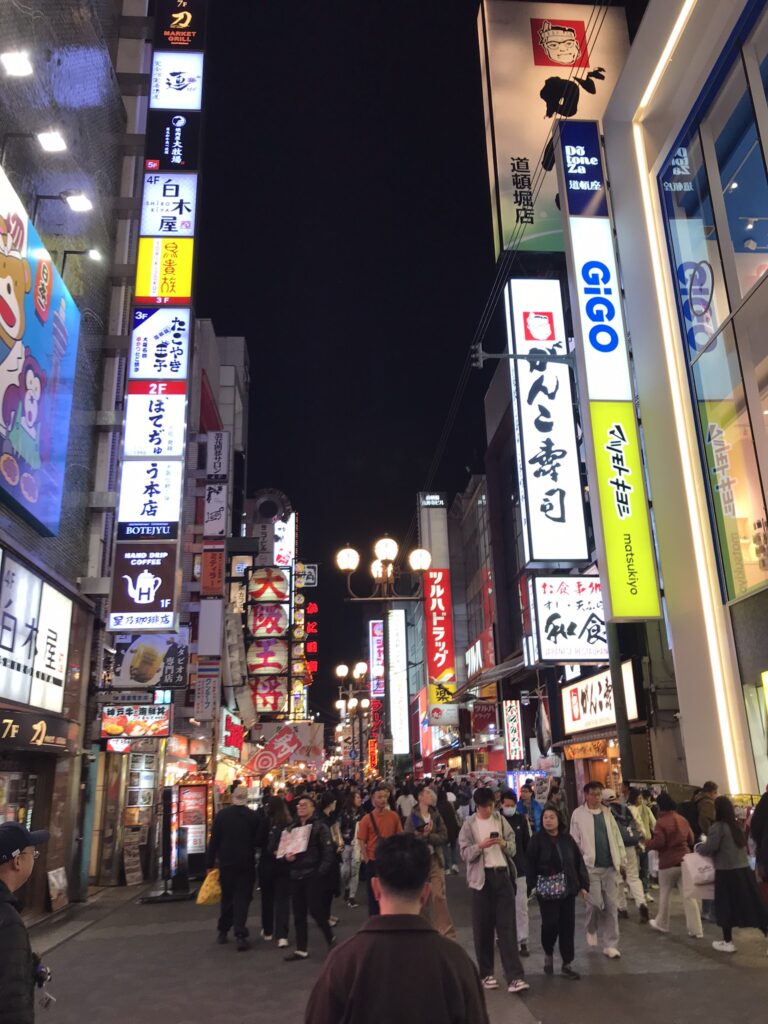
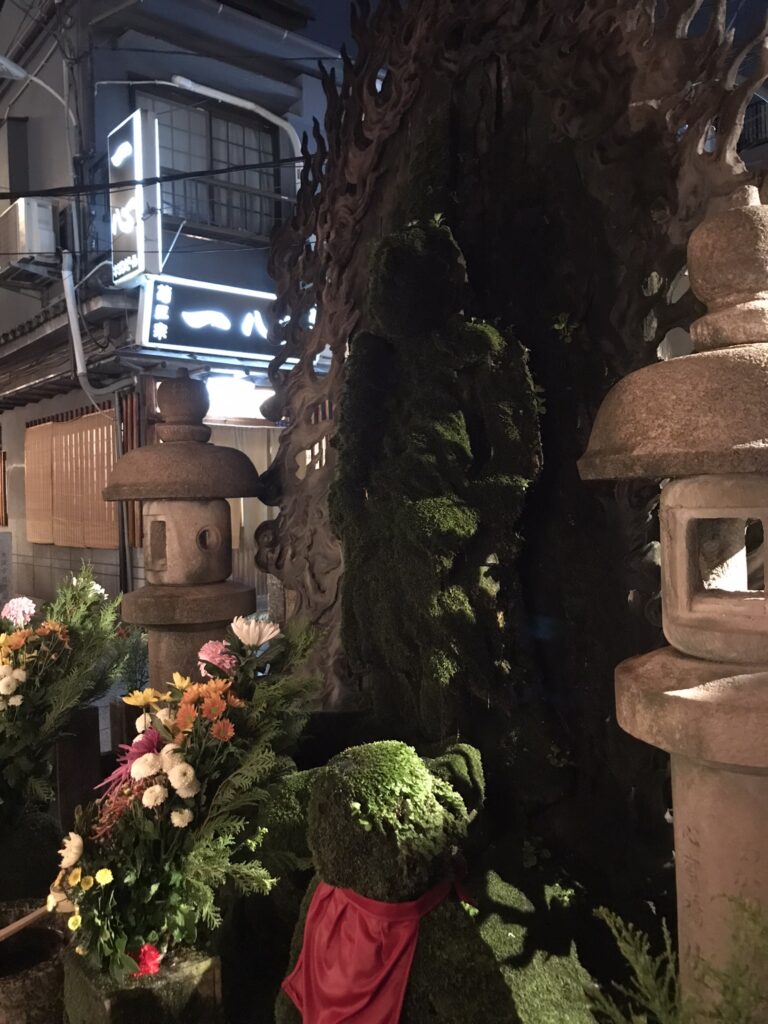
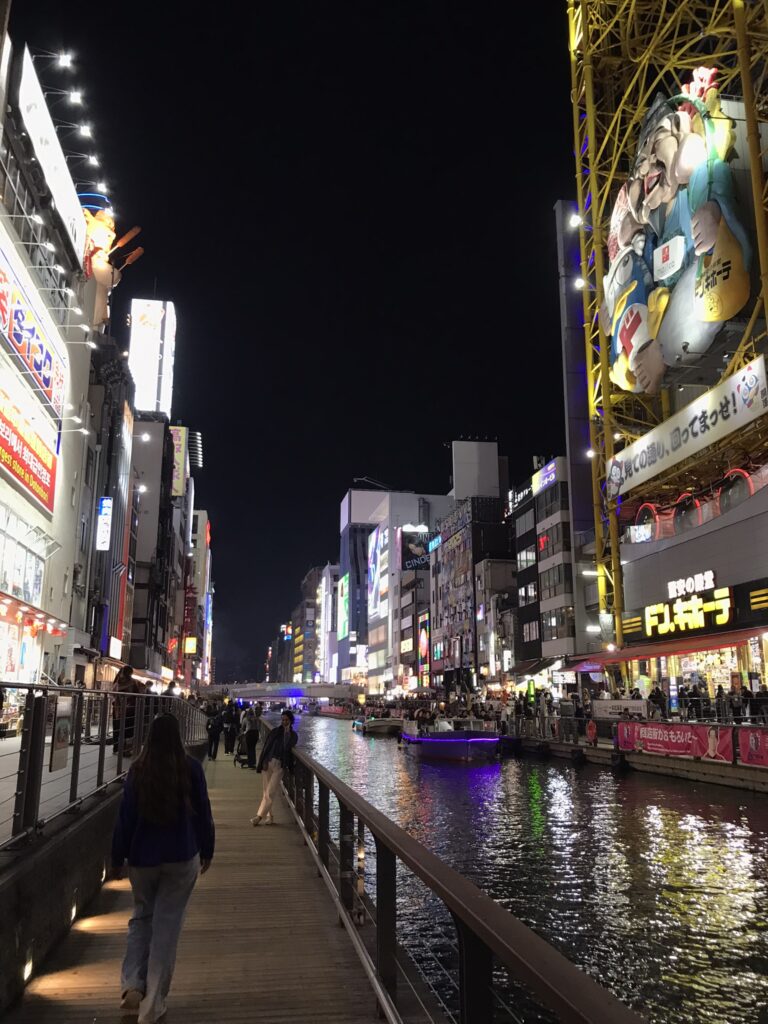
There are still hidden nooks and crannies in Dotonbori – don’t forget to check out the moss covered Buddha statue at Hozen-ji
If you become overwhelmed, head for the canal as the crowds don’t seem to make it there and there’s a cool canal-side path. There are also tourist boat rides on the canal that looked pretty popular and the price wasn’t as much as we expected. For a quirky side mission, check out the massive heads at Dotonbori Hotel – each bulbous head atop little legs represents a man from a different continent. And yes, they do have bums on the rear side facing the hotel. We spotted a group of Japanese businessmen doing their typical bowing ritual outside this hotel.
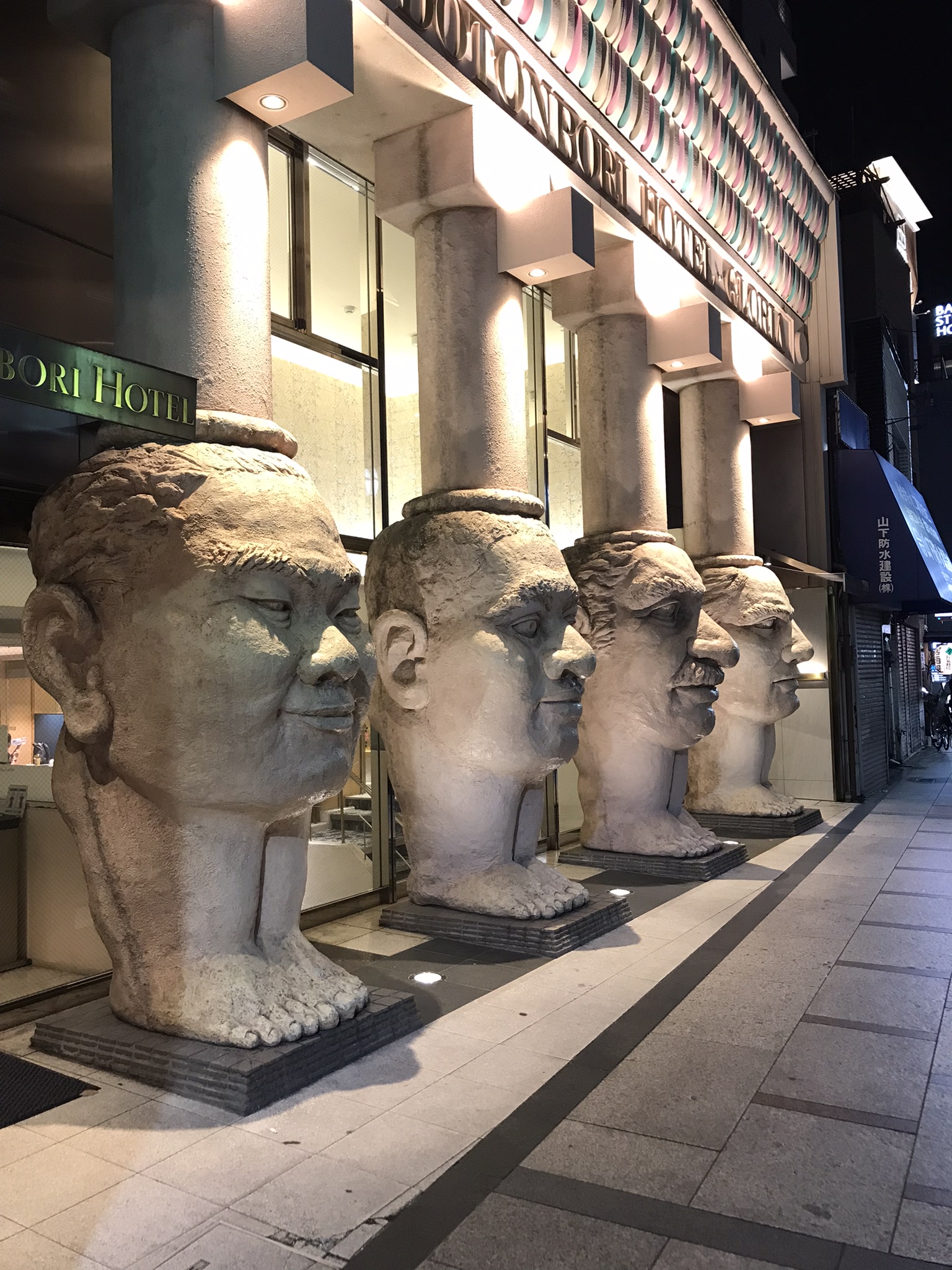
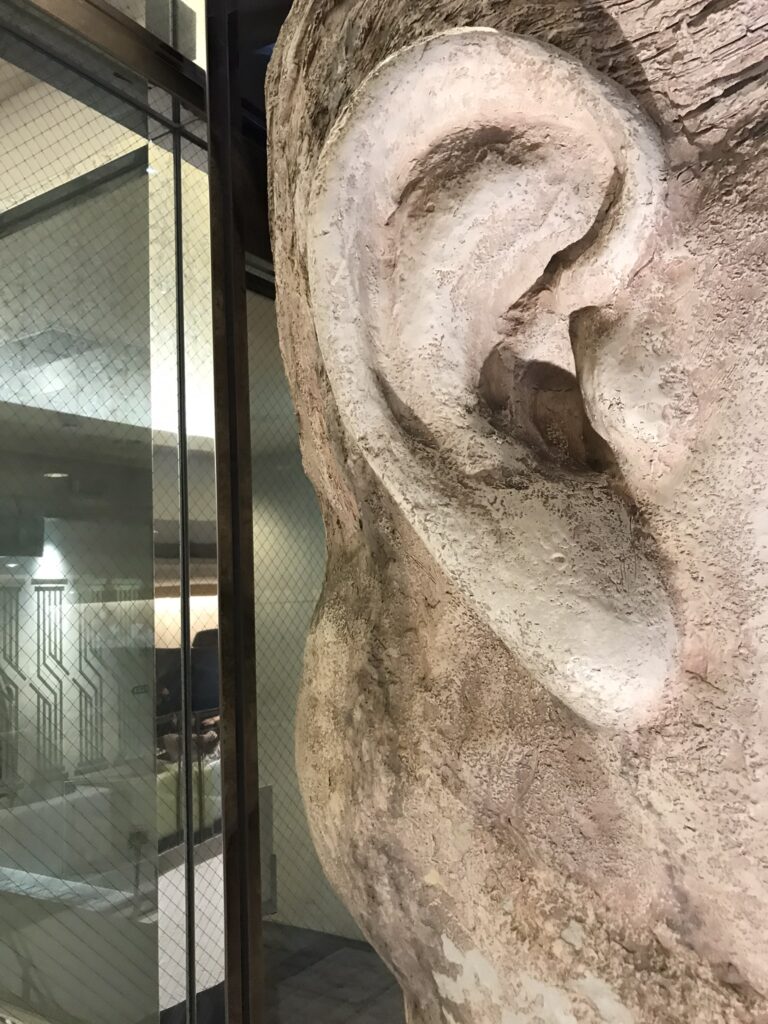
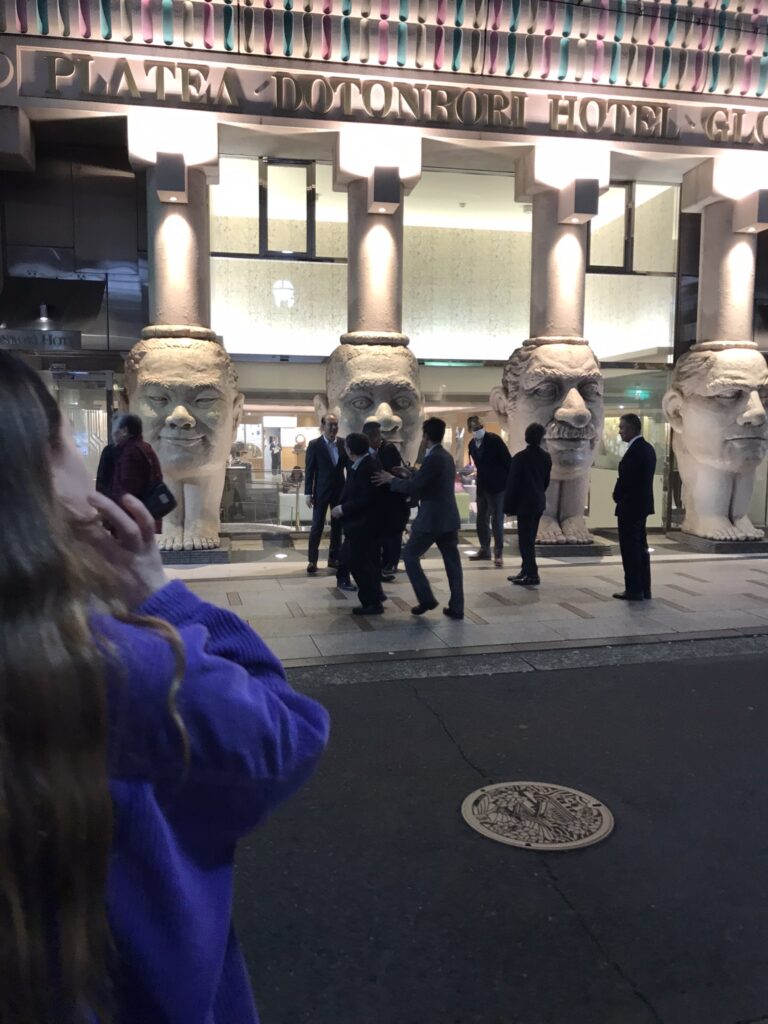
The bootylicious statues outside the Dotonbori Hotel
Sakai – once a separate city to the south of Osaka, it has now been sucked into the huge metropolitan area of the city. Sakai is very proud of its seafaring heritage, high-quality swords and 5th century kofun keyhole burial mounds. If you’re looking to escape the tourist crowds in Osaka, Sakai is a great place to visit and easily reachable on the train from the city centre.
Mozu Mounded Tombs – an aerial view of Sakai reveals multiple keyhole-shaped green areas encircled in moats and covered in dense foliage, situated in the midst of the built-up cityscape. These enormous and mysterious structures, the Mozu Mounded Tombs, are actually some of the largest burial mounds on the planet, known as kofun mounds. Predating the verifiable history of Japan, the largest of these mounds is attributed to Emperor Nintoku, Japan’s 16th emperor who is said to have lived in the 4th century CE. This mound holds the record for the largest area of any grave in the world.
As they are reputed to be the graves of past emperors, these mounds are maintained by the Imperial Household. Ordinary people are not allowed to walk on these sacred mounds nor desecrate the graves by performing archaeological excavations or digs – strictly forbidden for imperial gravesites as per Japanese customs. However Haniwa pots (animal, human and anthropomorphic shaped funerary vessels) have been discovered in abundance in the surrounding areas.
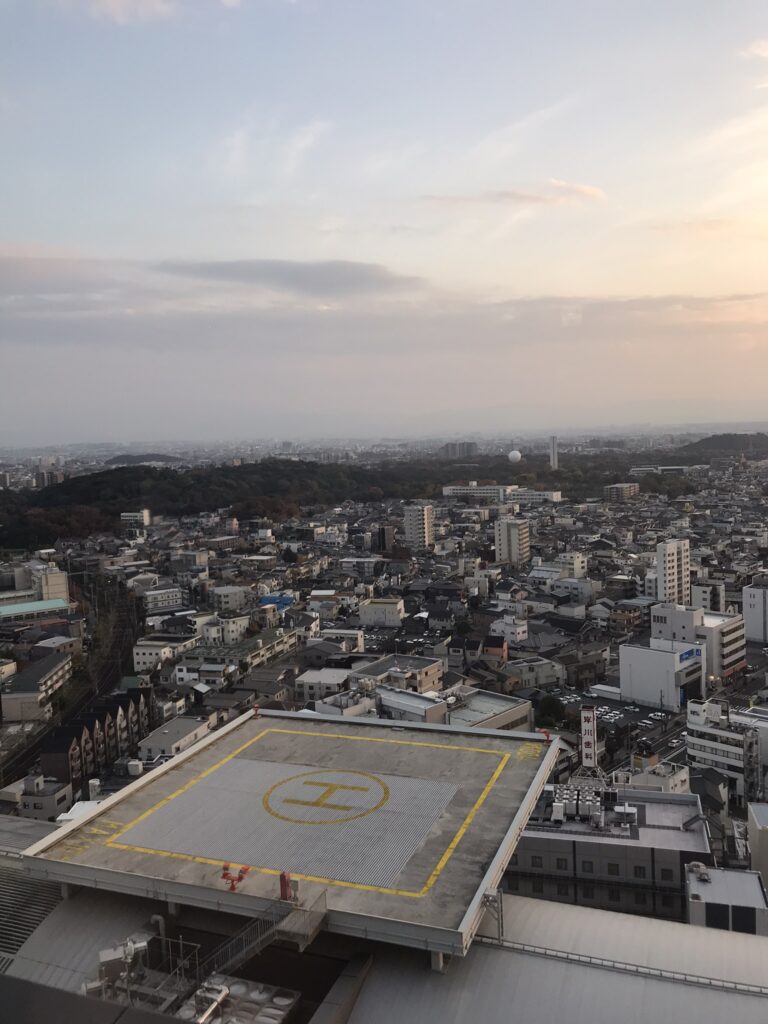
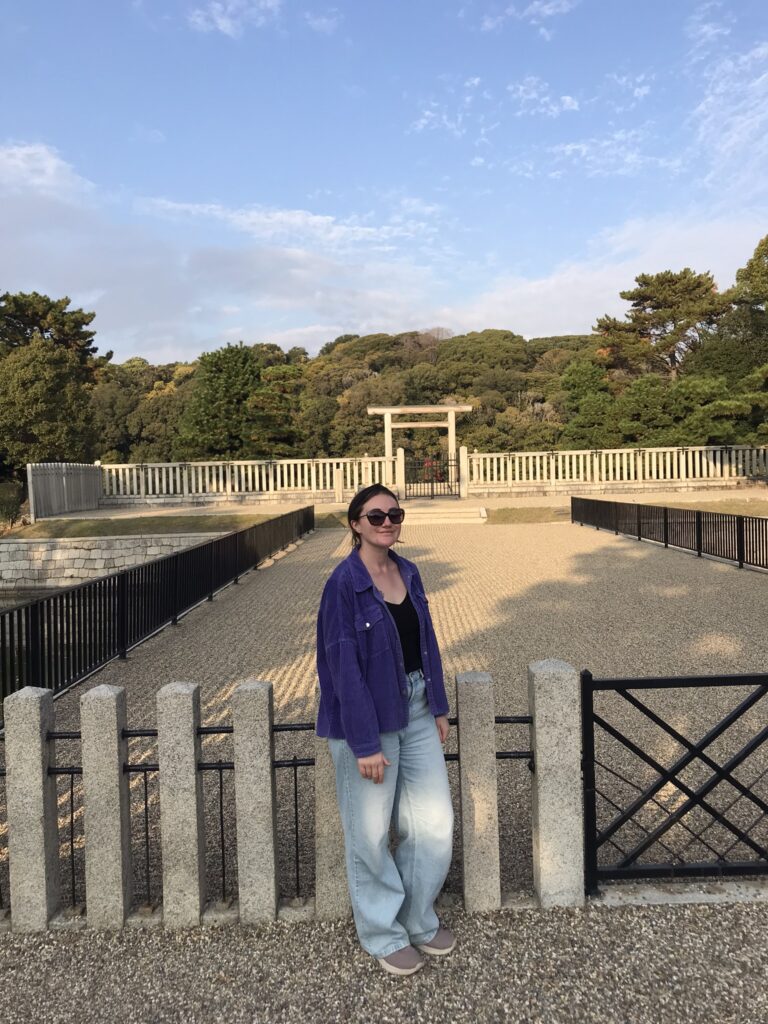
To appreciate the size of the mounded tombs head to the Sakai City Hall – outside you can’t really see much
The Mozu Mounded Tombs have received UNESCO World Heritage status and can be best accessed via Mozu train station. The free visitor centre is the best place to start any tour of the area – inside are some displays about the history, a map of the locations of the mounds, a miniature reconstruction of the tumulus and a video featuring aerial views of the various kofun, which really gives you a good introduction and appreciation of the scale and size of the mounds. The Nintoku Kofun is right next to the visitor center and Daisen Park, which contains many smaller kofun mounds, is across the road. It’s interesting that the mounds are now located in urban areas – the city has grown organically around these mounds, however they have remained untouched for centuries.
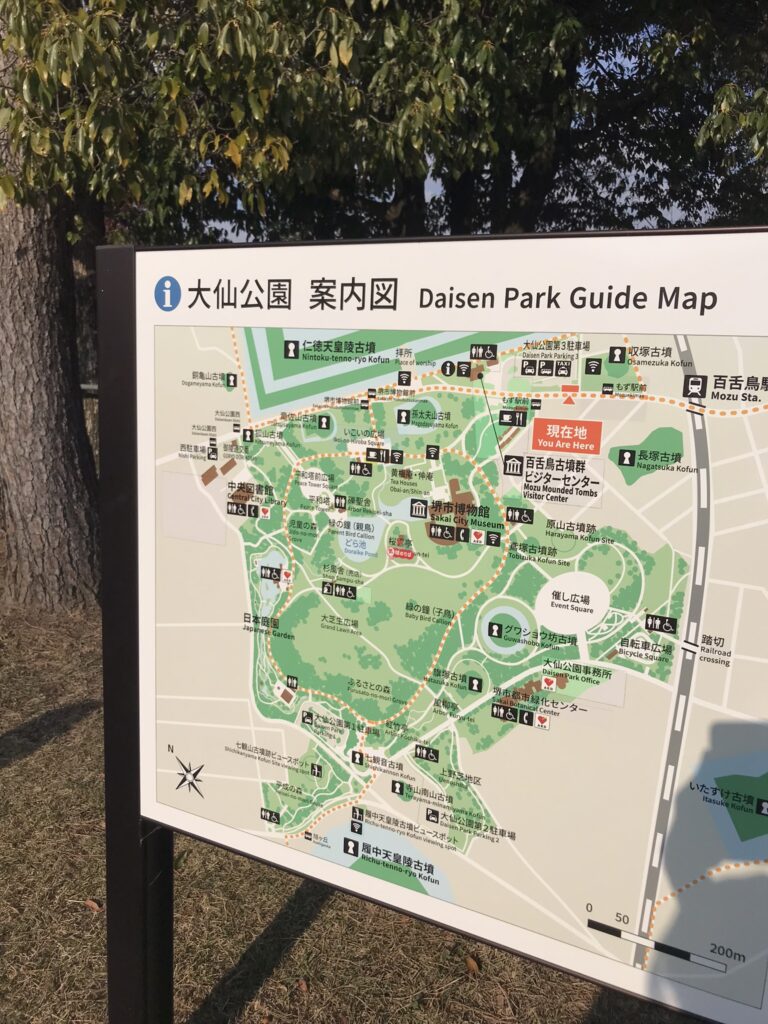
A map of Daisen Park – there are so many tumuli to check out
We spotted a hot air balloon in Daisen Park offering paying customers an aerial view over the Nintoku tumulus from the park – this looked like an excellent opportunity but we didn’t partake as we’re cheapskates. The mounds are likely best appreciated from above though, as you can only walk around the perimeter and peek through the gates at the moat otherwise. In any case we really enjoyed visiting this off-the-beaten-track attraction, which gets absolutely no attention from most of the tourist masses in Osaka.
Sakai City Hall – this skyscraper has a free observation deck on the top floor, offering sweeping views of the burial mounds from a higher vantage point. Head up here to watch the sun dipping below the horizon and twinkling city lights of Osaka after dark. There’s also a piano inside which visitors are free to play – particularly atmospheric.
Kuromon Market – a mixture of souvenir stalls, street food and seafood eateries. Here you can find delicacies like pufferfish sashimi, kobe beef and sea urchin. Some of the seafood joints here are extremely highly-rated, although you wouldn’t tell from the outside as it is a typical bustling market environment. As with all similar touristy markets, you can expect to pay a more premium price for things here – it’s not necessarily a great place for those of us on a budget, although it’s still fun to walk through and have a browse.
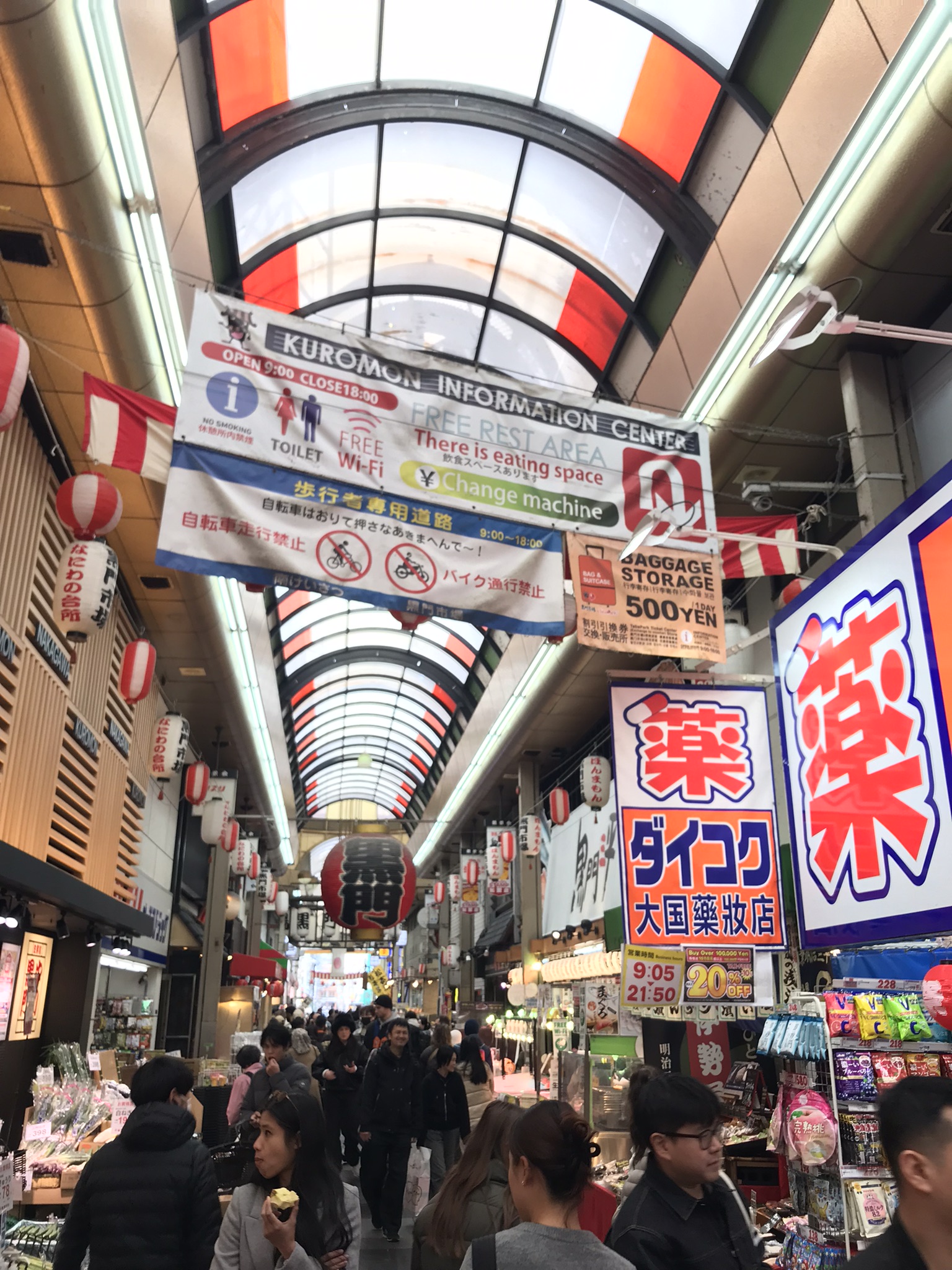
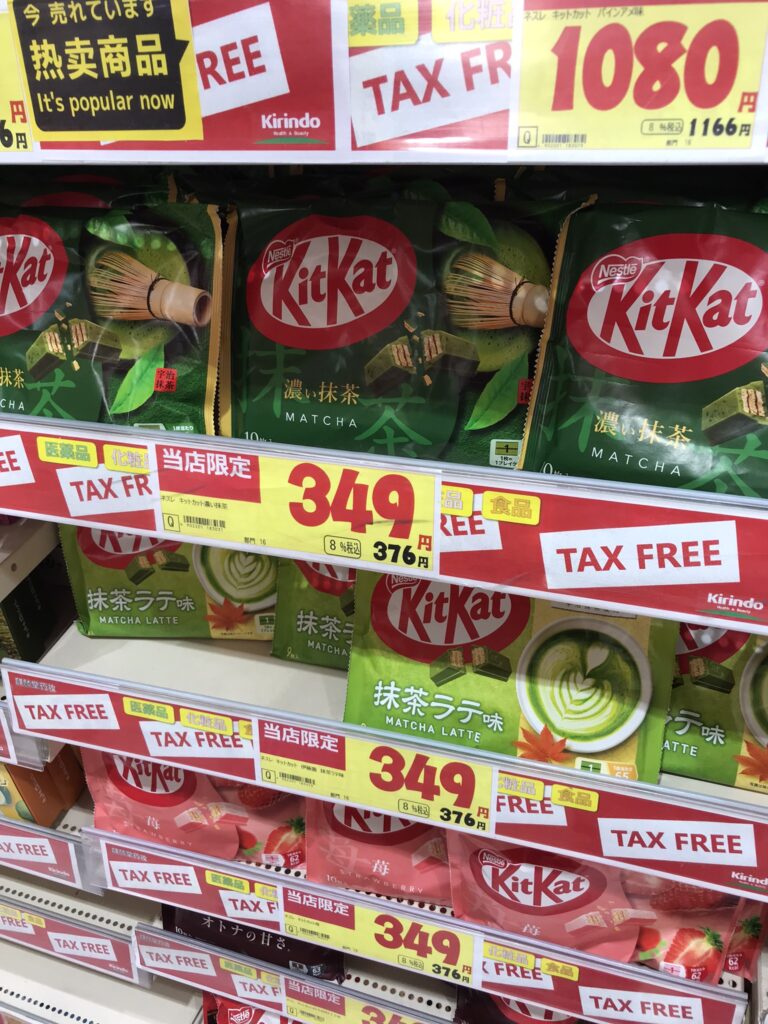
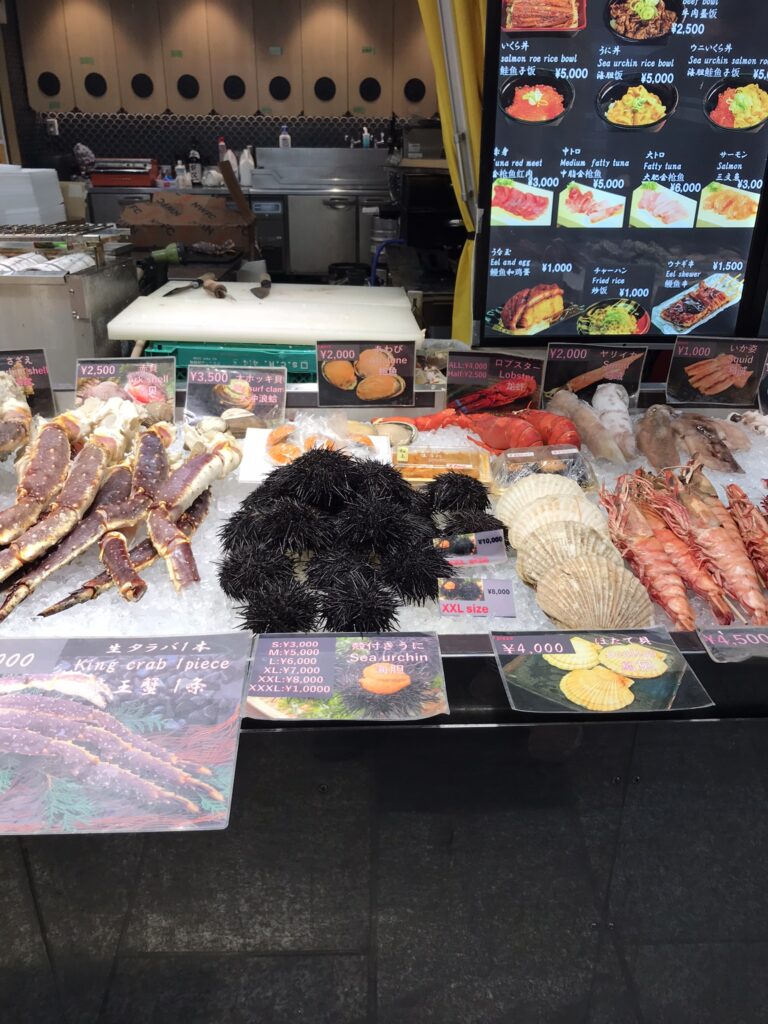
Scenes from Kuromon Market
Nipponbashi Denden Town – Osaka’s equivalent to Akihabara in Tokyo, this former ‘electronics area’ is a magnet for the otaru subculture, featuring multi-level arcades, trading card shops, maid cafes and all manner of anime and manga repositories. Compared with Akihabara it felt much less crowded and chaotic, although we did visit during the day here. We had some fun playing Mario Kart arcades in the Taito Station and looking at the various shops filled with Pokemon cards.
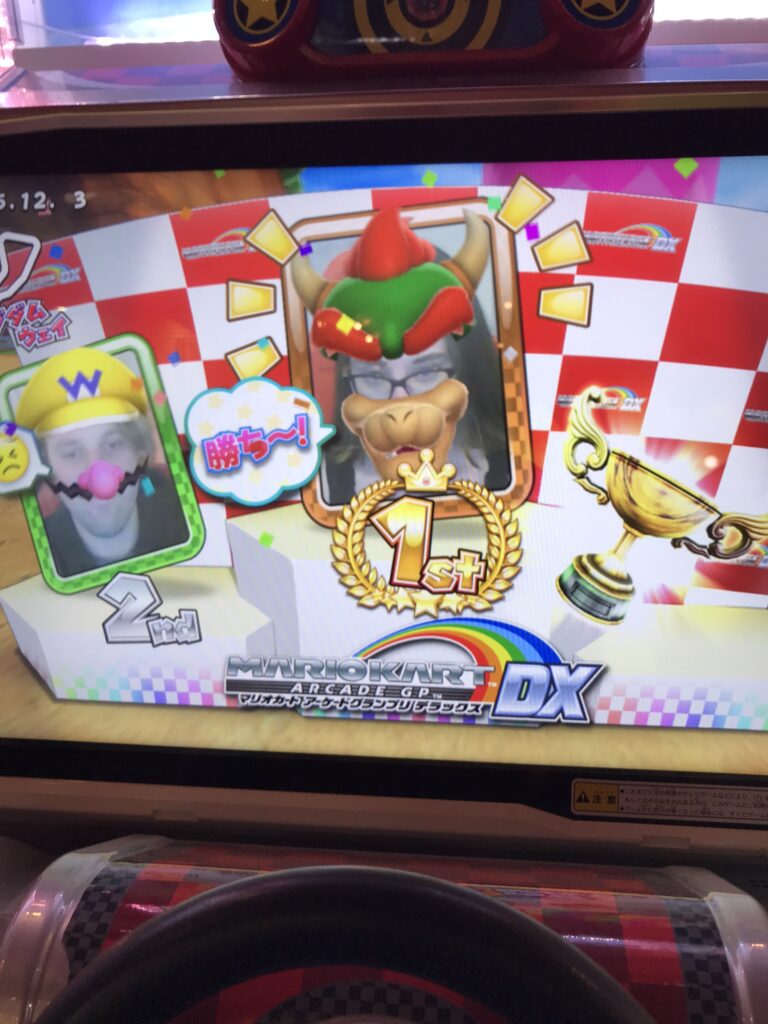
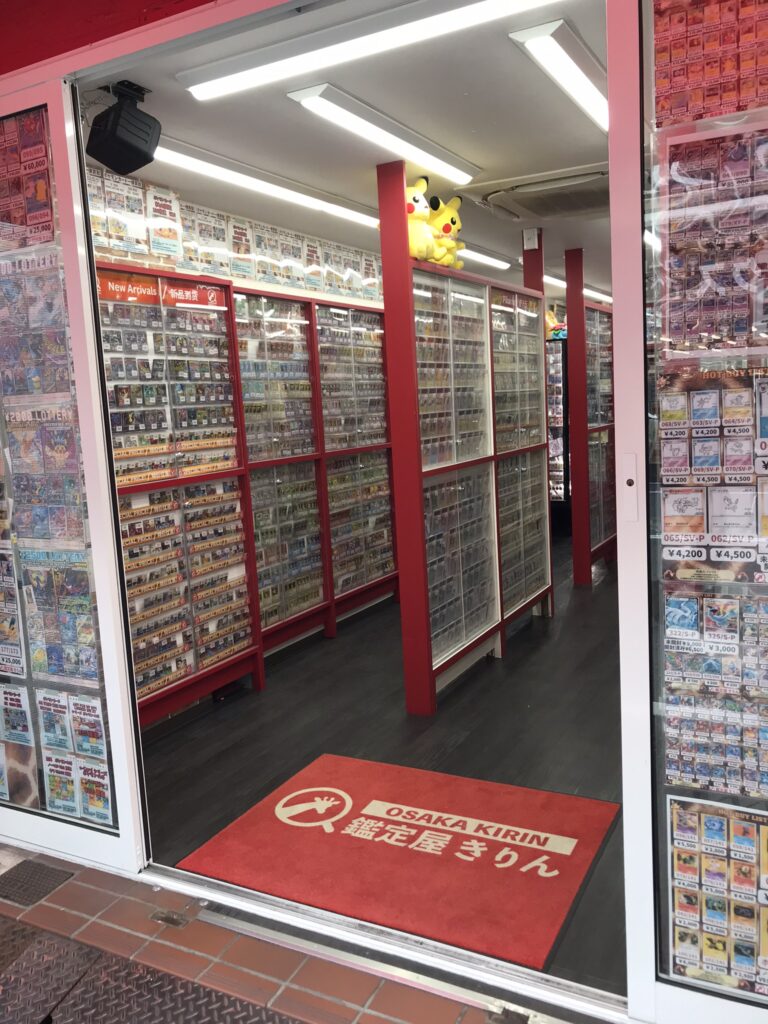
We found it difficult to drag ourselves away from Mario Kart in Denden Town; a whole shop devoted solely to Pokémon cards
Nara
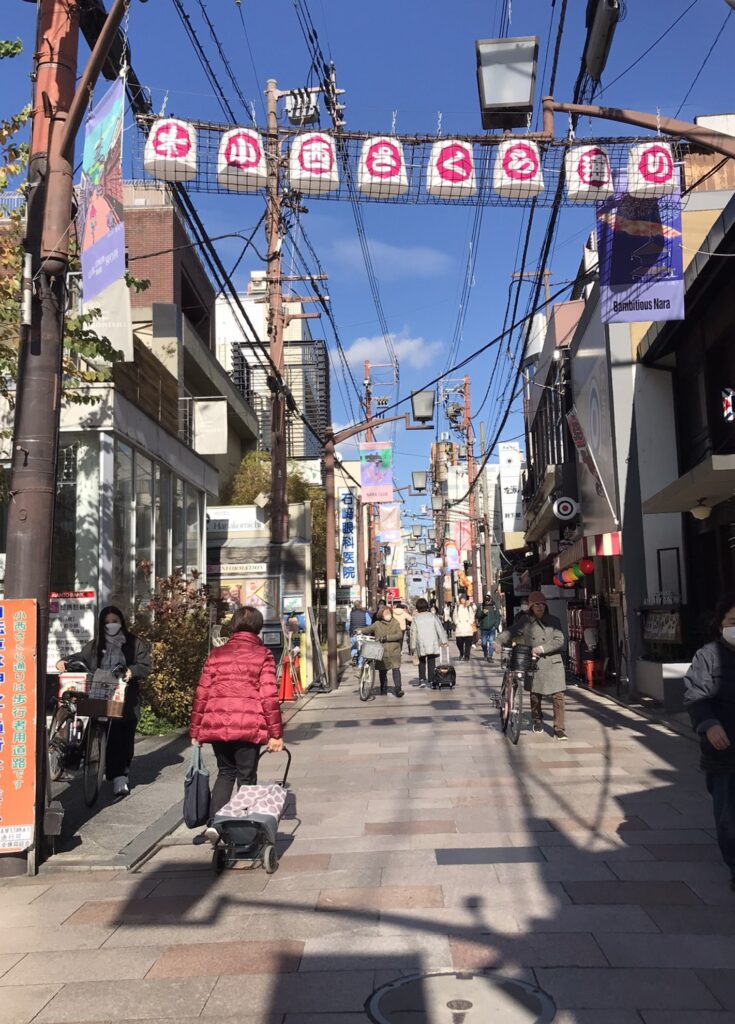
The historic city of Nara became the first permanent capital of Japan in 710CE. Prior to this, the location of Japan’s capital had changed with each new Emperor, mostly focused around the Asuka area to the south. Nara served as capital throughout the 8th century (the so-called Nara Period), before the creation of the new purpose built capital of Heian-kyo (later known as Kyoto) in 794.
As the first permanent capital, Nara witnessed the construction of many monumental temples and structures. Today, the historic Buddhist temple of Todai-ji and the hillside Shinto shrine of Kasuga Taisha are huge draws for tourists – these make up just two of the eight UNESCO World Heritage inscribed Historic Monuments of Ancient Nara.
Nara is exceptionally popular with both domestic and foreign tourists, so brace yourself for crowds. The streets become more quiet with a more residential feel the further away from Kōfuku-ji you get – the historic Naramachi area makes for a tranquil place to spend the night. For those short on time, it’s possible to visit Nara on a day trip from both Kyoto and Osaka, while for those with more time there are a couple of other great day trips from Nara itself, such as Ikaruga for the famous Horyu-ji temple or Asuka, which predates Nara as an even earlier centre of power.
The most famous aspect of Nara by far is the sacred ‘bowing’ deer that roam the city, particularly in Nara Park (commonly known as the Deer Park). Deer are considered divine messengers in Shinto belief, and the Nara deer have a protected status. As soon as you step foot outside the Kintetsu-Nara train station, you’ll spot the deer. These clever creatures usually congregate around the rice cracker sellers in Noborioji Park, waiting patiently for their next snack. Scientists have recently uncovered interesting distinctive DNA traits which distinguish these deer from other deer populations in Japan. They are known for their polite, docile nature and friendly interactions with humans. In all honesty, most tourists come to Nara to see the bowing deer – the rich history and spirituality aspect comes second for most visitors unfortunately.
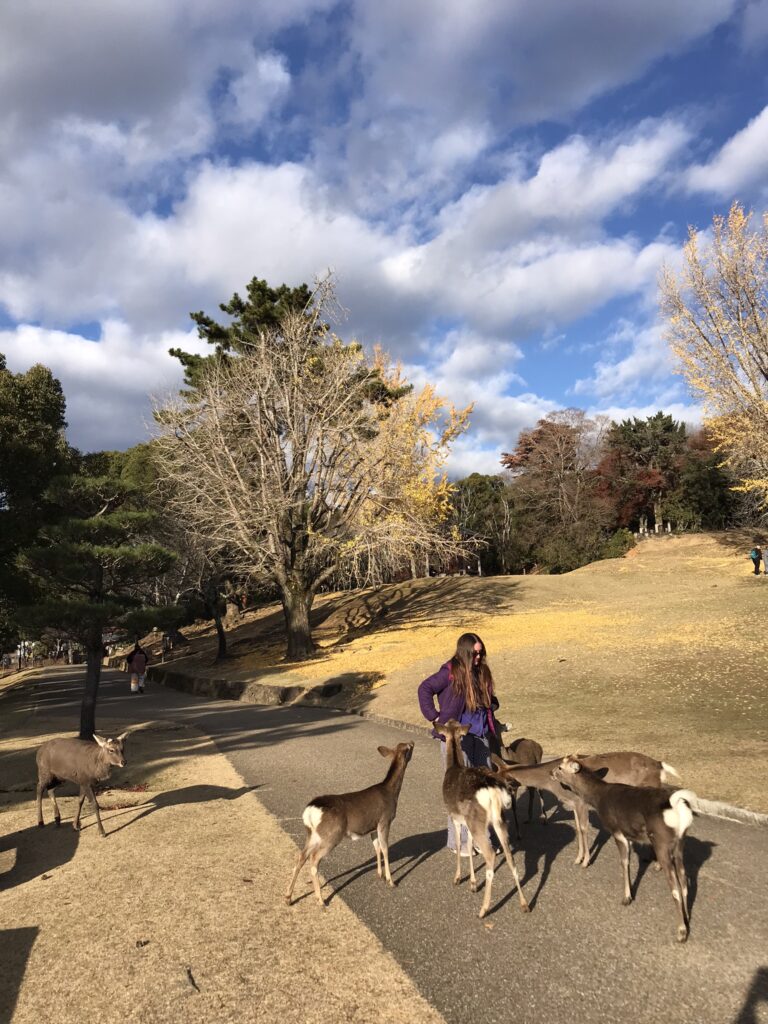
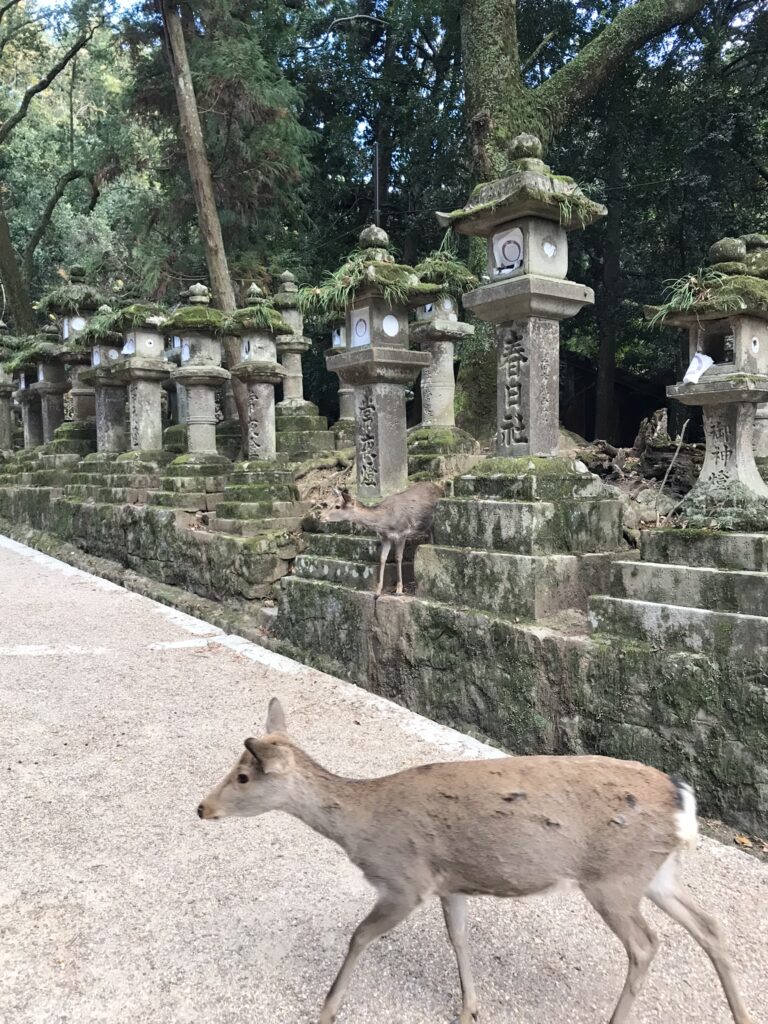
Getting swarmed by the sacred deer in Nara Park and on route to Kasugataisha shrine
Feeding the deer is a very popular activity for visitors to Nara. The deer must be fed specific rice crackers which can be brought from sellers in and around Nara Park. It is strictly forbidden to feed them anything other than these crackers. The feeding technique is as follows: first bow to the deer, hopefully they will reciprocate, and then feed them a rice cracker. The trick is to feed one deer away from a group, otherwise you’ll be inundated with whole packs nudging you for food. The deer will often approach humans – if you don’t have any food or don’t want to feed them, show them your empty hands, palms turned outwards – this is the universal sign which the deer acknowledge, and they will then leave you alone.
There are quite a few signs warning visitors about the risks of feeding the deer – they may charge at you, push you over or bite you. We noticed a sign warning visitors specifically about the male deer as it was mating season when we visited (early December). From experience, most of the deer were quite gentle except the male deer sprouting stumpy horns, who tended to be more bullish and pushy if you teased them (accidently or otherwise) or tried to walk away. One young buck rammed me with his horns (which weren’t particularly dangerous as the horns are cut down every year in a special ceremony) after I stopped feeding him, and decided to keep headbutting me until I gave in. My jacket was also munched by this cheeky deer as well.
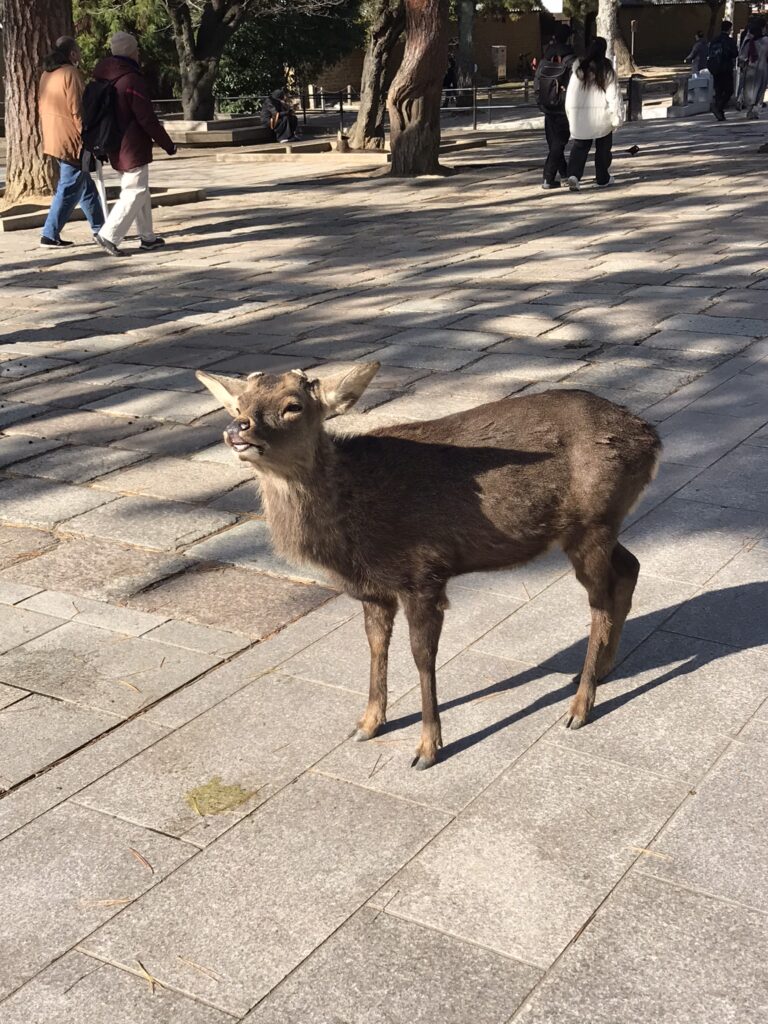
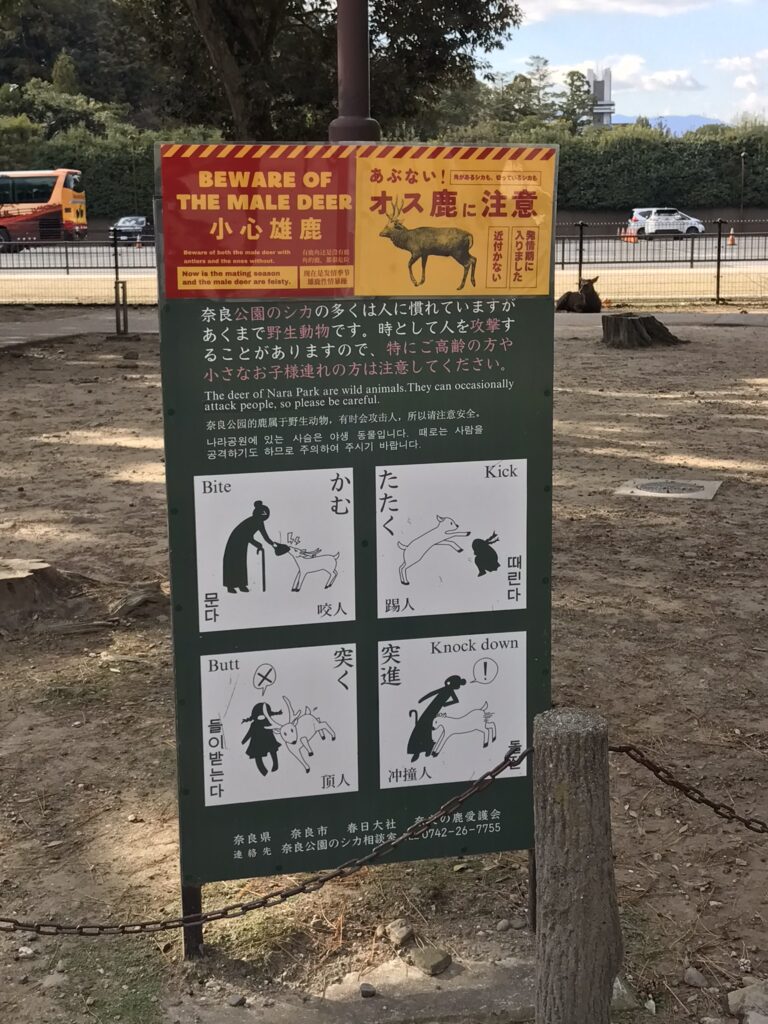
Tread carefully (literally) – the deer can be mischievous
We saw a few other people getting into hot water with the deer – we even witnessed a lady getting chased by a persistent deer in the Deer Park whilst her laughing boyfriend filmed the encounter. It’s important to remember that while they might look cute, they’re actually wild animals that have become accustomed to humans, and so must be treated with caution.
The deer aren’t just confined to the park land, they freely wander the hillside temple areas too – you’ll spot them all along the route up to Kasugataisha and Kinryu Shrine, often bowing between the lanterns on either side of the path as visitors make the steep climb up. We’ll never forget the strange noise they make – almost like air being let out of a balloon. It can get particularly crowded in Noborioji Park in the closest section to the train station as people jump off the train and immediately want to feed the deer. Nara Park is a much better place to head with less crowds. It’s such a special experience to interact with the deer.
Accommodation
Naramachi Guesthouse EN – although the Korean proprietor was very welcoming, the walls were quite thin and unfortunately for us our room was directly opposite the kitchen so we didn’t have the best experience. The rooms were exceptionally clean and comfortable and the kitchen had everything you could possibly want. We wouldn’t stay here again though.
Foodie Places
There are two covered shopping arcades with a plethora of dining options: Higashimuki Shopping Street and Mochiidono Shopping Street.
Wakakusa Curry – a great place to head for a hearty meal of breaded meat, belly-warming Japanese-style curry sauce and filling rice. This place is open later into the evening than other places in the area so ideal for a late dinner.
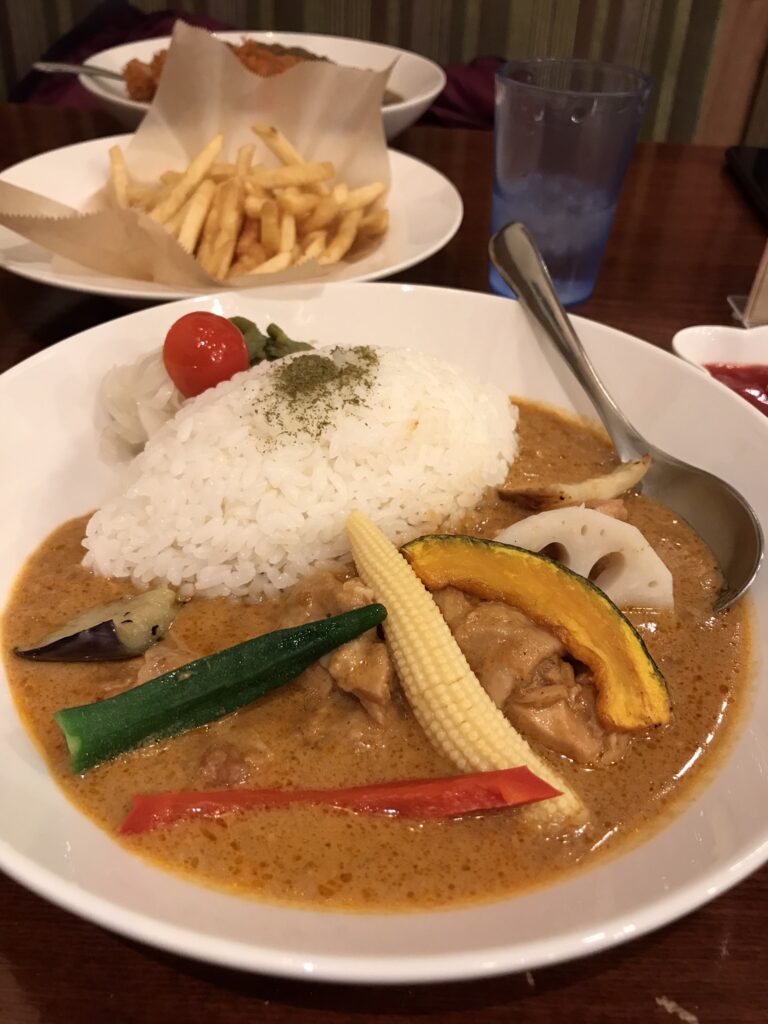
The curry was delicious at Wakakusa Curry
BoulangerieRiche本店 – an tiny independent bakery where you can pick up sandwiches to eat on the go and freshly baked goods. We found it more ethical to visit these local businesses rather than to solely rely on convenience stores (konbini) for cheap lunches.
Activities
Most of the main historic sites within the centre of Nara are located in and around the Deer Park and Nara Kintetsu station, and can easily be covered in a walking loop.
Isuien – a stunning strolling garden surrounding idyllic ponds with two distinct areas: the upper garden from the Meiji era is much larger than the more compact lower garden from the early Edo period. If you’re a traditional Japanese garden enthusiast, this is the place for you. The gardens feature bridges, stepping stones, bubbling waterfalls, a water wheel house and quaint tea house. Included in the ticket is entrance to the Neiraku Museum of Art which houses antique artefacts collected by the Nakamura family – well worth a peek.
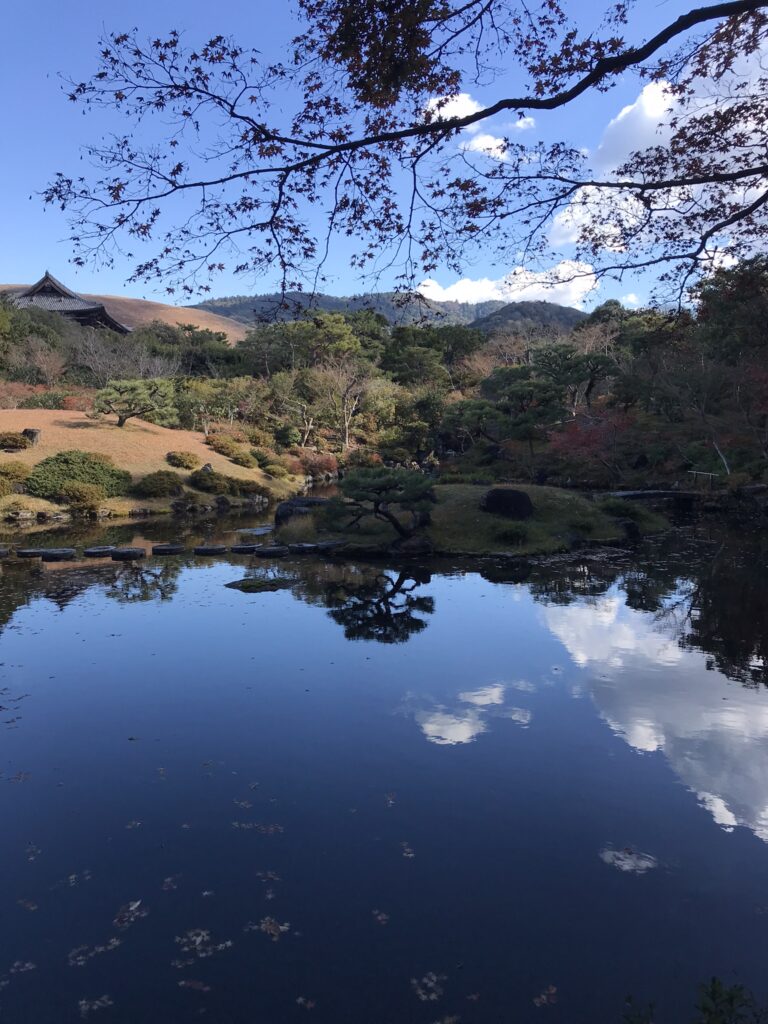
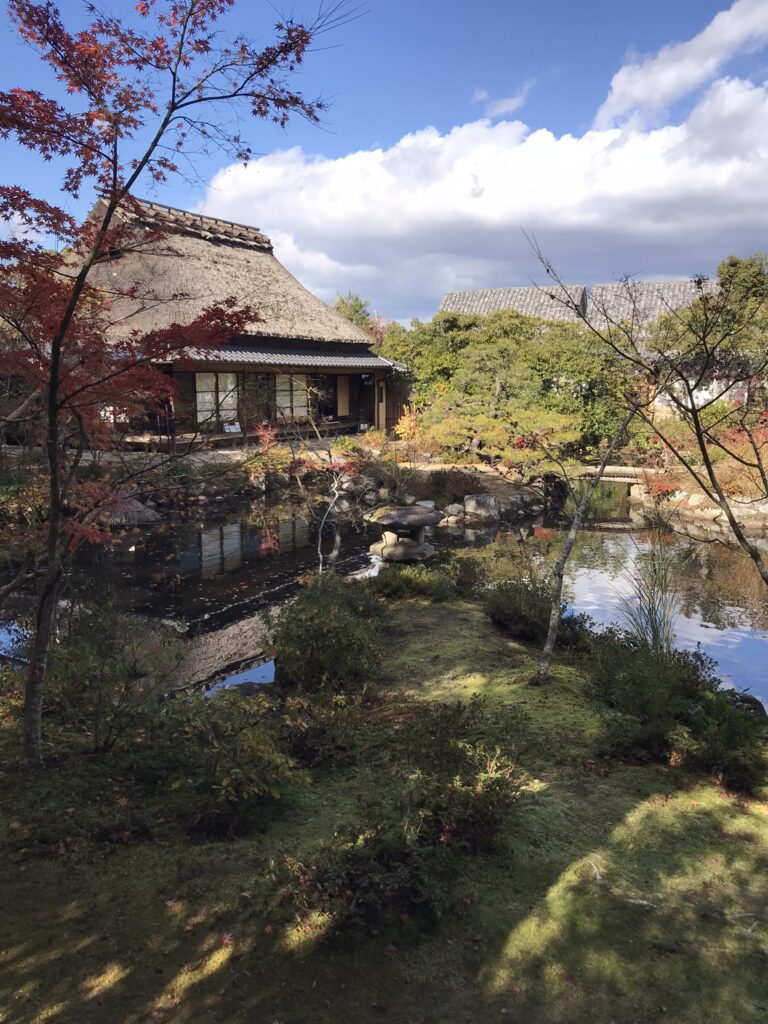
Check out Isuien for a marvellous traditional Japense gardens
Todai-ji – the number one attraction in the city. The temple was founded by Emperor Shomu in 728 after the death of his son, shortly afterwards commissioning the Great Buddha Image which still stands in the Great Buddha Hall. Apparently if you crawl through a hole in a certain wooden pole you automatically become enlightened – I’m not sure about the validity of this but plenty of school kids were giving it a good try. There’s also a very creepy 18th century wooden statue of Binzuru outside the entrance – it’s the stuff of nightmares. As usual, informative leaflets are provided and information plaques are in English for foreign visitors.
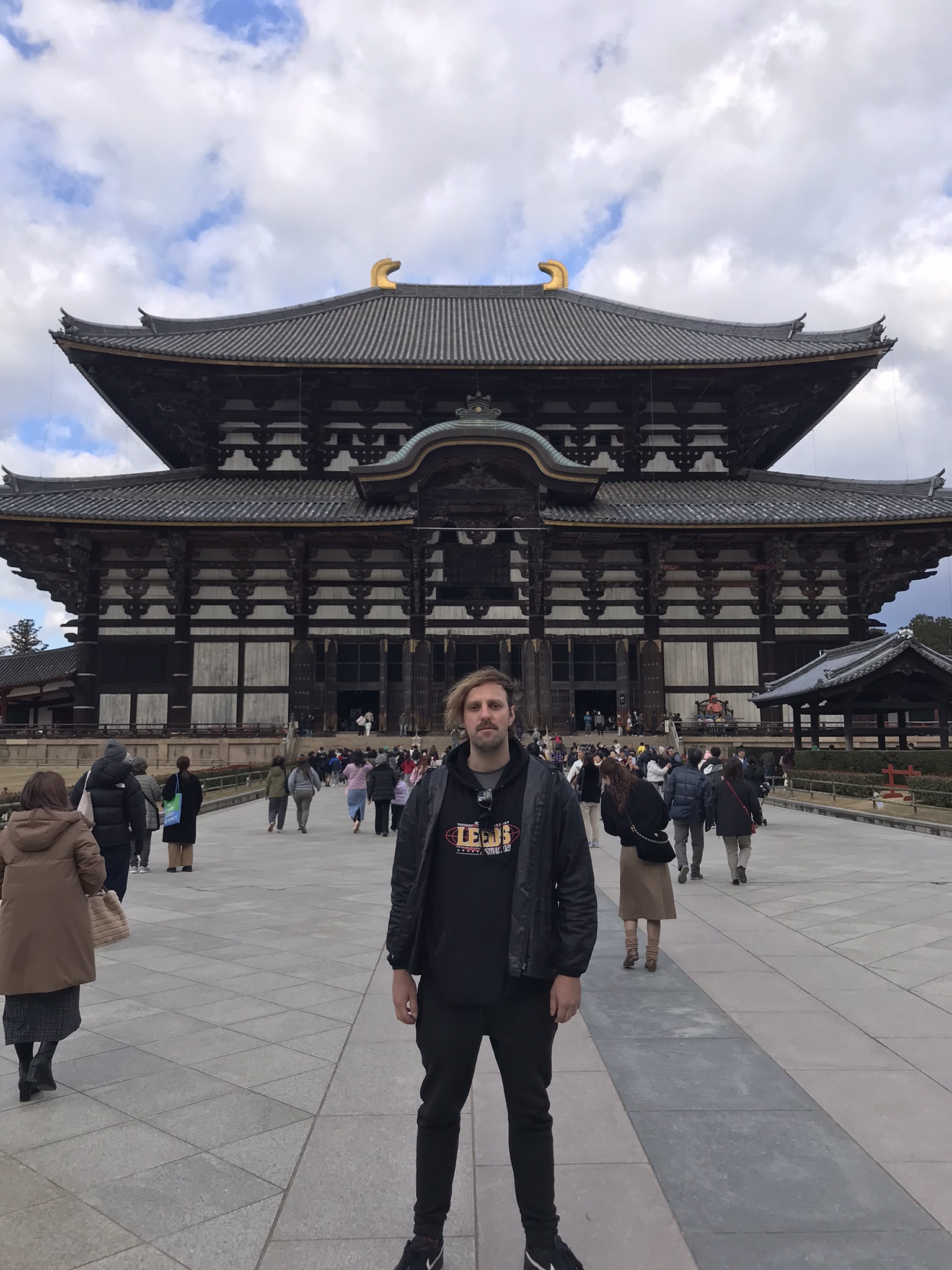
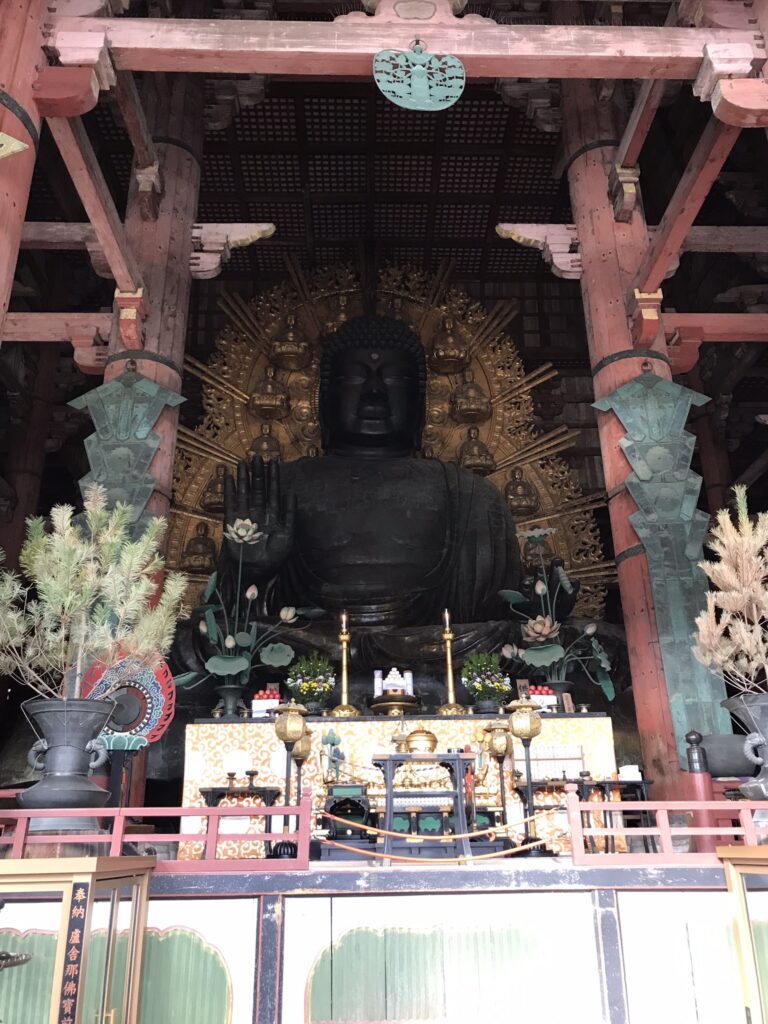
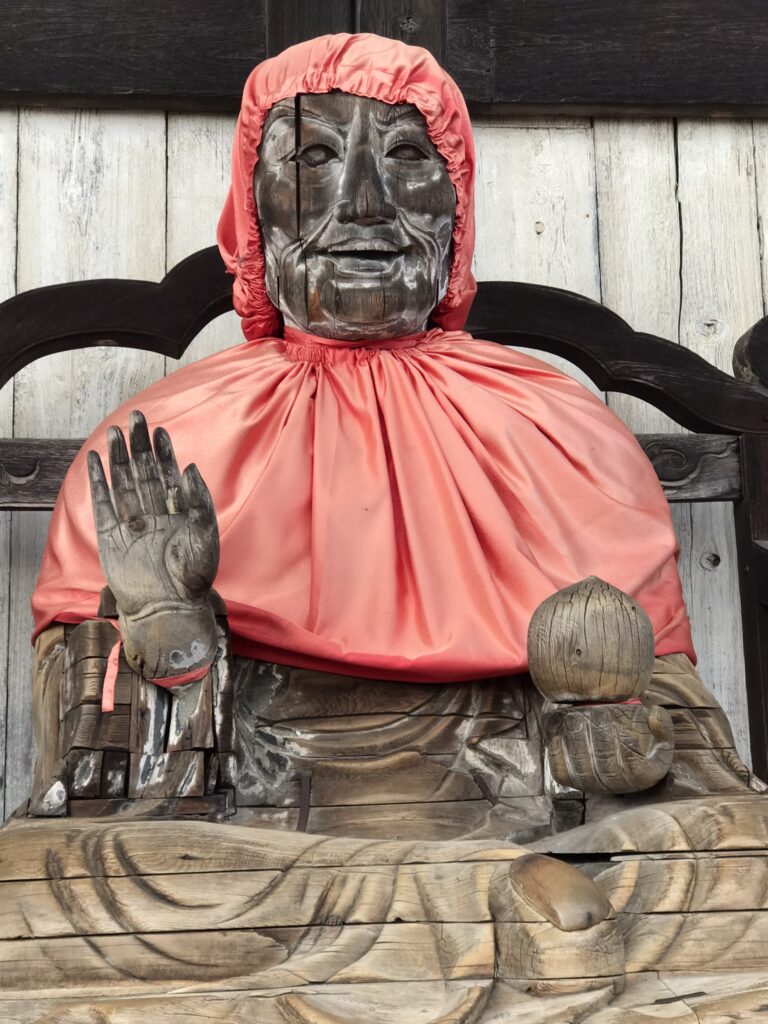
Prepare to be amazed (and scared) at the statues in Todai-ji
Nigatsu-do – part of the wider Todai-ji complex which is located a short walk from the Great Buddha Hall, don’t miss this overlooked temple hall which has an overhanging platform with fab views over the city. It reminded us a little of the famous Kiyomizu-dera in Kyoto. Entry is free to the temple platform.
Hokke-do – located near to Nigatsu-do, this is the oldest building in the Todai-ji complex. There is an additional admission cost which is separate to the Great Buddha Hall, and the ticket is relatively expensive in comparison so we didn’t go inside.
Nara Park – wide open parklands where deer tend to congregate. This makes an ideal place to interact with the deer away from the crowds. A scenic spot for a stroll, whether you’re planning to feed the deer or not.
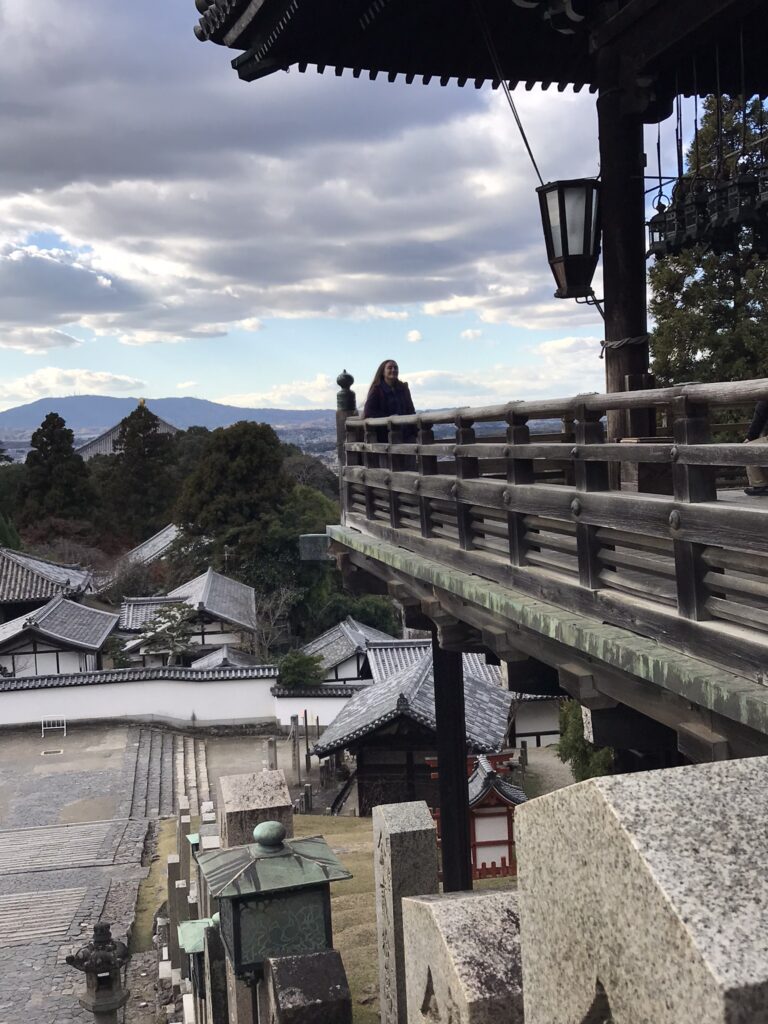
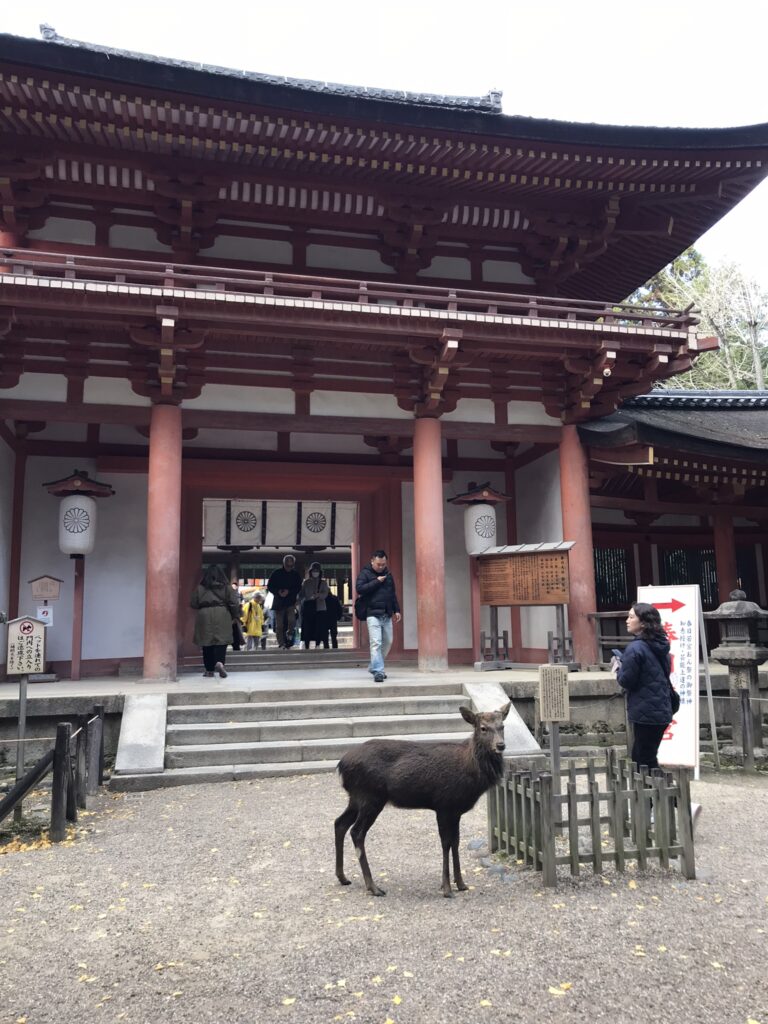
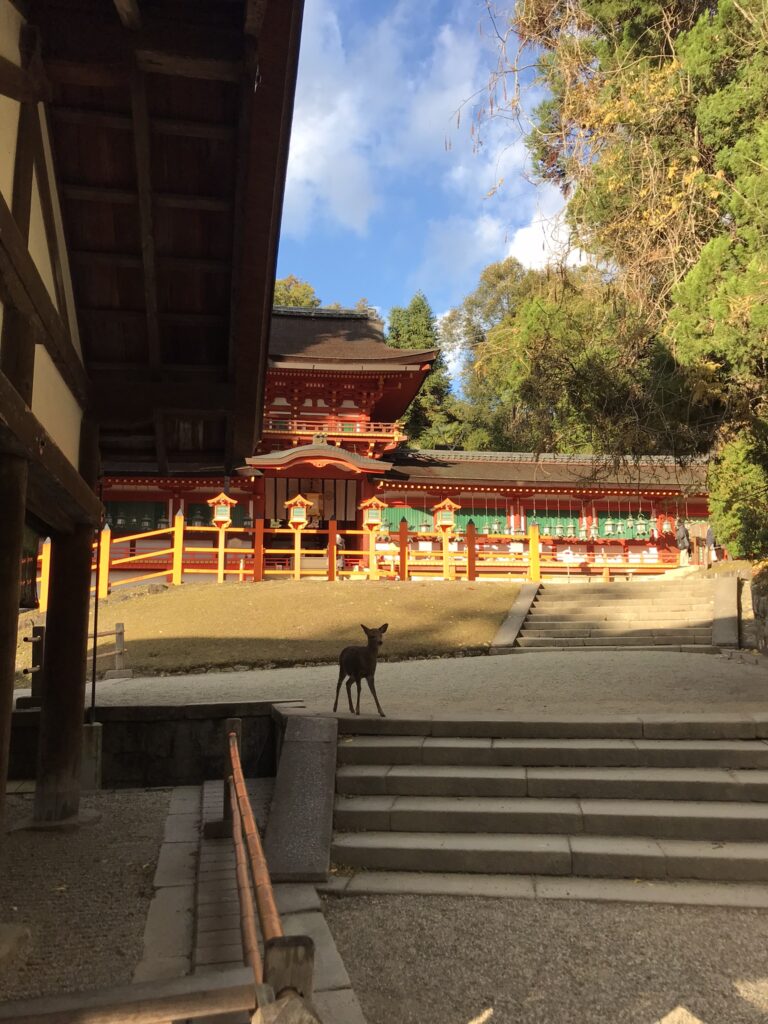
Stunning views from Nigatsu-do and the colourful Kasugataisha shrine with some furry friends inside
Kasuga taisha – the ancestral shrine of the Fujiwara family, now known for its brightly coloured appearance. The shrine charges an admission fee for entrance into the main complex, but visitors can peek at the buildings from the main courtyard after passing through the free entrance gate. Rows of weathered stone lanterns and vivid red torii gates line the approach, adding to the austere atmosphere.
Kofukuji Temple – another historic Buddhist temple from the Nara Period – visitors can peek at an array of reliquaries and artefacts in the National Treasure Hall. We decided against paying the entrance fee as there’s a platform where you can view the Great Hall without needing to fork out any money. The iconic pagoda here was sadly under construction during our visit.
Nara National Museum – worth a mention but we didn’t visit as we ran out of time. The architecture of the building was fascinating.
Heijō Palace Site Historical Park – the site of the former imperial palace in Nara – most tourists neglect coming to this historical site which is such a shame as we found it to be extremely worthwhile to visit and super interesting. Perhaps this is because the park is situated away from the main attractions in the vicinity of Kintetsu-Nara train station. To visit the historical palace site, hop on the train to Yamato-Saidaiji Station (the same station that former president Shinzo Abe was assassinated in 2022) and walk the short distance to the complex.
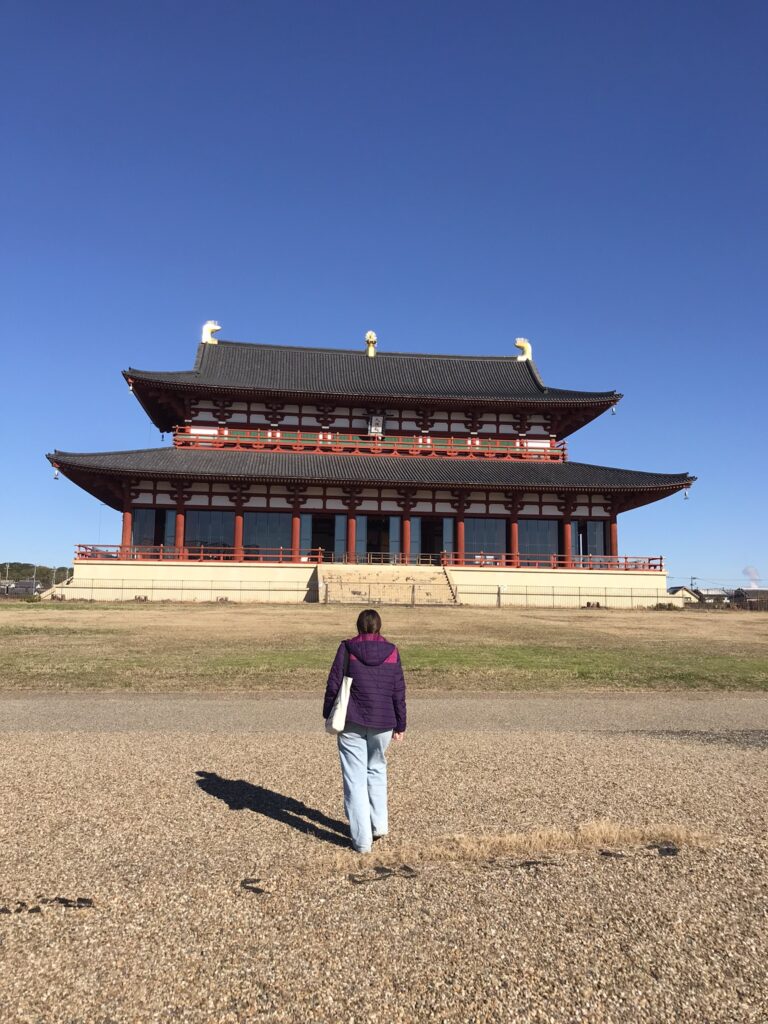
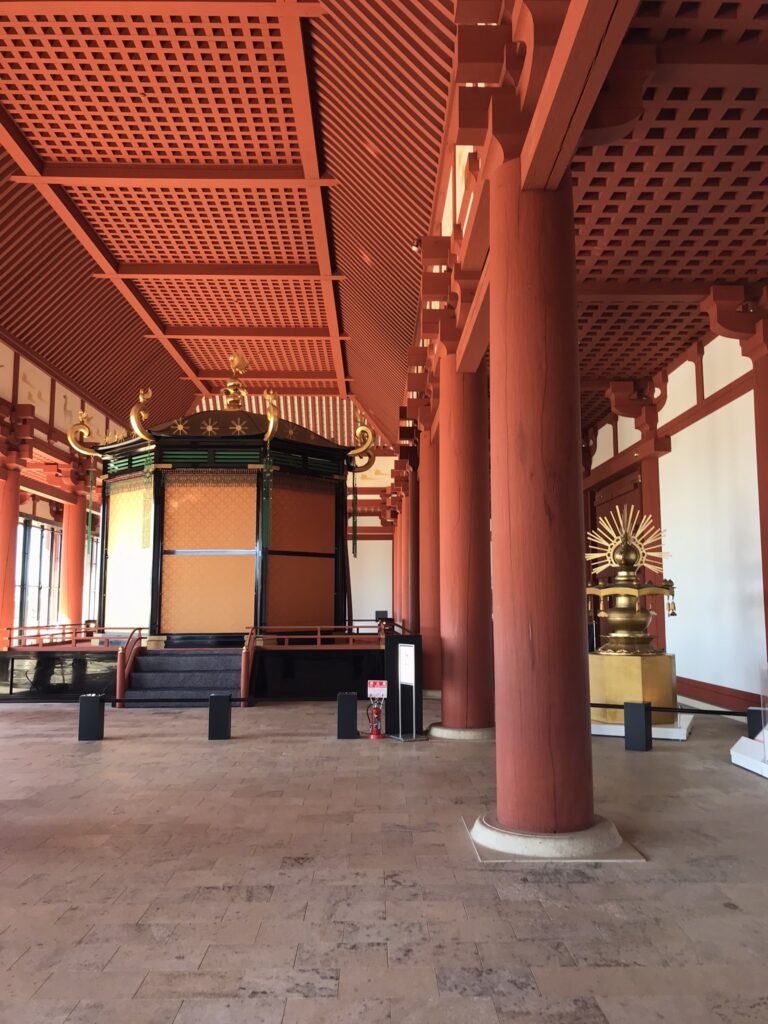
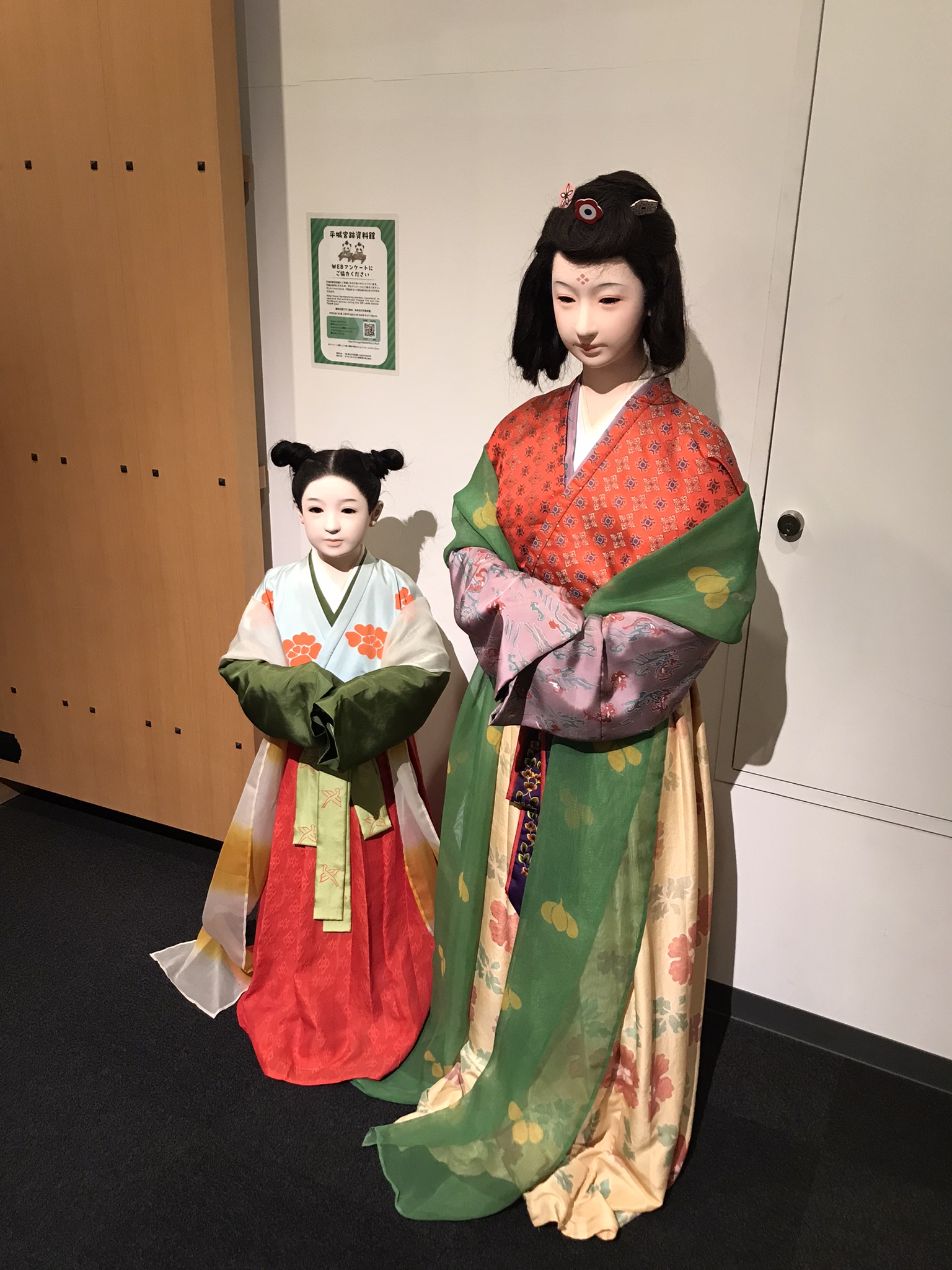
The reconstructed Great Hall and visitor centre are the best places to visit at this former palace complex
There is a visitor centre with a small free museum offering visitors an insight into the history and layout of the complex, as well as the clothing and furniture of the time. Parts of the palace complex have been rebuilt using traditional techniques and archaeological evidence, and visitors can now wander around the dutifully reconstructed throne room and gape at the grandeur of the complex for free. We were struck by the sheer size of the complex, the incredible number of buildings that once stood here and the vast scale of the grounds, of which absolutely nothing other than the reconstructed palace, gatehouses and faded remains of the irrigation ditches remain. Most of the former palace site is now public park land, with locals jogging around or kids playing baseball. The only other non-locals we encountered here were a noisy group of Chinese tourists on a guided bus tour. This is a great off-the-beaten track historical place which reminded us of a similar place in Gyeongju in South Korea.
Day trip to Asuka
Asuka was a refreshing contrast to the built-up urban centres in Kansai. It was blissful to meander around the rice paddies, visiting lesser known sights from the Asuka era without the annoying crowds of the big cities. During the Asuka Period (named after the settlement), Asuka rose to prominence as the imperial capital with grand palaces, temples and burial grounds – none of these remain intact but there are still traces of this era to be found if you look closely enough.
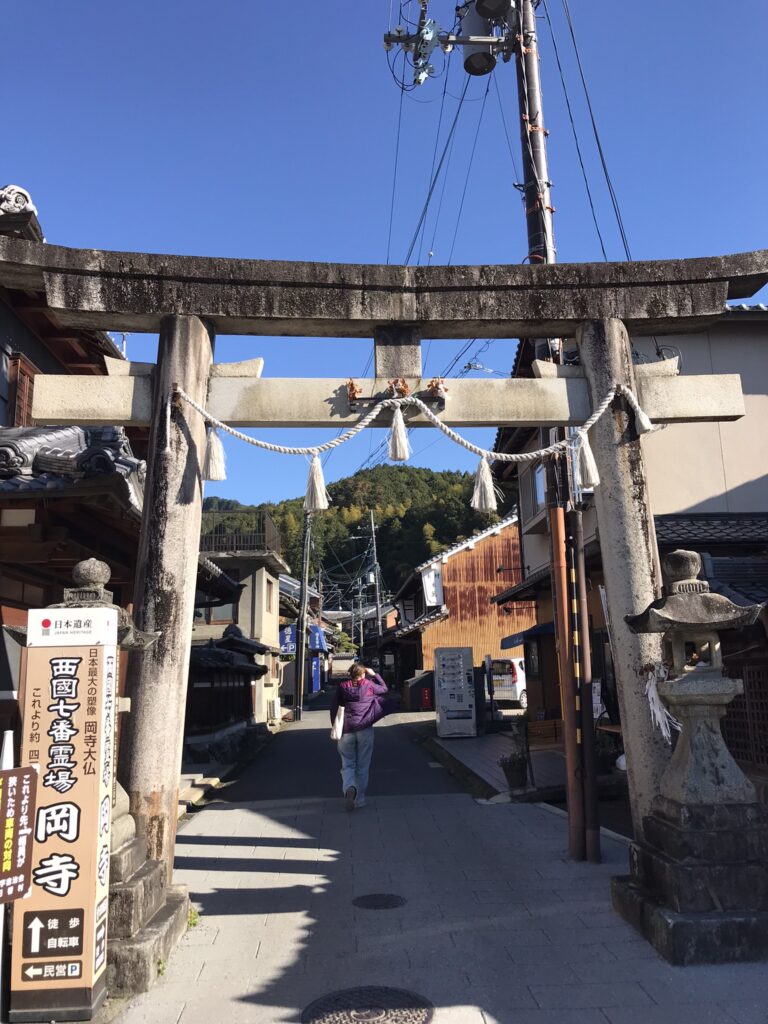
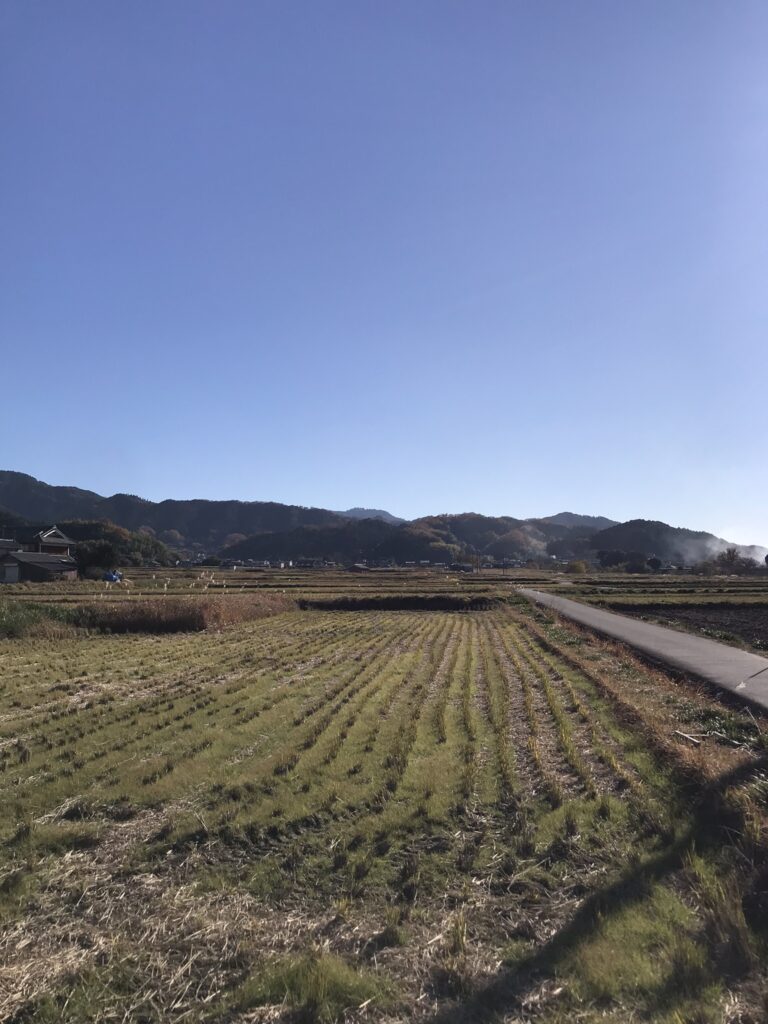
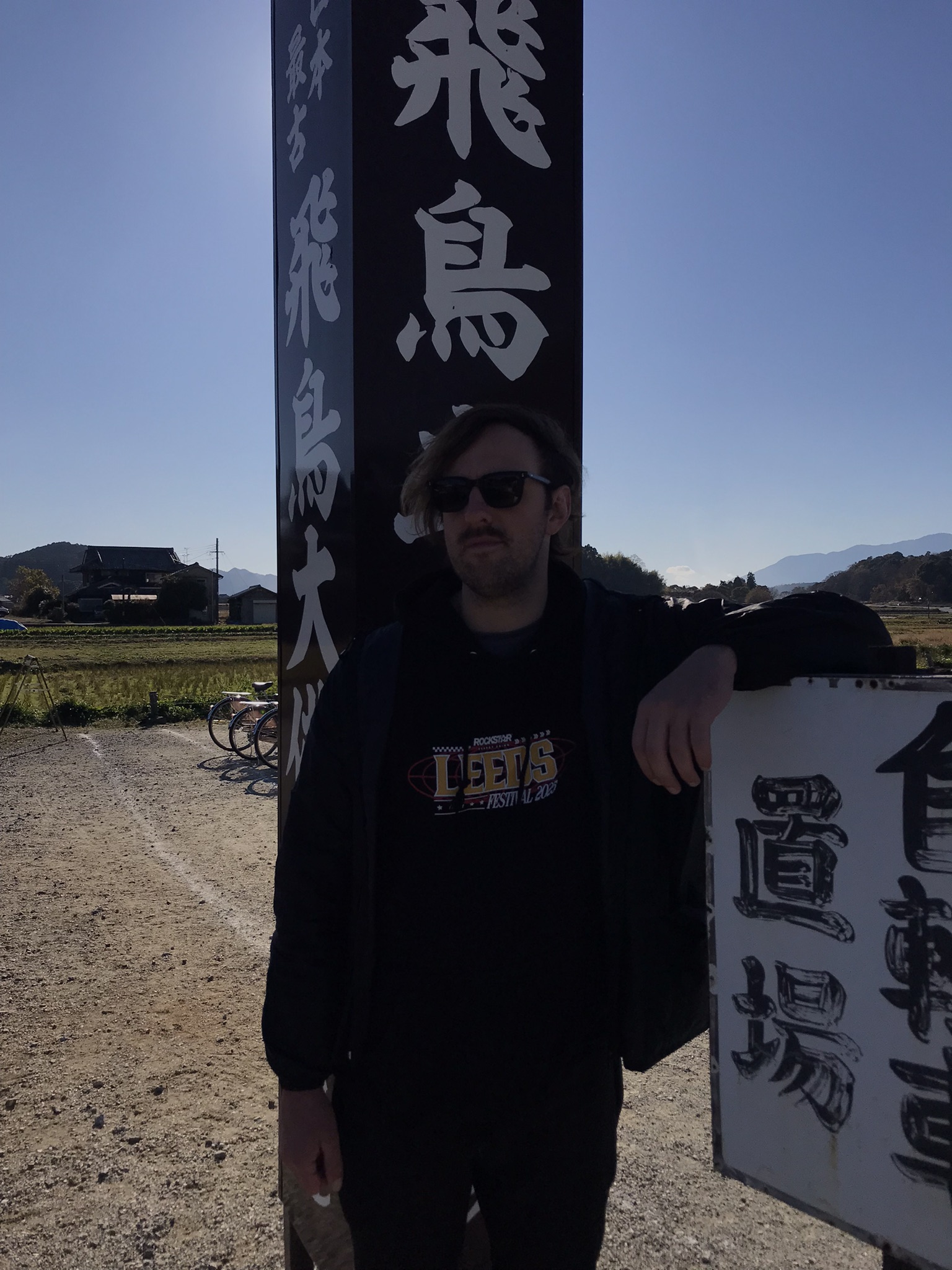
Asuka is a breath of fresh air from other packed tourist sites in Kansai
Luckily Dan has created a ‘low-key sightseeing’ self-guided walking tour that takes in all the sights we visited so you can walk in our footsteps. Click here for the tour!
Day trip to Horyu-ji (Ikaruga)
The UNESCO World Heritage Site of Horyu-ji makes for an ideal stop along the train line for those traveling from Osaka to Nara, or as a day trip from either Osaka or Nara. One of the most iconic and historic temples in Japan, Horyu-ji dates back to the year 607, close to the introduction of Buddhism to Japan.
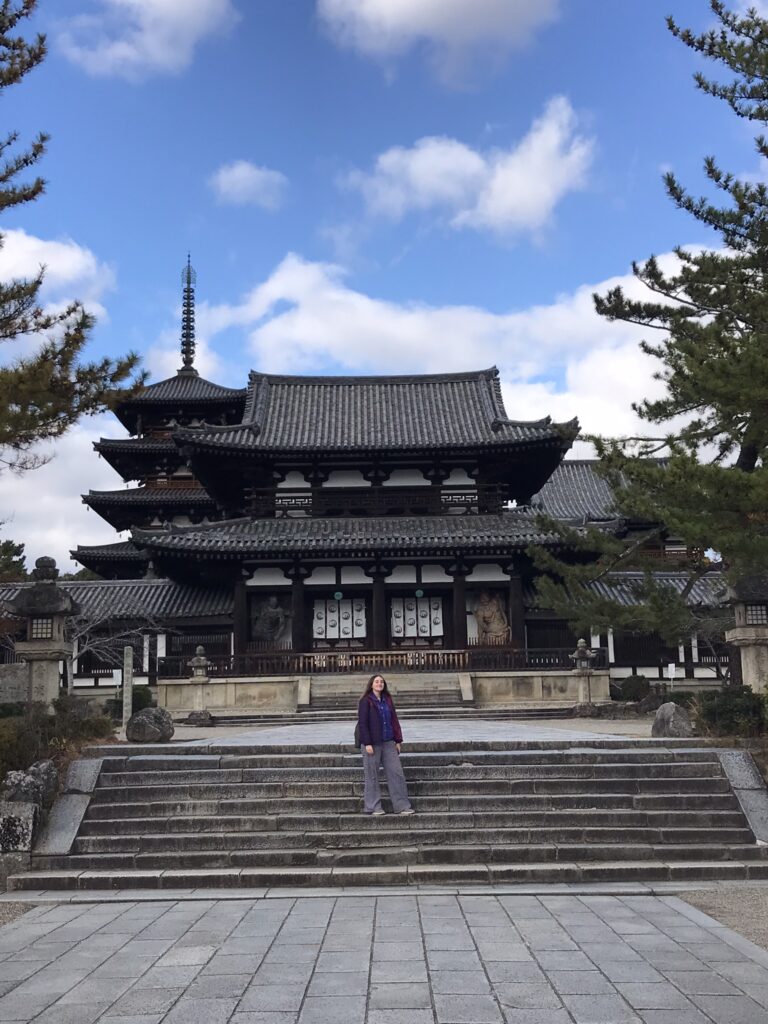
Grand entrance of the western precinct
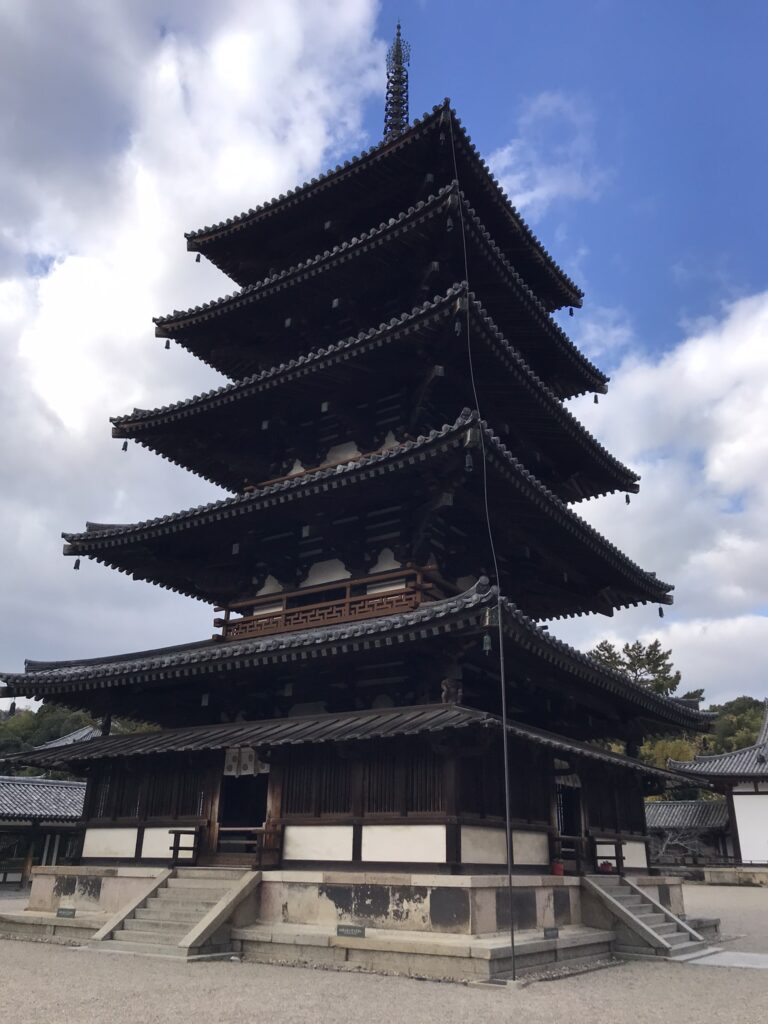
Horyu-ji means ‘temple of the flourishing law of Buddhism’. Many National Treasures and culturally significant artifacts have been found at Horyu-ji – there is an entire gallery devoted to treasures recovered from this temple at the National Museum in Tokyo. The temple consists of two distinct areas – the western precinct, which contains many of the main buildings and a famous 5-storey pagoda, and the eastern precinct which contains some smaller ancillary halls and buildings. Between the two precincts is a walkway featuring the temple’s Gallery of Treasures. Tickets to enter the temple complex are purchased at the larger western precinct, and this then also covers entry to the eastern precinct as well as the treasure museum. A pamphlet with detailed information about each of the various structures and buildings is provided to visitors when entering at the Western precinct. Be aware that the temple complex is a popular site for coach trips full of domestic tourists or school groups, and it can get busy if too many arrive at once. We saw plenty of coaches leaving the area just as we were arriving, but thankfully there weren’t too many groups inside when we visited.
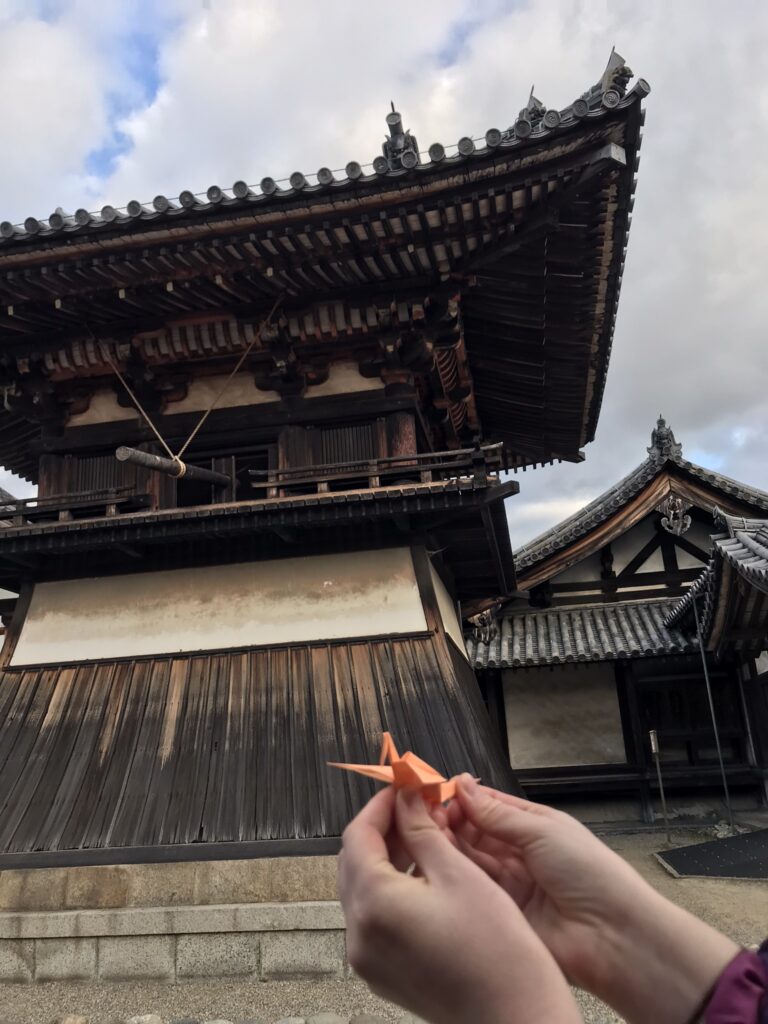
A kindly old man presented us with an origami crane at Horyu-ji
To get to Horyu-ji, take the train to the small town of Ikaruga – the temple complex is walkable from the station. Lockers are available at the station for those with luggage. We found that the town of Ikaruga was incredibly peaceful and laid-back – a world away from the bustling streets of Osaka. Video game enthusiasts might be aware of a very chaotic and intense Japanese ‘bullet hell’ video game which is named after this town. Thankfully, the real Ikaruga is nothing at all like this. To the west of Horyu-ji are some small burial mounds, which are worth a quick look after visiting the complex.
Foodie Places
北小路 – located within walking distance of Horyu–ji, this was one of our most unique dining experiences in Japan. Very unassuming from the outside and also inside, it seems like you’re walking into somebody’s house and we weren’t 100% sure that we had come to the right place. After entering the empty room and calling out to see if anyone was there, we were greeted by the jovial 92-year-old proprietor who functions as both the waitress and chef. The elderly lady didn’t speak a word of English and the menu was written entirely in Japanese on wooden tablets on the wall. The lady gestured towards the boards, we said ‘hai’ and ended up with a very satisfying and healthy vegetarian meal for a ridiculously low price. I still don’t really know what all the food was, but we enjoyed it nonetheless. This is an ultra-homely place – you can sit at tables or on the floor in a traditional Japanese-style, and the elderly lady shuffles along with her little trolley to bring out the food. Some other guests entered as we were leaving. I recommend visiting quite early, as the lady may be sold out of food.
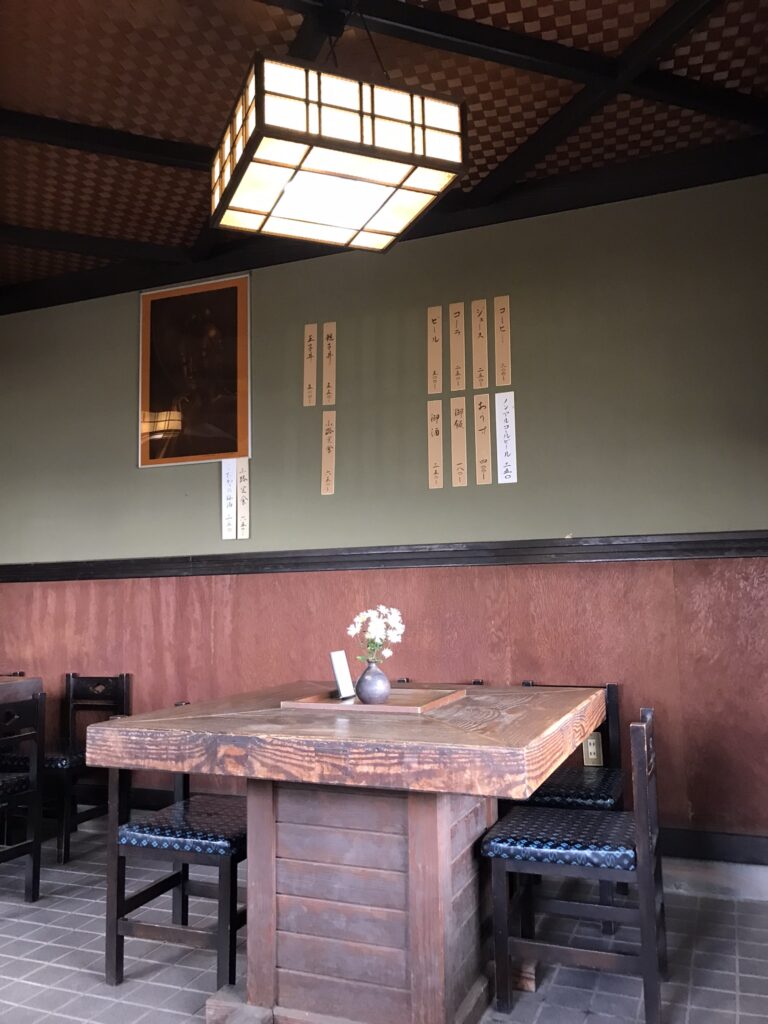
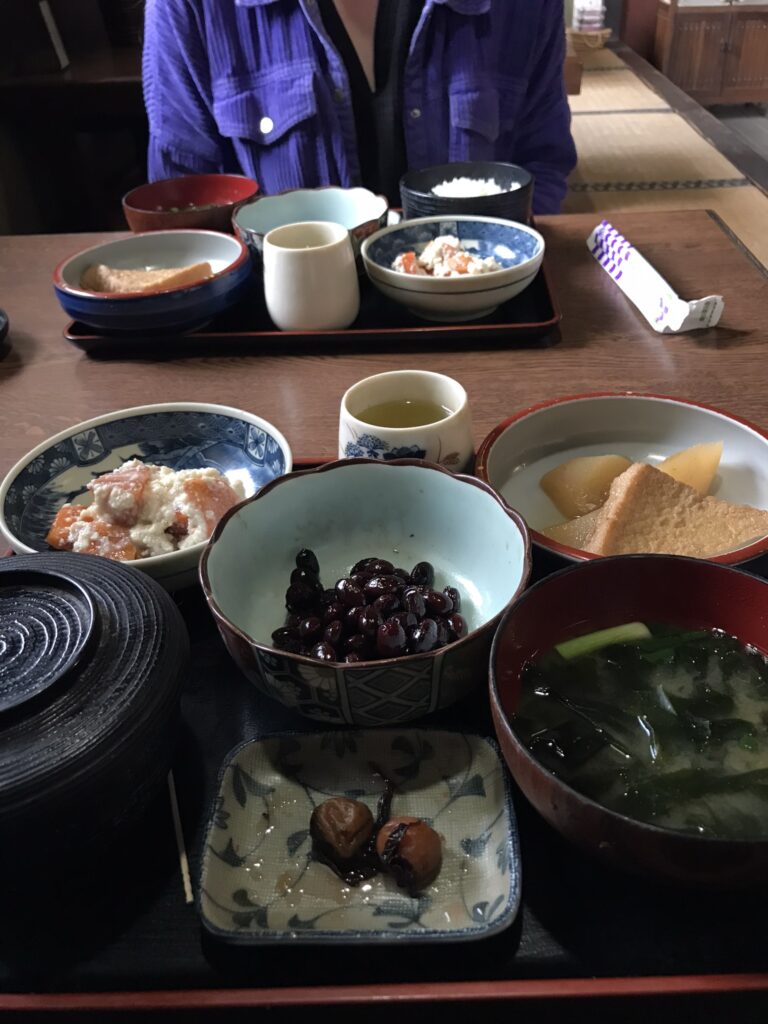
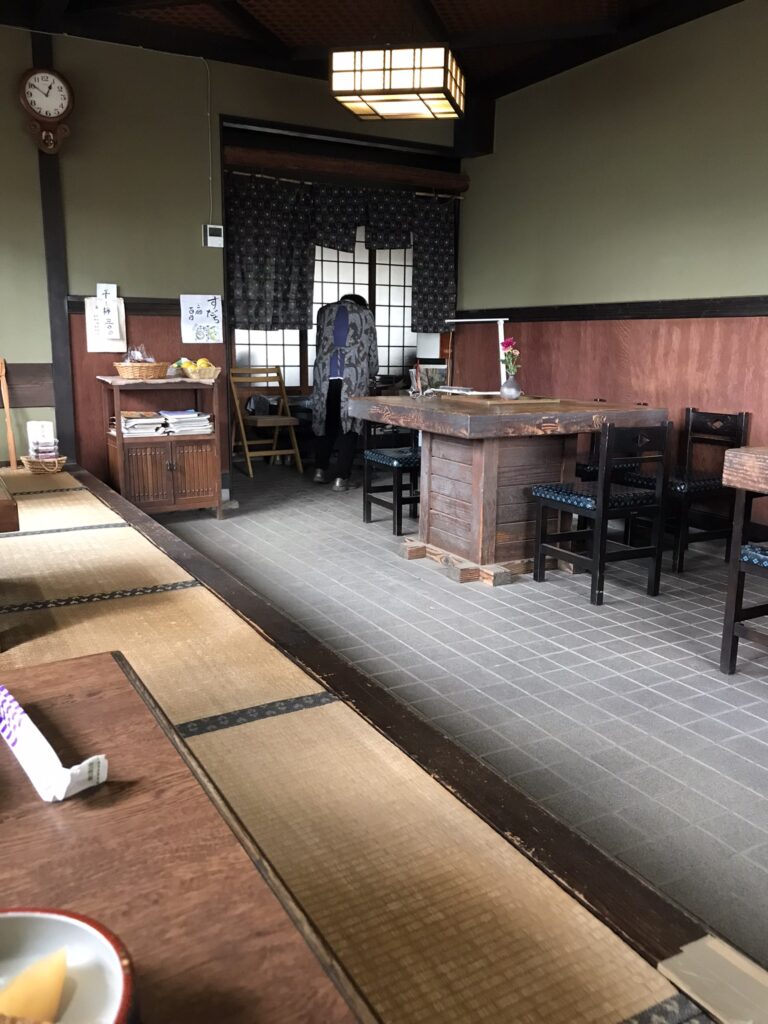
A completely unique and special dining experience at 北小路
Kyoto
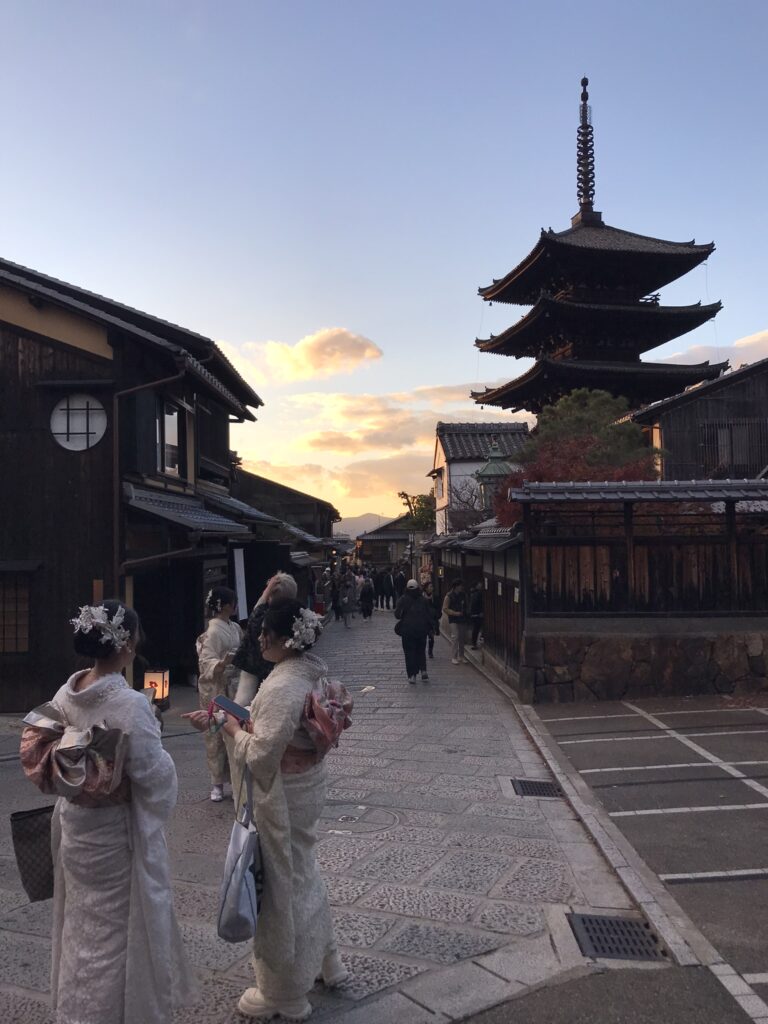
The cultural heartbeat of Japan, Kyoto was the capital of the territory for over 1,000 years, having been established as a purpose-built capital known as Heian-kyo in the 8th century. The name Kyoto literally translates to ‘capital city’. Even after Edo (Tokyo) rose to prominence during the Tokugawa Shogunate between 1603-1868, the Emperor of Japan continued to reside in Kyoto which meant that Kyoto continued to hold the official title as imperial capital throughout the period even though Edo was really the economic, political and administrative centre of the country. The Meiji Restoration in 1868 saw the return of direct imperial rule, and the imperial household was then moved to the former shogun’s palace in Edo. Imperial capital status was therefore conferred on Edo and the city’s name was changed to Tokyo (which is Kyoto backwards), ending Kyoto’s time as capital. The city remains the most significant centre of Japan’s rich history and culture – a place filled with historic gardens and shrines, where formal tea ceremonies, geisha spotting and temple-hopping are top attractions. Due to its cultural significance, Kyoto was mercifully spared by the American bombing campaigns during World War 2 so there are plenty of original historic buildings here, giving it a slightly different vibe to many other Japanese cities.
We were a little confused and overwhelmed when we arrived to Kyoto. At first glance, most of the major attractions in the city seem to be religious buildings such as temples and shrines. There are over 2,000 Buddhist and Shinto shrines within the city and 17 sites with UNESCO World Heritage status. Visiting a load of shrines didn’t seem particularly interesting to us, especially as we’d already visited dozens and dozens of shrines all over Japan. As it turns out, many of the shrines within Kyoto are actually historic buildings (some are former private palaces) which were donated by various landowners throughout history. Some of the larger shrines are also very spectacular and unique. The shrines vary massively, from the great and small to the orthodox and the more peculiar. It’s unlikely that you will have time to visit all of them, so I recommend picking out a couple of the major shrines and then also seeking out a few of the smaller or more quirky local shrines as you explore other areas. Most of the major shrines are worthwhile purely for their scale and/or aesthetic value. For history buffs, sites like Nijo-jo Castle (the former shogun’s palace) and the Imperial Palace grounds are also worth a visit.
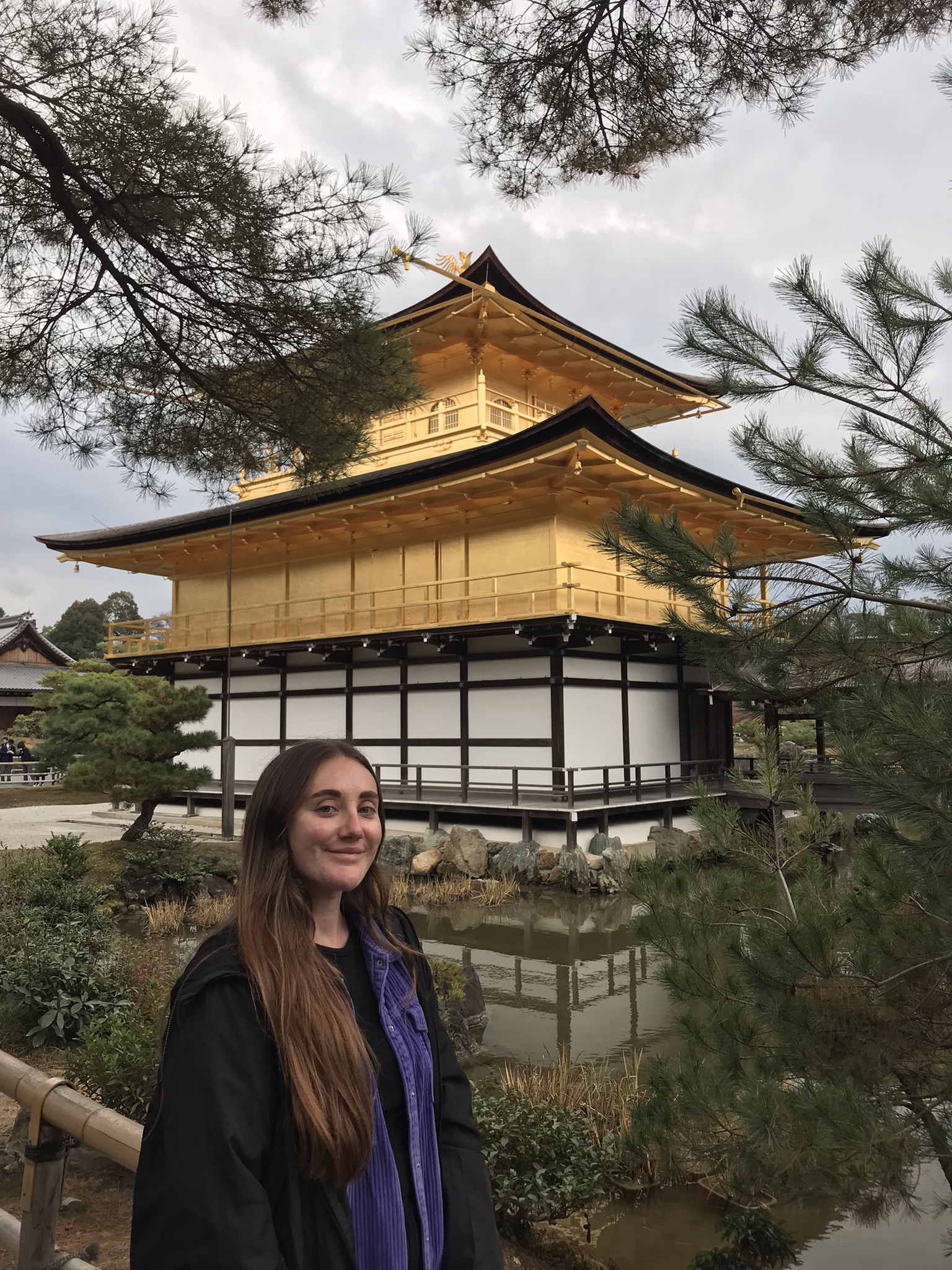
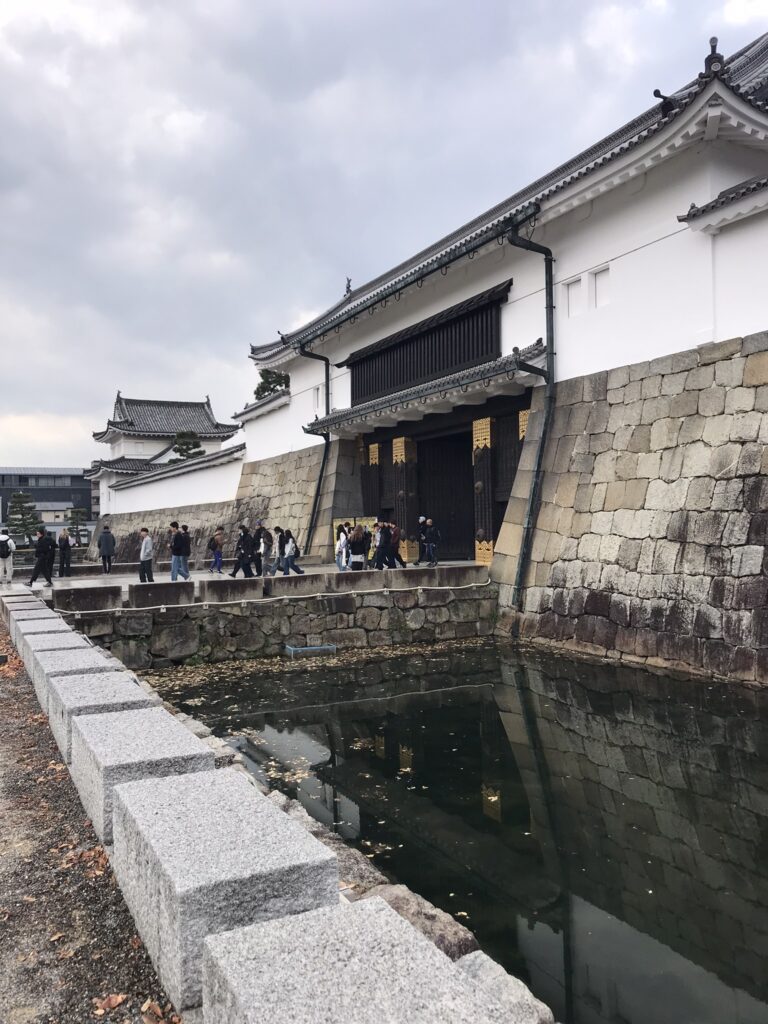
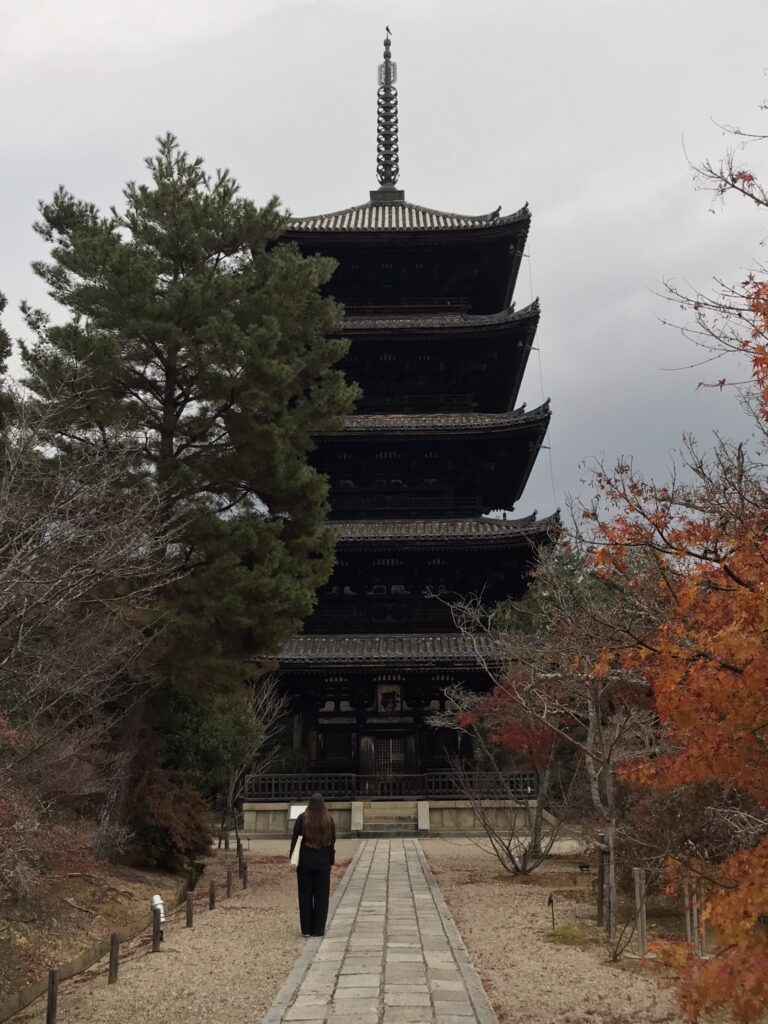
The ‘Golden’ Kinkaku-ji temple; entrance to Nijo-jo Castle and wooden pagoda at Ninna-ji temple
Outside of Tokyo, Kyoto is by far the most popular tourist destination in the country so be prepared for crowds at most of the major attractions. Luckily tourists generally seem to flock to many of the same places, such as Arashiyama Bamboo Forest and Fushimi Inari shrine. Away from these hotspots, there are still many parts of the city which actually feel quite tranquil – we were surprised at how quiet many of the lesser-known shrines were, even some of the UNESCO sites. As always, we tried to mix it up and avoid the hordes by going to some of the lesser-known sites, as well as a few of the main iconic attractions. Of course we still encountered huge crowds at places like Kinkaku-ji and Kiyomizu-dera, but generally we found Kyoto to be super manageable crowds-wise – although we did visit in early December, which is probably outside of peak season for most foreigners.
Accommodation
M’s Hotel Nijojo Oike – a small hotel in the area near to Nijo-jo Castle. We liked this area – quiet and with a residential feel, yet within walking distance of one of the city’s major landmarks.
Foodie Places
Brother Bakery – located within a covered shopping arcade near to Nijo-jo Castle, this is an excellent independent bakery serving an array of baked goods and sandwiches. Prices are on the lower end of the scale, but the quality was still exceptional. An ideal stop-off for those looking to pick up a quick lunch. I even picked up a couple of cookie gift packs here to take home as Christmas presents.
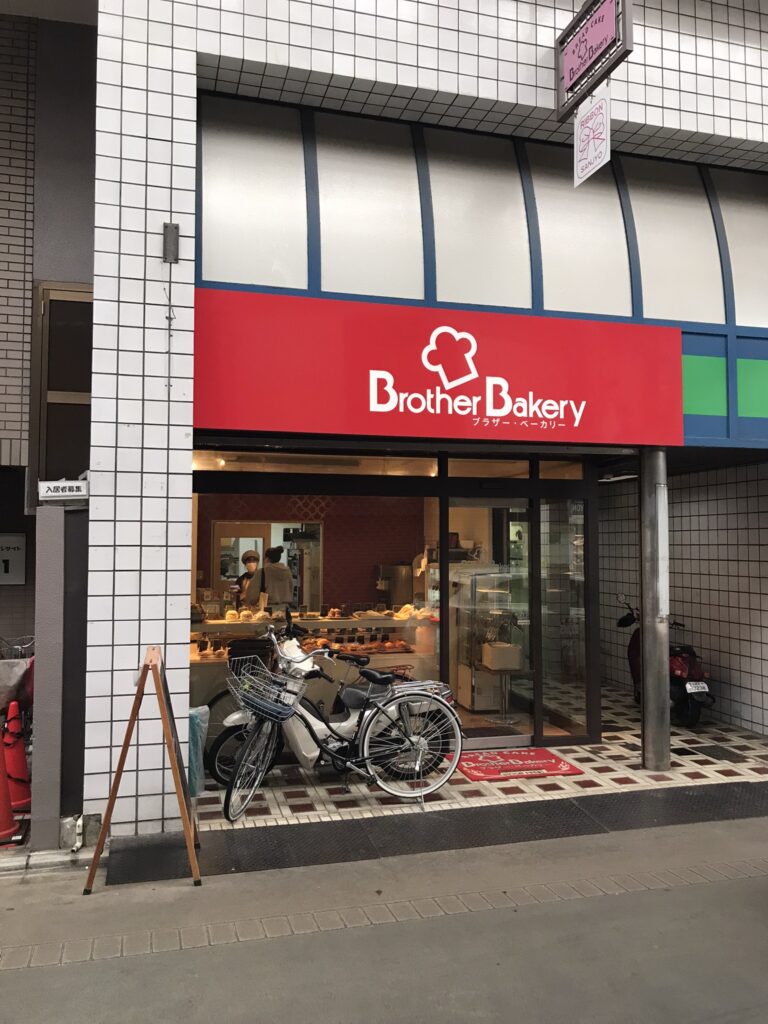
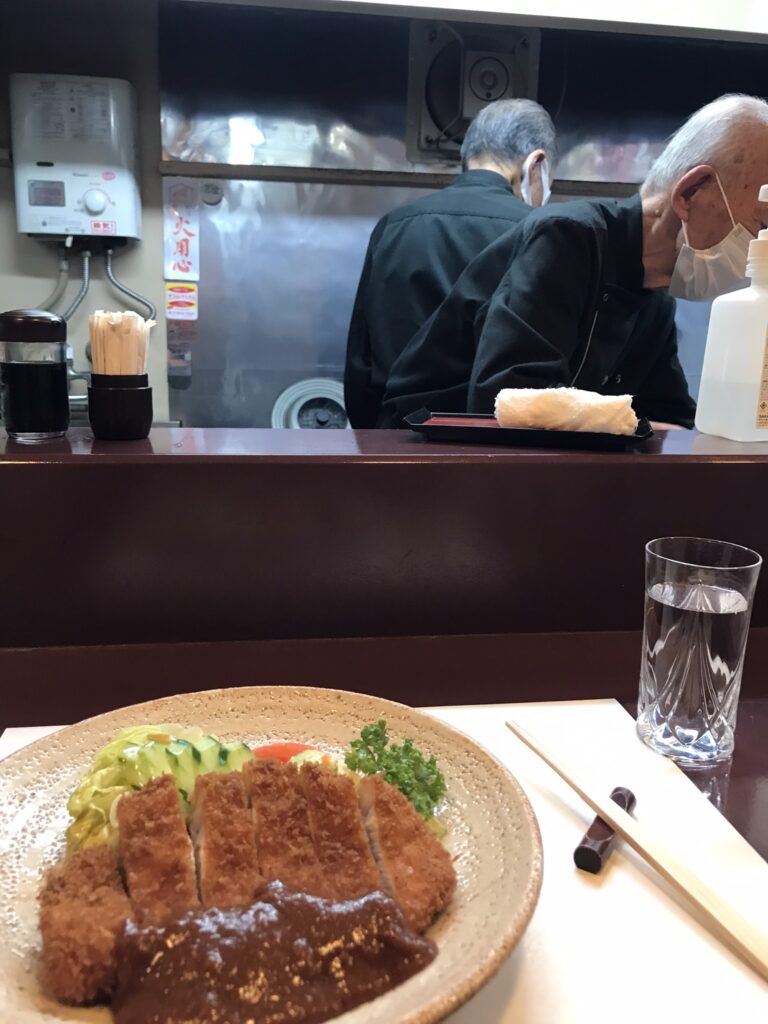
The irresistible Brother Bakery and elderly gentlemen chefs at Rindou
Rindou – a tonkatsu restaurant near to our hotel. I’m not sure how old exactly the grandfatherly chefs here are, but I would guess at well over 70. We speculated that it might have been a bit of a passion project for them. The food they cooked up was good, and the chefs themselves were very attentive and eager to help.
らくから (chicken restaurant) – we got the lunch deal here and were blown away by the value of the meal. This is a local place serving typical karage (fried chicken) sets, it mainly seems to cater to local office workers but they were welcoming to us.
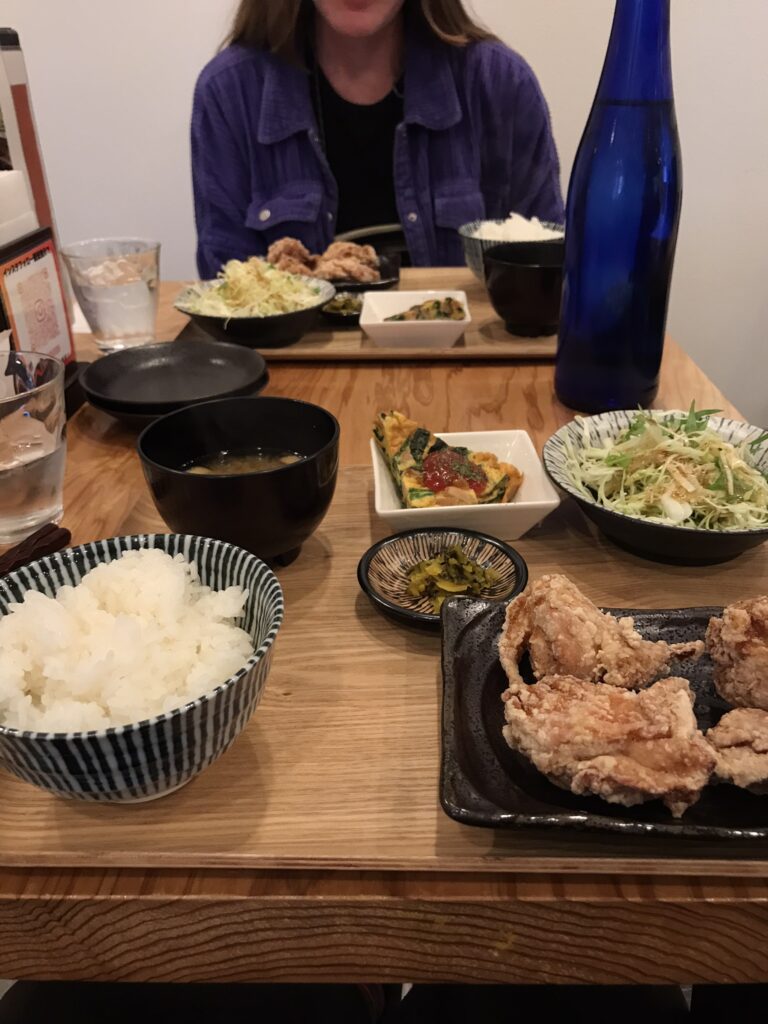
We still don’t know what English name for らくから but the price and quantity was top-notch
OC Burrito – located in the basement of the shopping mall which contains Kyoto Pokemon Centre. Typical tex-mex style burritos with portions definitely more to the American than Japanese standard. It’s a fast food style setup with orders placed via a screen. We ate here for a change as we had eaten almost exclusively Japanese food since arriving in the country. As well as the burrito place, there are other tempting food options and eateries in the mall’s basement food court..
Activities
National Museum of Modern Art – directly opposite Kyoto City KYOCERA Museum of Art – it was a toss-up for us which of these art galleries to visit. Both have extensive special exhibitions but very limited permanent collections (I’m not sure if KYOCERA actually has a permanent collection at all). KYOCERA had a Hello Kitty exhibition at the time of our visit which seemed to be a hit with the kawaii crowd, so much so that tickets were sold out. In the end, we visited the National Museum of Art and browsed the small permanent collection. It’s not mind-blowing but entry was very cheap – the woman at the entrance was almost apologetic. There was an exhibit from a Japanese-American artist detailing his struggles with racial identity, which was somewhat interesting.
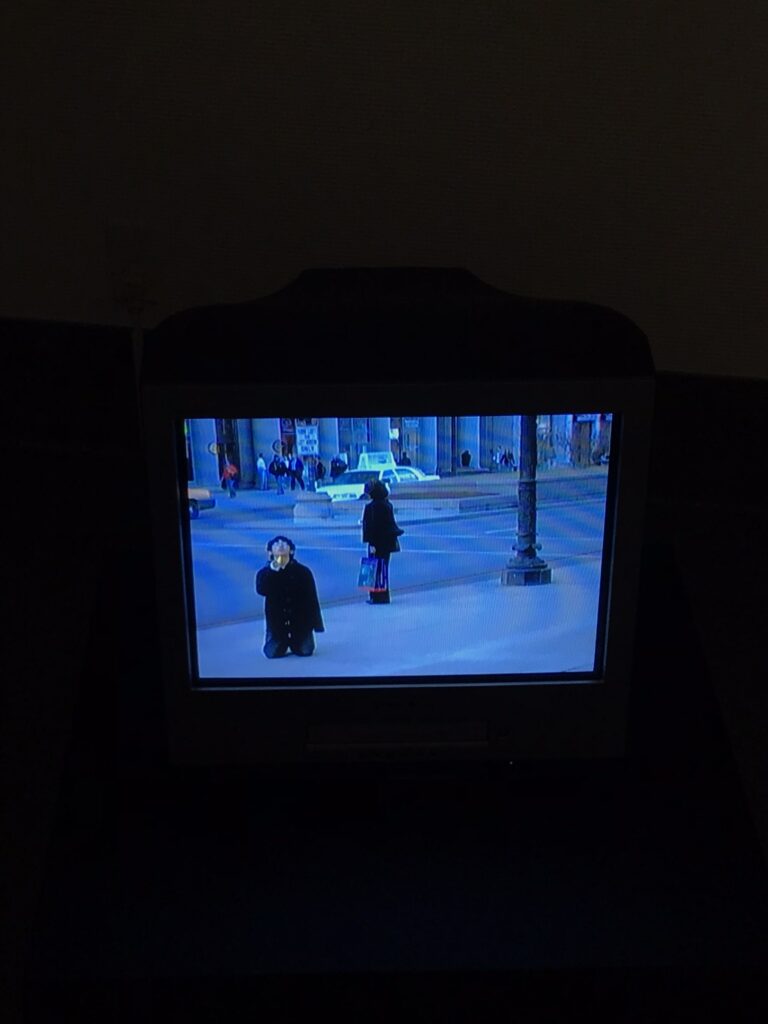
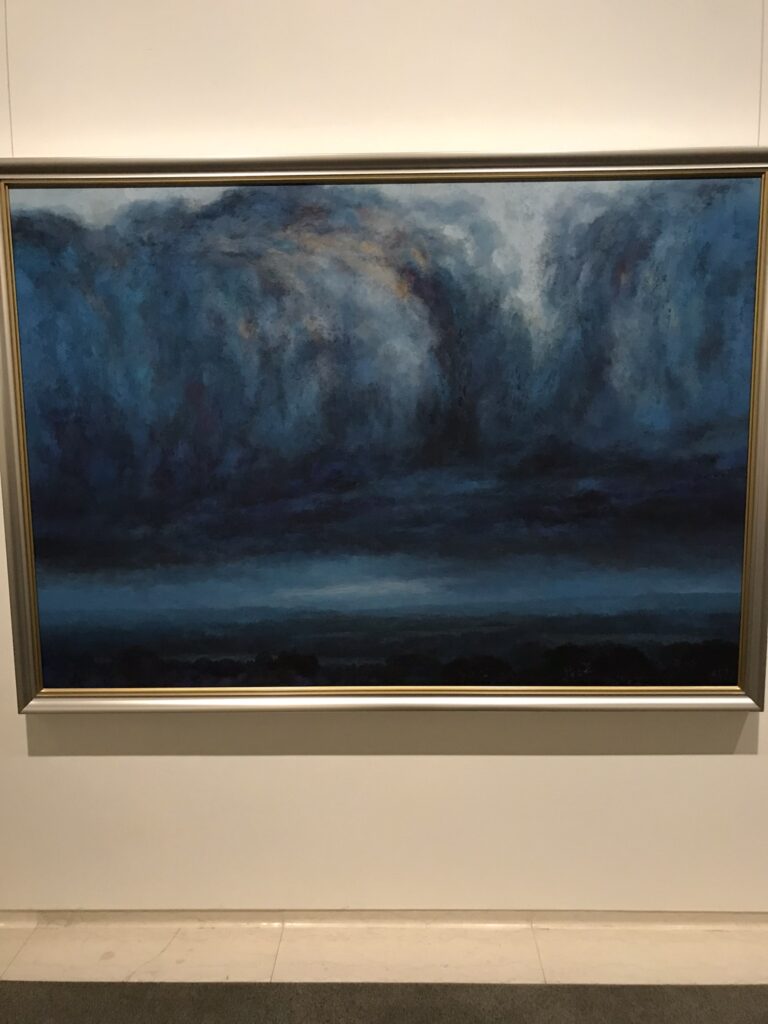
Thought-provoking artwork at the National Museum of Modern Art
Heian-jingū Shrine – a very modern shrine by Kyoto’s standard, this complex was constructed in 1895 to commemorate the 1,100th anniversary of the foundation of the city and beginning of the Heian period. The shrine is said to have very extensive landscaped grounds and gardens. The main building was under renovation when we visited so we didn’t really explore much or go inside. There is quite a lot going on in the vicinity of the shrine, including the two art museums, a zoo and a baseball field where we were able to watch a few minutes of little league through the fence (and were suitably confused – as British people, baseball is a total mystery to us)
Okazaki Shrine – a quaint little shrine near to Heian-jingu which is dedicated to bunny rabbits. This is surely the most kawaii shrine in Kyoto. It’s impossible to miss the many statues, votive plaques and adorable figurines depicting the furry creatures which are dotted throughout the small complex. The rabbits are there as they are a symbol of fertility and safe childbirth. Sadly we didn’t see any real rabbits.
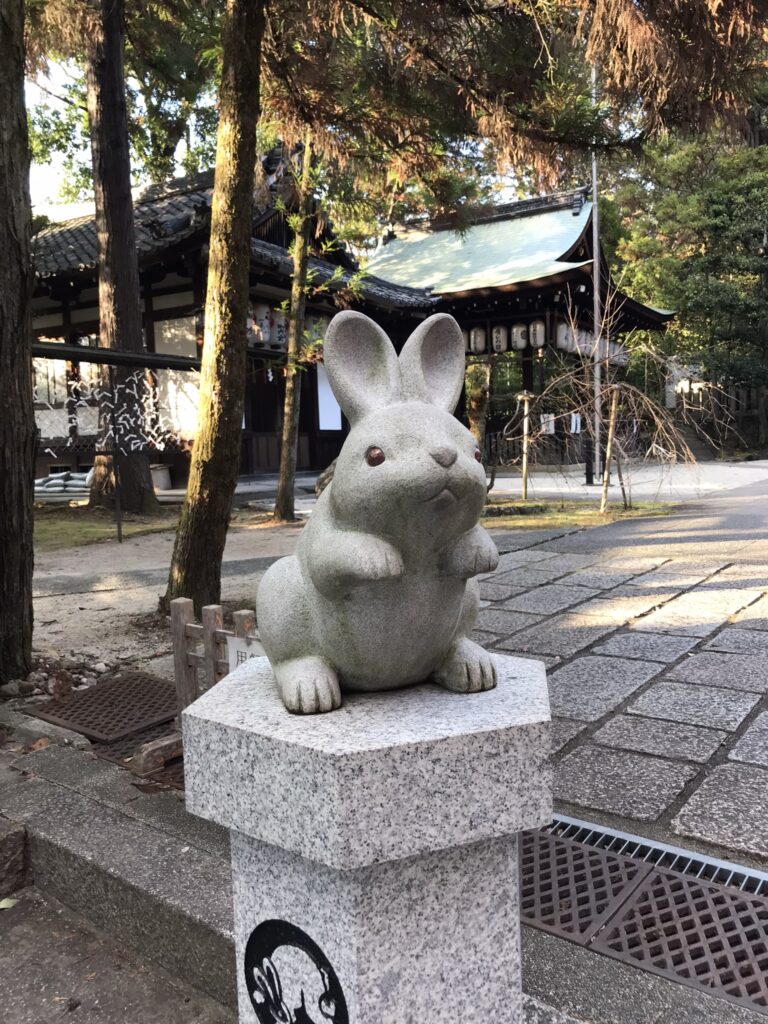
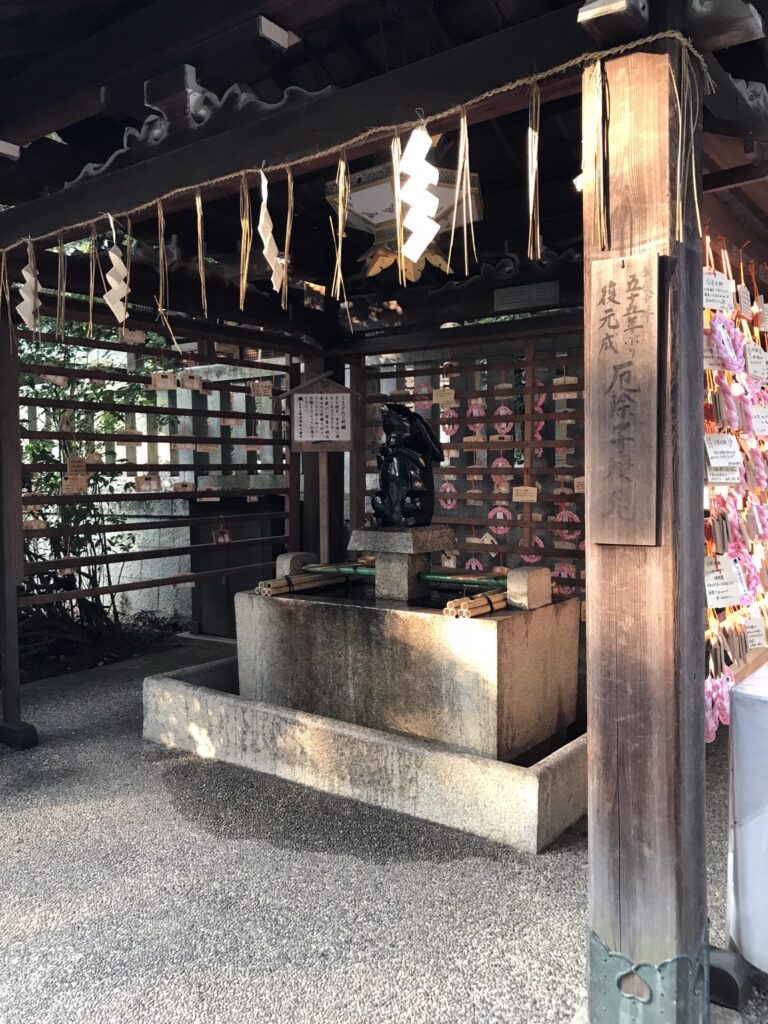
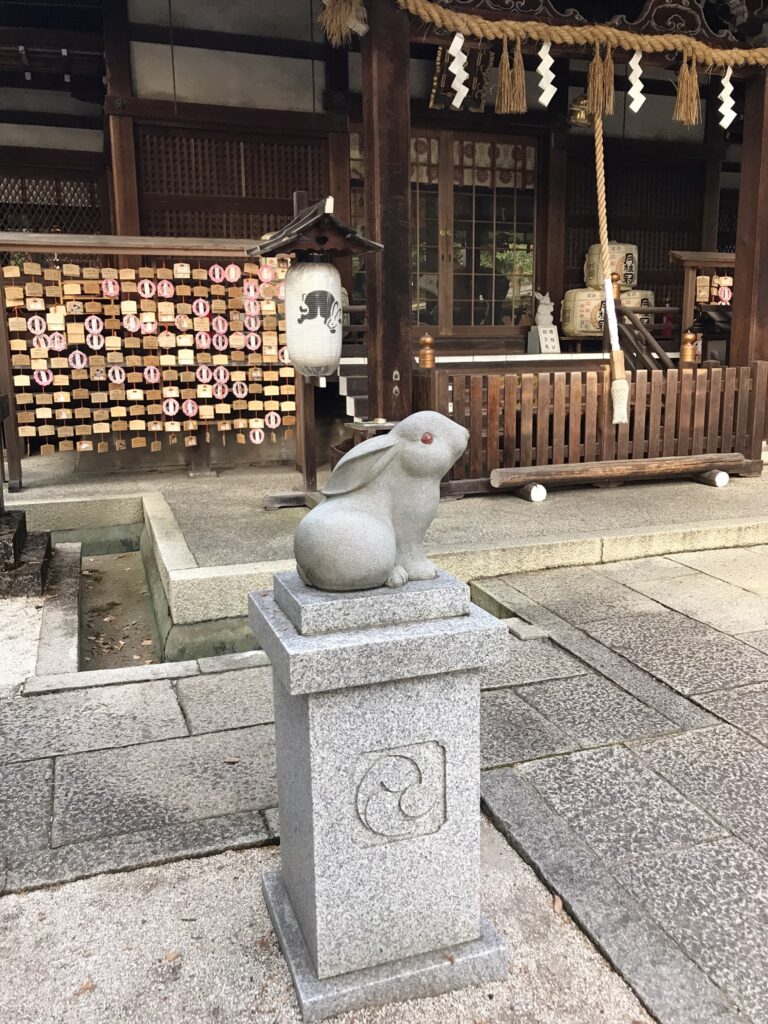
Bunnies feature heavily at the Shinto Okazaki Shrine
Nijo-jo Castle – this is the former castle and official residence of the Tokugawa Shogunate in Kyoto. Although based in Edo, the shoguns deemed it important to keep a presence in Kyoto, which remained the imperial capital of Japan. In actuality the shogun very rarely visited Kyoto, and so for most of its history the castle was mainly occupied by the samurai guards who were garrisoned here. Nonetheless, this castle has witnessed some of Japan’s most important historical moments. The castle was built by the first shogun, Tokugawa Ieyasu, in the early 1600s and was also the place where the last shogun announced his intention to restore imperial rule in 1867, ending the feudal era in Japan. The palace was then repurposed for imperial use for a period, before being given to the city of Kyoto and opened to the public.
Entry to the castle is ticketed, with visitors paying an admission fee before crossing the moat and heading through the Higashi Ote-mon (east gate). The entrance ticket includes admission to the Ninomaru-Goten Palace, the Honmaru Garden and the Seiryu-en Garden, with most visitors making a clockwise loop of the premises. The Honmaru-Goten Palace within the complex can also be visited, but this requires prior online reservation and is an extra cost, which we didn’t think seemed to be worth it as this smaller palace doesn’t really seem to compare to the history or grandeur of the Ninomaru-Goten.
The Ninomaru-Goten is the centrepiece and main attraction of the castle complex. This is the historical palace of the shogun, containing exquisitely-decorated interiors which have remained the same for hundreds of years. This palace contains the famous ‘nightingale floors’, which make a distinctive whistling sound when they are stepped on – a result of the specific design of the floorboards which are secured with nails. This design quirk is commonly believed to be a deliberate ploy in order to alert the shogun to any intruders, although there is some debate around this.
The decor inside the Ninomaru-Goten is quite spectacular. Walls are covered in gold leaf and the various rooms each have different decorative themes and motifs. There are specific meanings behind the different wall paintings and decorations. The tiger designs within the reception rooms were designed to scare and intimidate first-time visitors. Interestingly, the artists that created these decorations hadn’t actually ever seen real tigers, so they have a bit of a bizarre appearance. The tigers’ eyes in particular are really weird and evocative. Within the audience rooms there are two levels, with the higher level for the shogun and the lower level for the guests and retainers. The various design aspects of the audience rooms are very specific and ritualistic, intended to show the authority of the shogun.
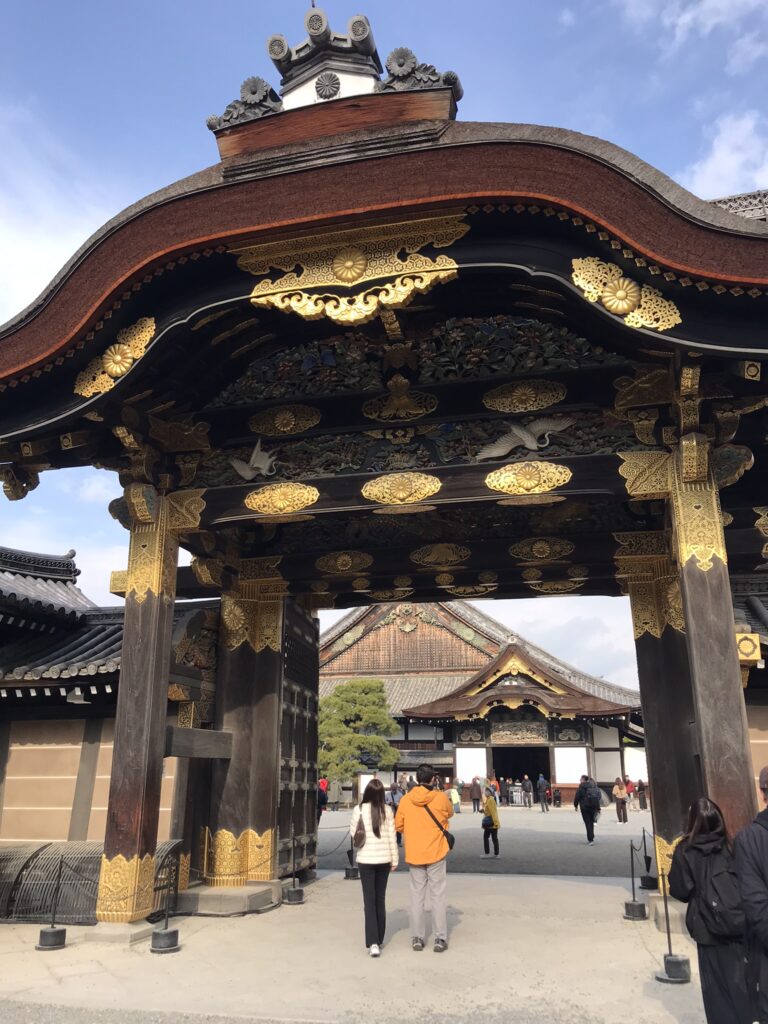
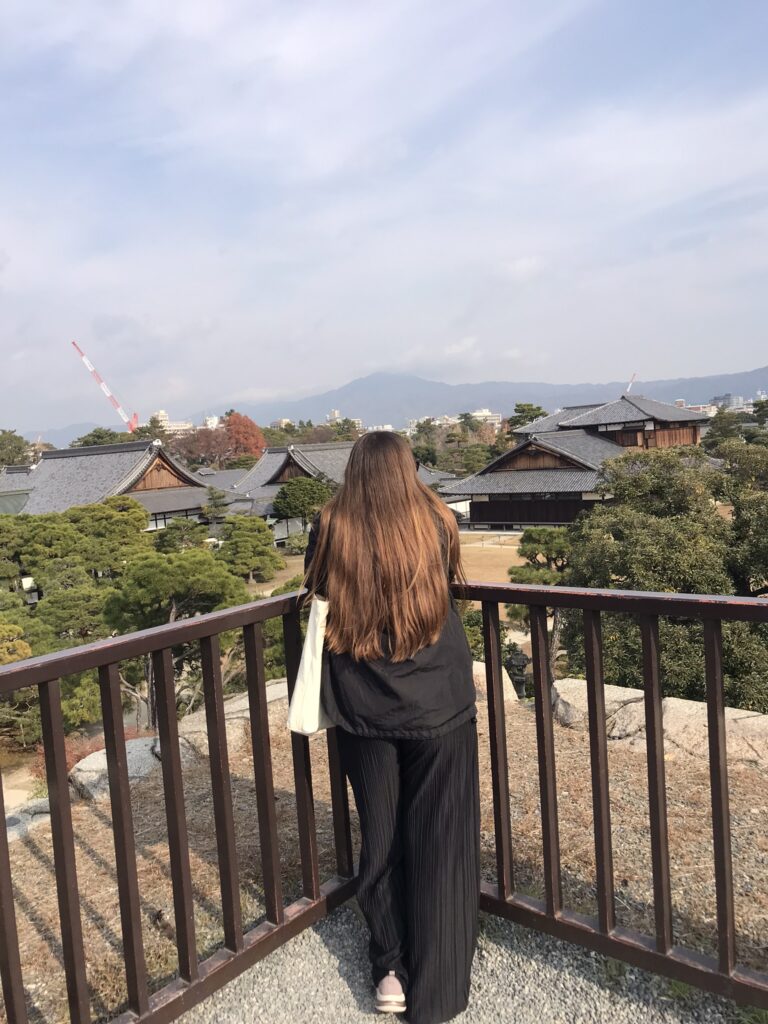
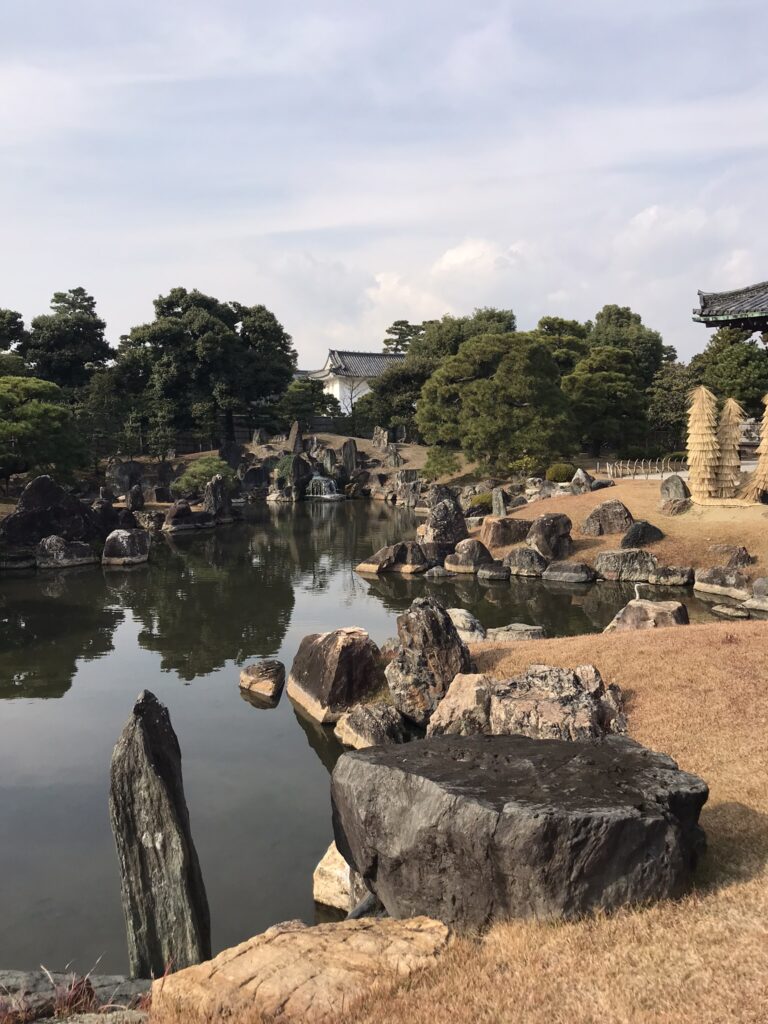
Photos are only allowed outside the Nijo-jo castle buildings
A provided leaflet and extensive information plaques contain plenty of information about the layout and various rooms of the Ninomaru-Goten, so it’s best to explore at your own pace. We saw groups with tour guides being quickly hustled through, which seemed like a shame. By exploring independently we were able to take our time and fully appreciate all of the various intricate nuances and subtleties. As is common practice in Japan, shoes must be removed before entering Ninomaru-Goten and photos are also prohibited inside.
Outside the Ninomaru-Goten Palace is a rock garden dating from the early Edo period – a scenic rockscape featuring symbolic islands within a pond. A vending machine here sells fish food and it’s pretty fun to feed the carp that occupy the inner moat. After crossing the moat, visitors enter the Honmaru Garden which is a more modern creation dating from the period in which the palace was under imperial control. The Honmaru-Goten palace at the centre was moved here from the Imperial Palace grounds in 1893. The keep tower at the corner of the Honmaru Garden can be climbed by visitors and offers expansive views over the castle grounds.
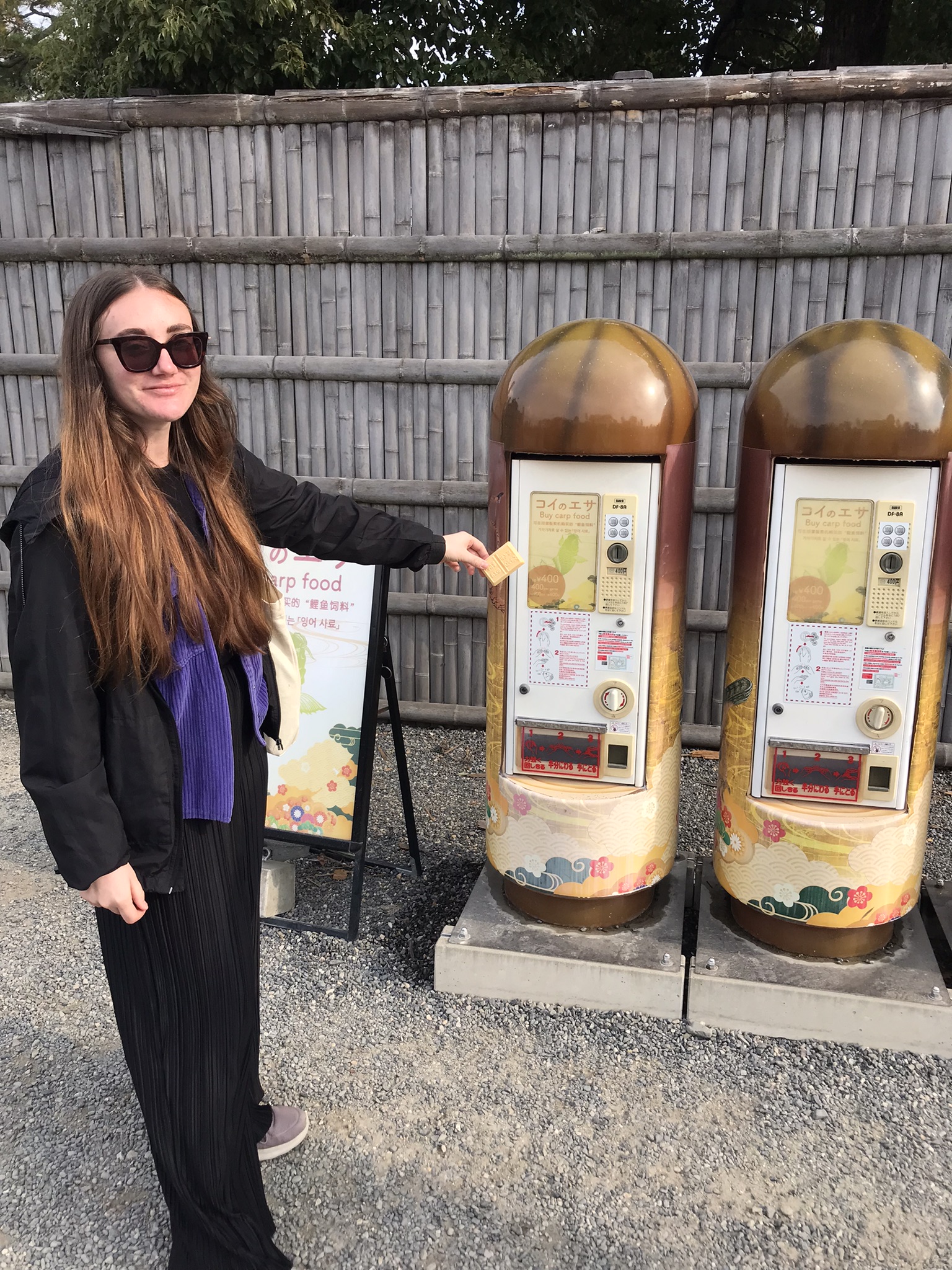
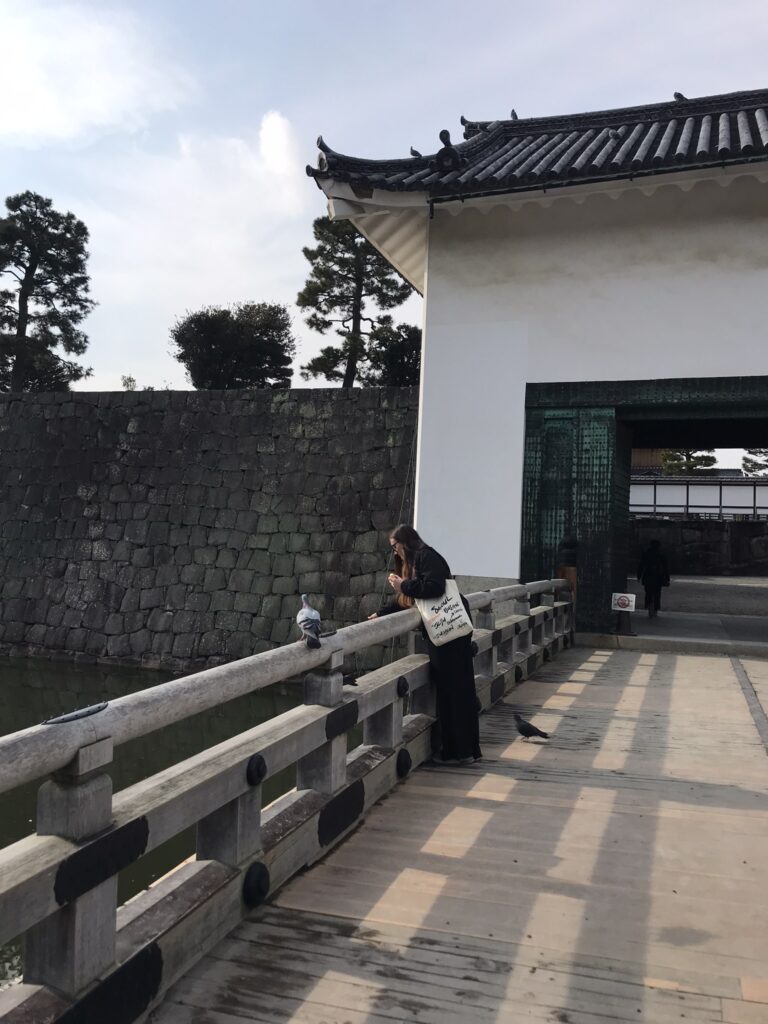
The carp can be pretty fierce when it comes to feeding time at Nijo-jo
After leaving the Honmaru, visitors can amble along the path through the Seiryu-en Garden, which contains a couple of historic teahouses for those who want to try their expensive matcha sets.
Kinkaku-ji – a UNESCO site and one of the most iconic temples within Kyoto, Kinkaku-ji is a Zen temple of the Rinzai Buddhist denomination. The temple is best known for its Golden Pavilion. Built in 1397, this was originally used by the shogun Ashikaga Yoshimitsu as a retirement villa until his death in 1408, before being donated to the Rinzai sect. It’s now one of the most popular and well-known tourist destinations in Kyoto. After paying the small entry fee, tourists are directed along a set route, first taking in the Golden Pavilion before being herded to the secondary Anmin Pond and lastly Fudo-do Hall.
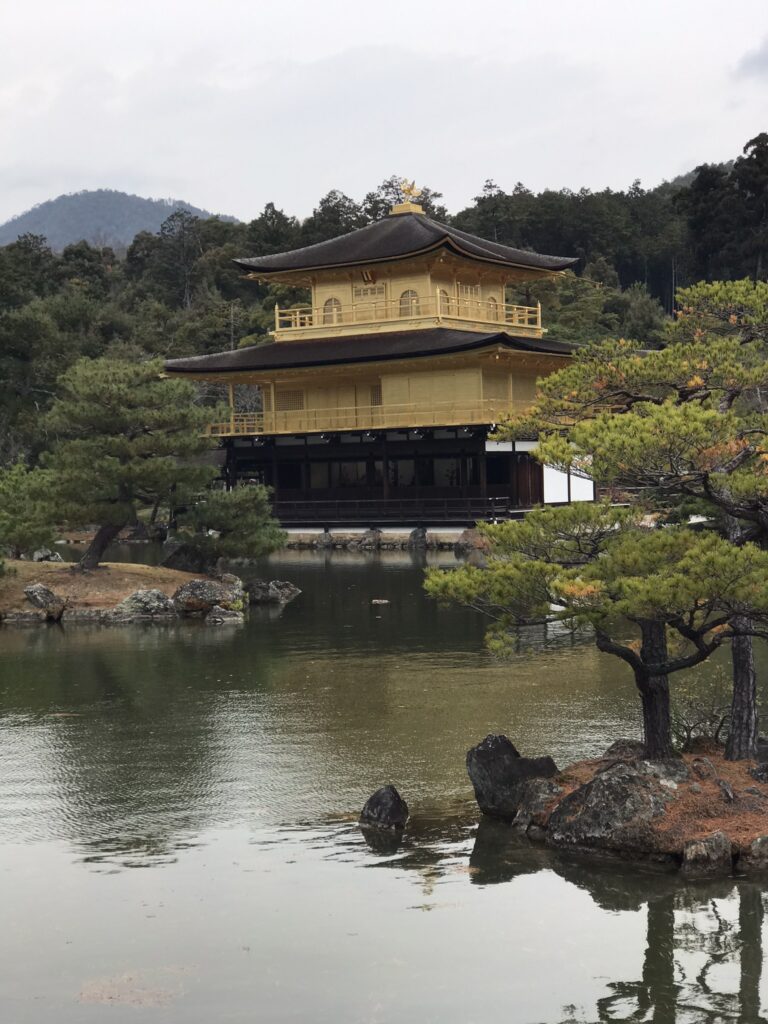
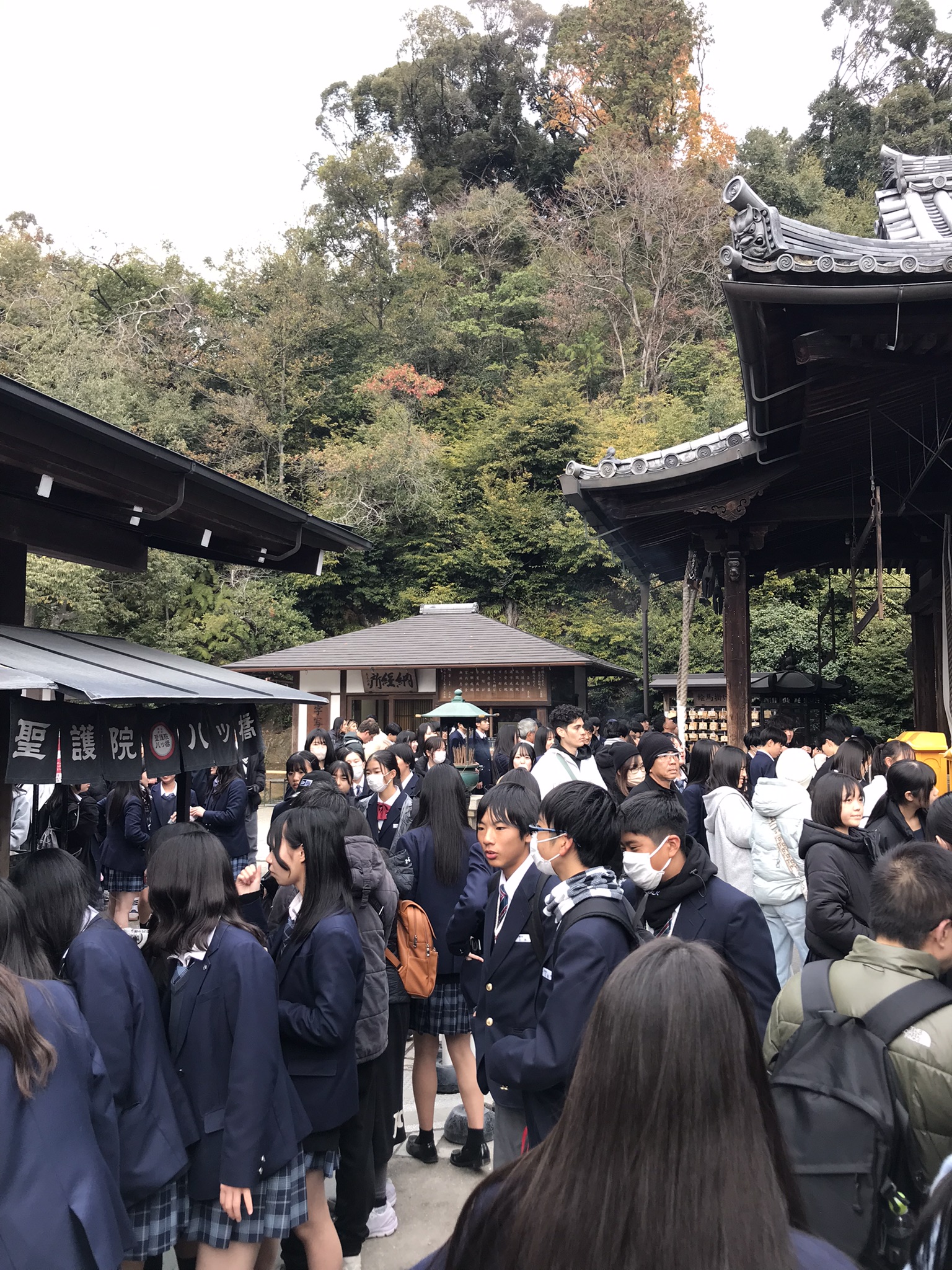
So serene yet teaming with school kids at Kinkaku-ji
We were a little worried about the crowds before visiting. As it was, there weren’t actually too many tourists. The bigger issue here was the constant school groups – there seemed to be a constant flow of coaches bringing literally hundreds upon hundreds of boisterous teenagers who were shepherded around by exasperated teachers and chaperones. Without these enormous school groups the crowds probably would’ve been manageable but as it is the whole thing became a predictable slog, with tourists and teenagers jostling for the best position to snap photos with the dazzling Golden Pavillion encircled by the calm reflective waters of Kyoko pond. The site can get particularly crowded at the entrance as people predictably bunch up, unable to resist taking a photo immediately upon arrival. Despite the heaving crowds, it wasn’t actually too bad in the end – the site is quite spacious and has plenty of good vantage points. Apart from the Golden Pavilion itself, there isn’t a huge amount else to see here so it’s a relatively short activity.
Ryoan-ji – one of Kyoto’s many UNESCO sites, this was originally an aristocrat’s country villa and was converted into a Zen temple of the Rinzai Buddhist sect in 1450. The main focus here is the Zen rock garden – a garden like you’ve never seen before. Considered to be the ultimate example of the ‘dry landscape’ rock garden, this Zen garden contains only 15 rocks, placed amidst white gravel which is raked in clean neat lines. There is a noticeable absence of trees, bodies of water or flowers. Minimalist and thought-provoking, many worshippers (and tourist wannabes) meditate on the veranda overlooking the rock garden. People speculate whether the rocks are supposed to represent islands in the sea or a mother tiger carrying her cubs across a pond. There are also some impressive wall paintings of dragons inside the temple and scenic walking trails along the circumference of the pond.
The rock garden invites viewers to create their own interpretations as to its meaning. Sadly, I don’t think all of the tourists here fully got the memo as there were a couple of people sitting and talking loudly. The rest of the site itself wasn’t too touristy however, with gorgeous and very extensive landscaped gardens surrounding the main building. These seemed far more ‘Zen’ to us than the actual rock garden.
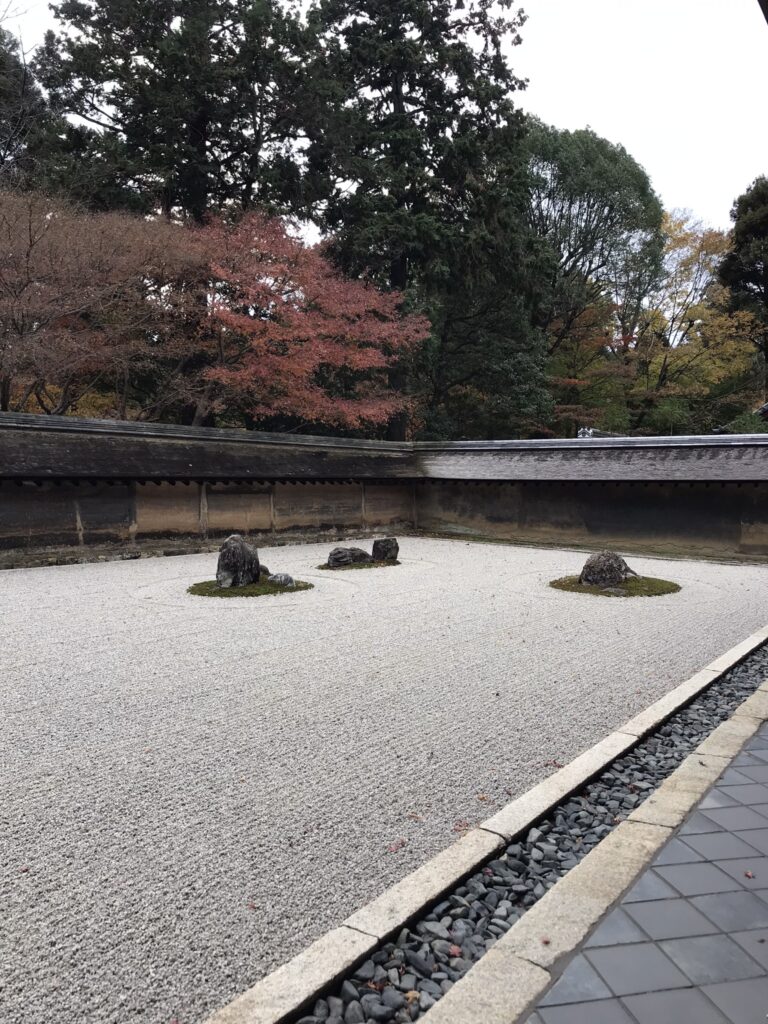
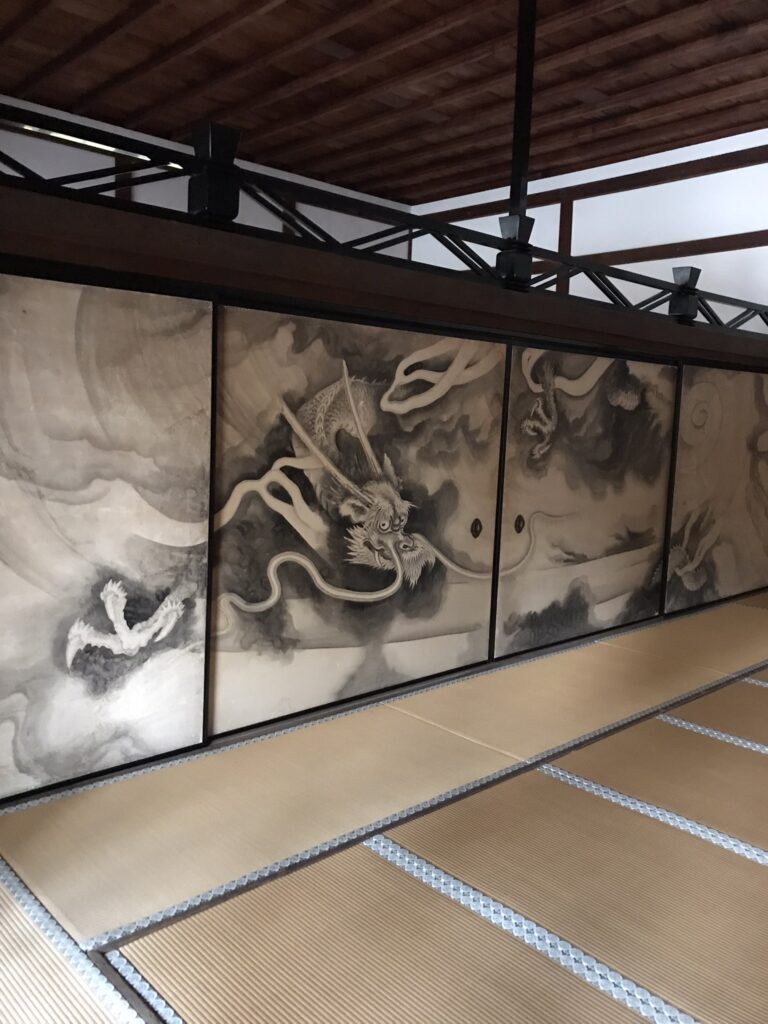
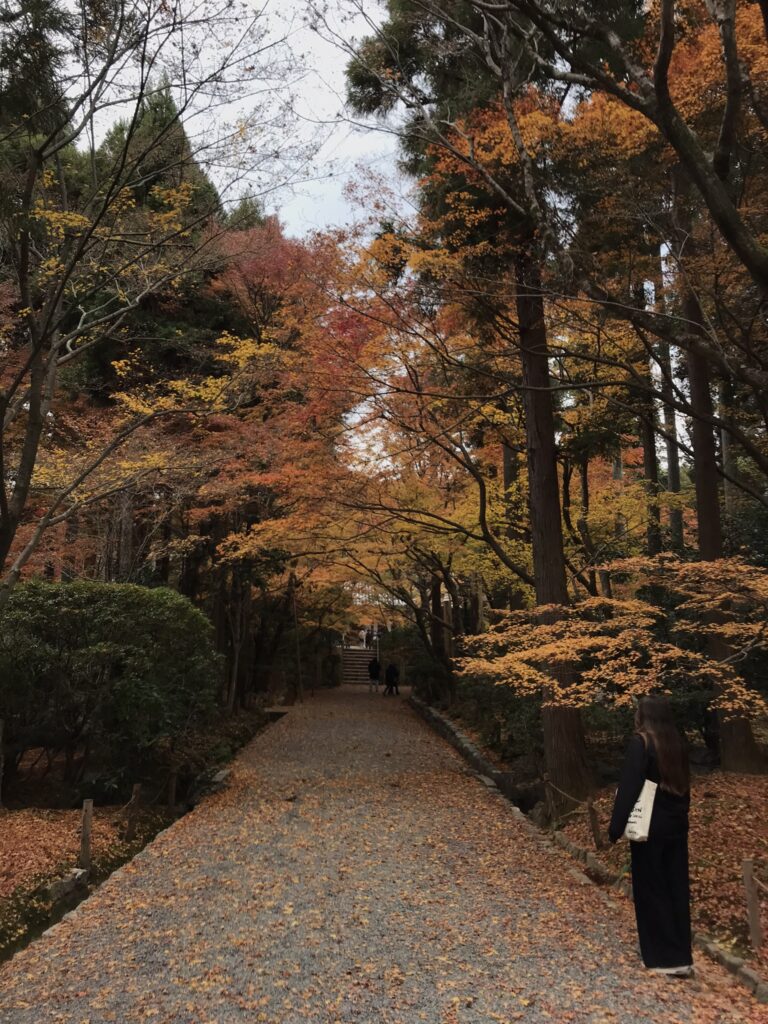
There’s more to Ryoan-ji than just the exquisite Zen Buddhist ‘dry rock’ garden
Ninna-ji Temple – the third UNESCO site within walking distance, we visited Ninna-ji after Ryoan-ji and Kinkaku-ji. A more conventional temple complex dating back to the early Heian period (9th century), we pretty much snuck in here as we entered less than an hour before closing and the ticket counter appeared to have been closed up. Completely unintentionally, we ended up getting in for free and were able to rush around the various structures and get out before the gates were shut. The temple is known for its cherry blossom garden, which was completely bare and looked more like something from a horror movie when we visited in December. There are some impressive structures and pagodas – we weren’t fully able to comprehend their importance and significance as we missed out on the usual leaflet that visitors get on entry.
Kinkaku-ji, Ryoan-ji and Ninna-ji are all situated within close proximity to one another and therefore it is ideal to walk from one to the next. It’s easy to access both Kinkaku-ji and Ninna-ji by bus from the city centre.
Nishiki Market – this famous covered shopping arcade offers eager tourists the opportunity to pick up unique souvenirs and try tasty seafood delights alongside tiny morsels of Kobe beef. There are also some slightly more bizarre options too. We didn’t buy anything in this touristy market but some of the most memorable cuisines that we spotted were ‘pickle on a stick’, cherry blossom tea and the notoriously grotesque baby octopus with an egg in its head. The latter we found to be distasteful and frankly quite off-putting. Keep an eye out for a grey torii gate near the eastern end of the market which predates the nearby buildings, they literally had to be built around it. We also spotted a micro-pig cafe here, amongst other things.
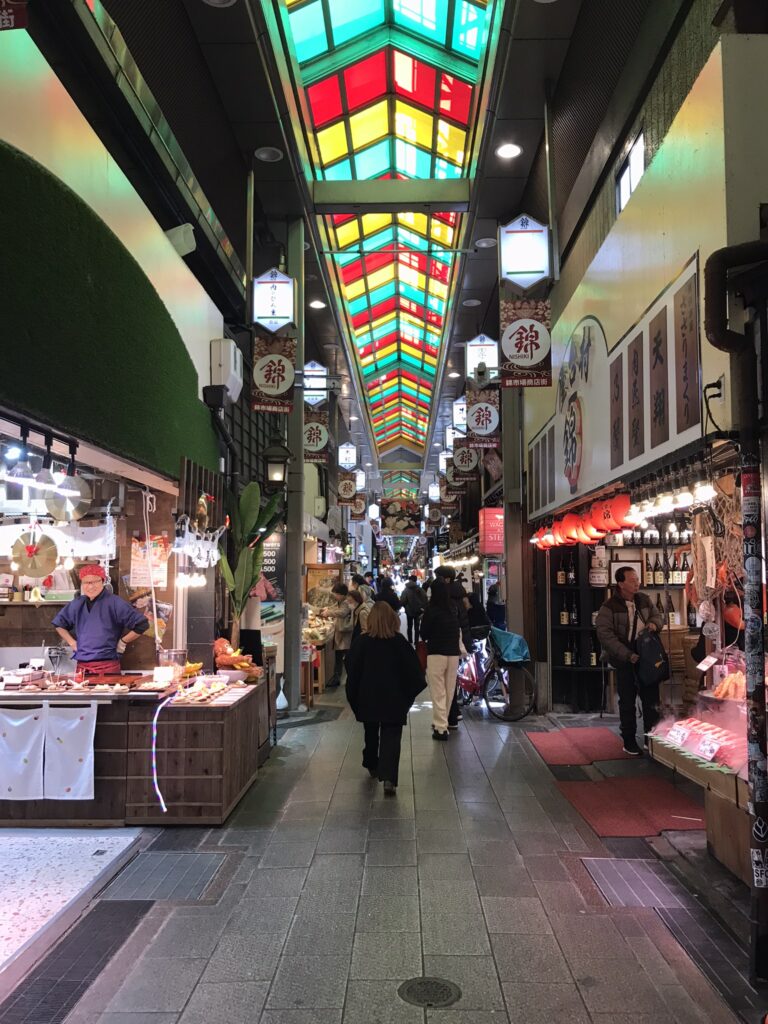
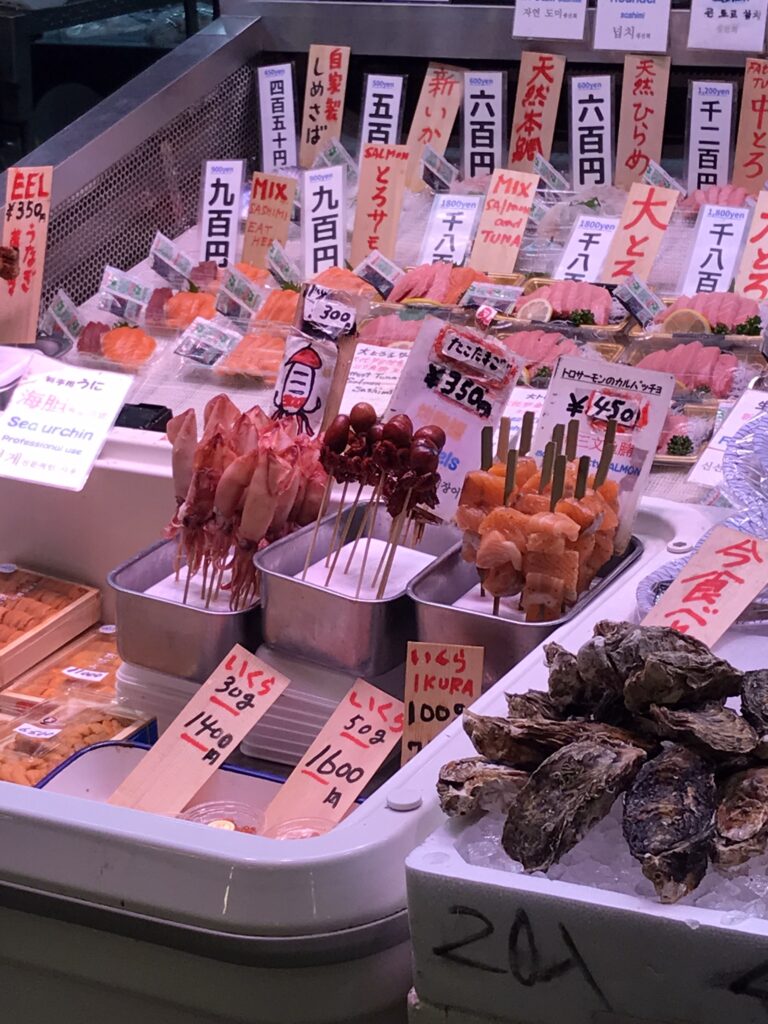
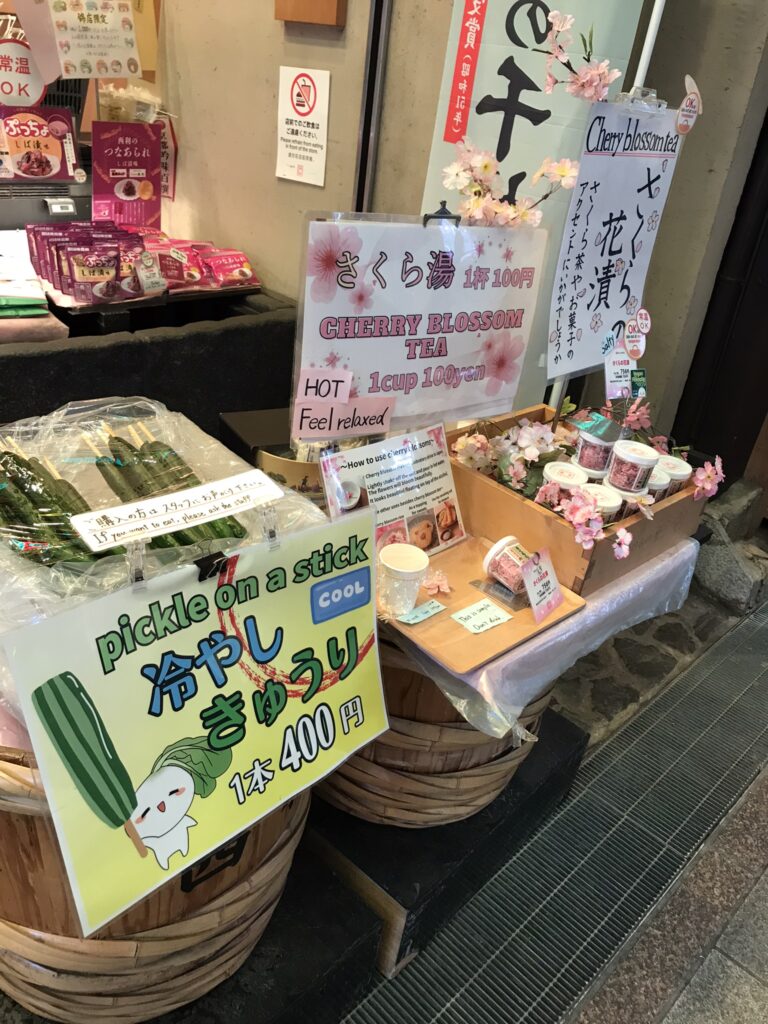
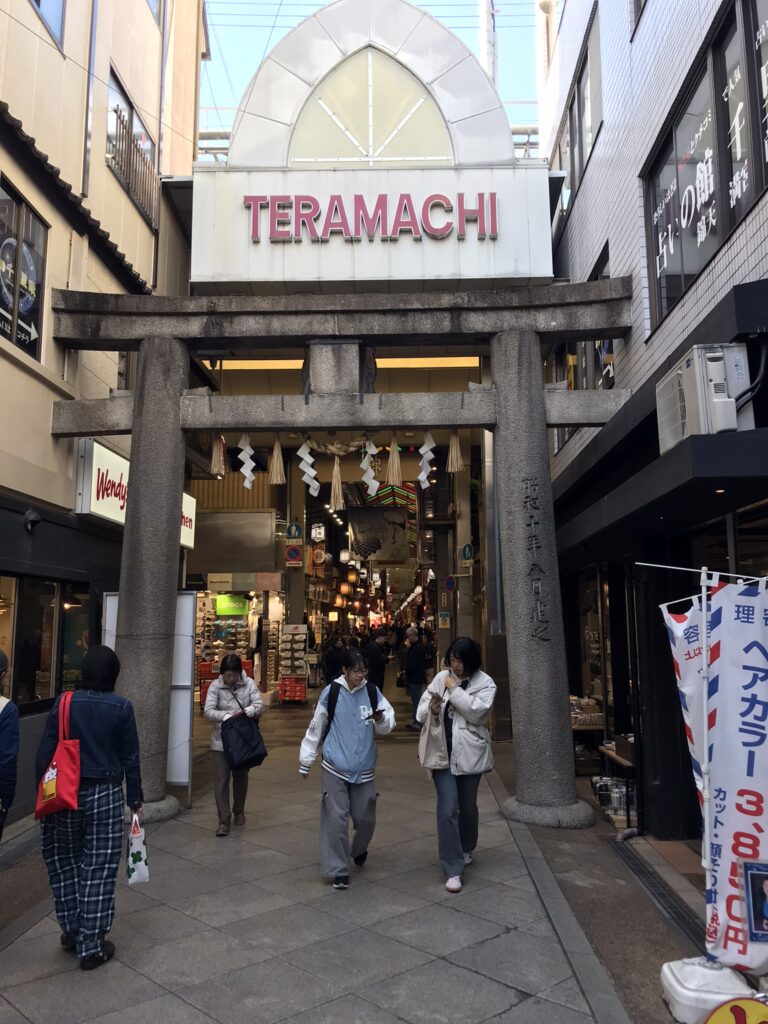
Nishiki Market has many wonderful and wacky edible treats and souvenirs
Pontocho-dori Street – one of Kyoto’s two hanamachi or geisha districts, this is a 500m narrow alleyway running directly parallel to the Kamo river. Many historic teahouses, upmarket restaurants and snazzy bars now call this street home. It’s said to be a great place for roof-top dining in summer as many of the establishments overlook the river. A common feature of the street is the slatted windows on many of the establishments which protect the privacy of the patrons inside. As it’s a Kyoto pleasure district, real-life geisha (geiko and maiko) may make an appearance from time to time. Please be respectful towards these ladies if you spot them, as reports of bad behaviour by tourists is common. Things to be avoided are invading their space, blocking their path, inundating them with unwanted attention and taking photos without permission. Some tourists almost act like they’re on safari. Police have now started issuing fines to the worst offenders of this type of behaviour and there are signs to that effect in both of Kyoto’s geisha districts.
Geiko and maiko hold cultural significance within Japanese society, symbolic of the past and a tradition that endures to this day. Although their numbers are steadily waning, some still serve drinks to patrons in ultra-exclusive clubs. Members have to be born into these establishments or invited – FYI, you’re unlikely to get an invite to any of the clubs. There are sometimes geisha performances at expensive hotels, and cultural events like those held at Gion Corner which non-Japanese can attend. We managed to catch a glimpse of two maikos (trainee geisha) making their way from one appointment to another. Sometimes it can be difficult to tell the real geiko from the Japanese tourists (who often dress up in a kimono for fun and walk around in full traditional dress), but you will know when you see them.
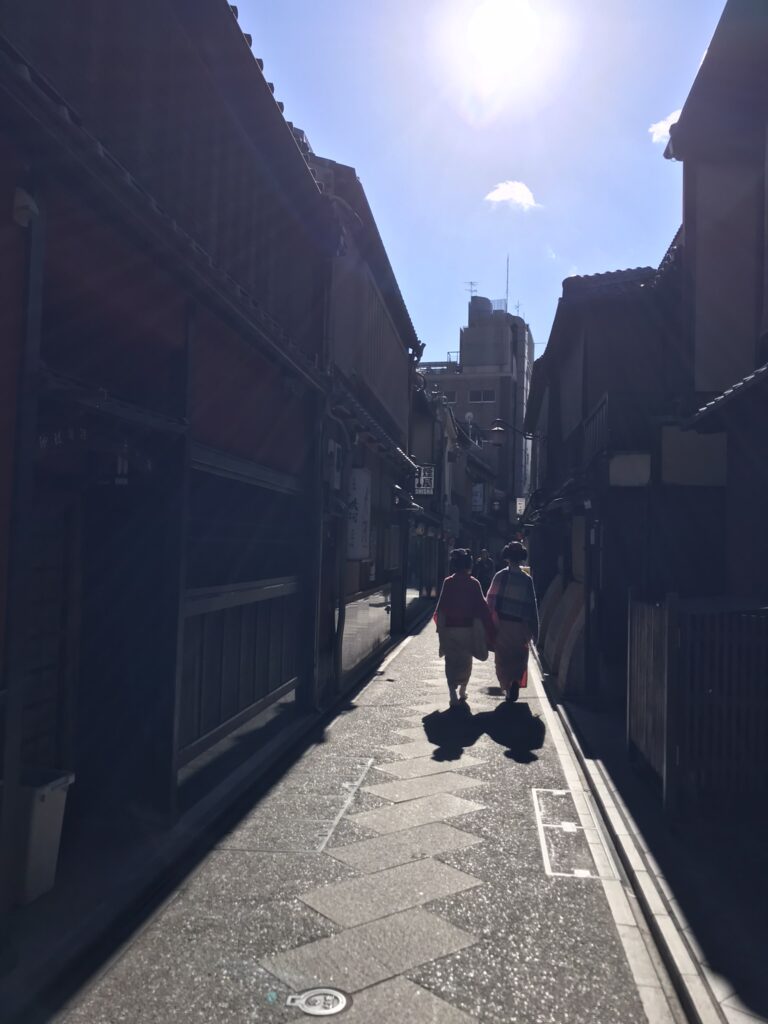
You’ll know if you spot a real maiko or geiko like these ladies on Pontocho-dori Street
Statue of Izumo-no-Okuni – a striking statue of a Japanese lady holding a sword and fan which is located close to Gion-Shijo station. This statue provides a visual illustration of the fascinating story of how kabuki came into being. Izumo-no-Okuni is said to be the founder of kabuki, gaining fame in Kyoto for her dramatic performances in men’s clothing alongside her female dance troupe. Her popularity led to a moral panic amongst the ruling class and the eventual banning of women from acting in kabuki during the early Edo period. This led to the development of the iconic onna-gata role (men playing women), resulting in the style of kabuki as it is today.
Original Headquarters of Nintendo (Marufukuro) – located just across the bridge from Shichijo metro station, this little-known site is the original office and headquarters of Nintendo, which was founded here in 1889 as a playing card company. A place of pilgrimage for loyal fans of Mario, Zelda, Donkey Kong, Kirby and the rest, the building is now a hotel and entry is not permitted for those that are not staying there. A plaque outside commemorates the building’s history. Nintendo is still based in Kyoto – its headquarters are now in a distinctive building just south of Kyoto station.
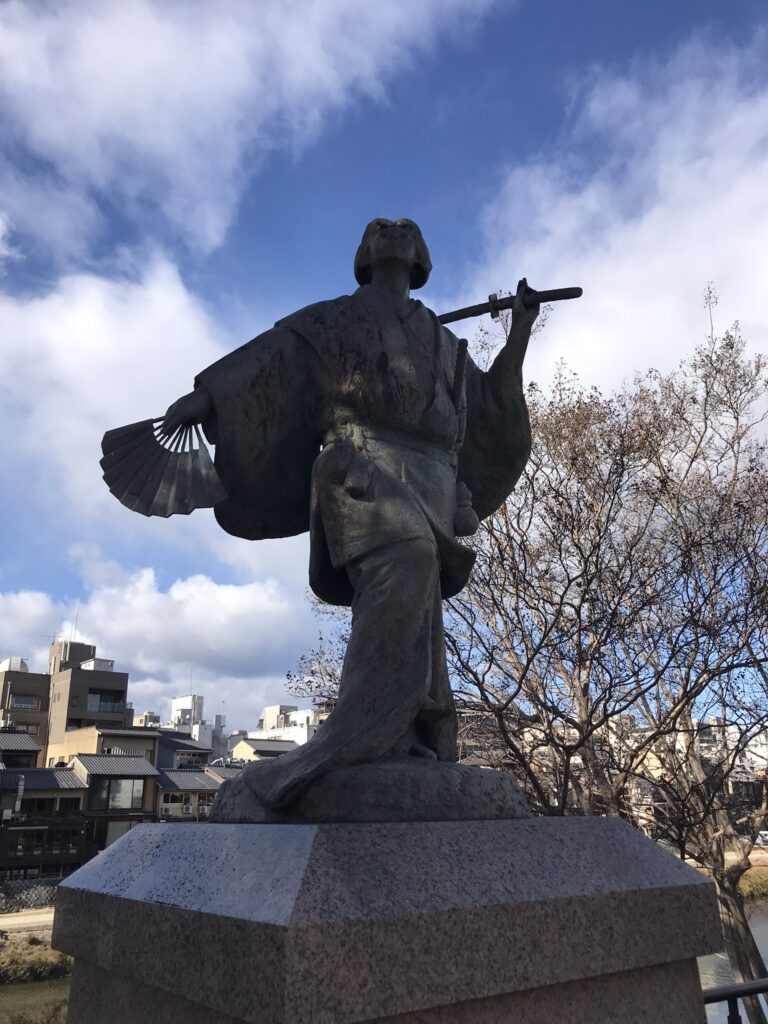
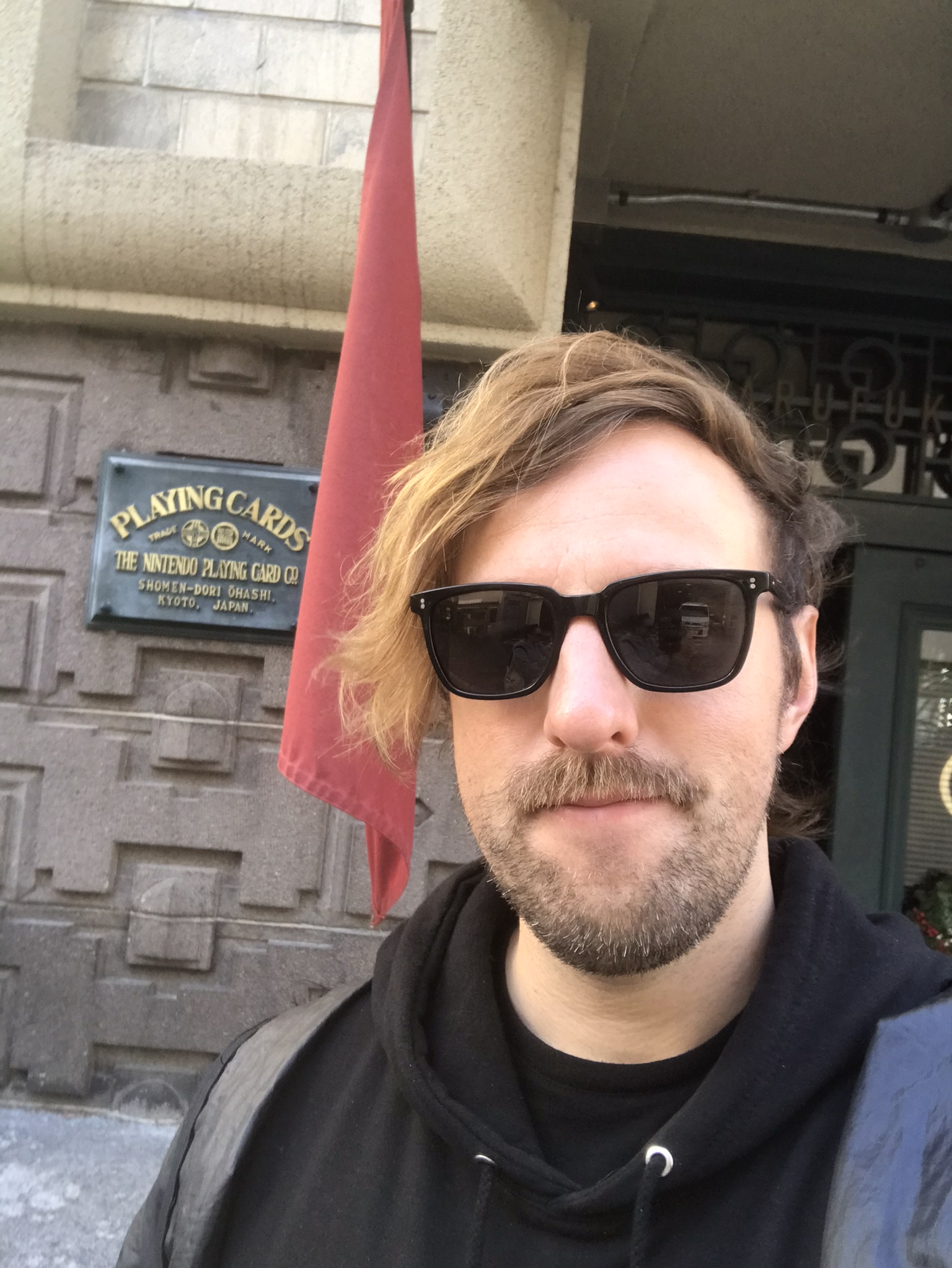
Some of the lesser known sights in Kyoto are well-worth visiting
Hokokubyo (Mausoleum of Toyotomi Hideyoshi) – after Toyotomi Hideyoshi (the great unifier of Japan) passed away in 1598, his mausoleum was erected on Amidagamine Mountain on the outskirts of Kyoto. Once the Toyotomi clan was finally vanquished by Tokugawa Ieyasu in 1615, the shrine was demolished. Centuries later, the Meiji Restoration saw the resurrection of the mausoleum, just in time for the 300th anniversary of Toyotomi Hideyoshi’s demise. Having stood on the mountaintop since then, this place seems to be absent from typical tourist itineraries and unknown by most visitors to Kyoto.
There are over 500 steps up the mountain to reach the mausoleum – not to be underestimated on a hot summer’s day. There are some warning signs about monkeys too, although we didn’t encounter any. This silent retreat offers magnificent views over the city plateau below. Barely another soul was present at the top besides us. It was quite bizarre to be all alone at the mausoleum of one of Japan’s most famous and consequential historical figures. The mausoleum also overlooks the much more popular and touristy Kiyomizu-dera temple. The admission fee is very low, and we found it to be much cheaper and more worthwhile than other attractions.
Nearby Kyoto National Museum was sadly closed when we visited – otherwise we would’ve combined the two.
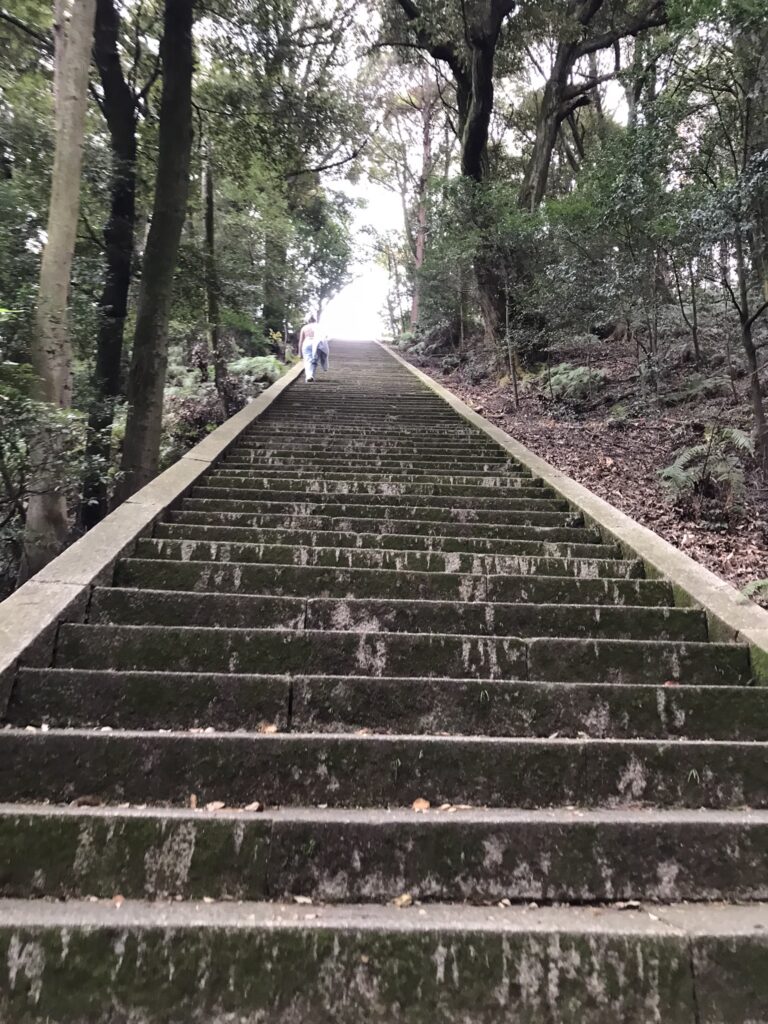
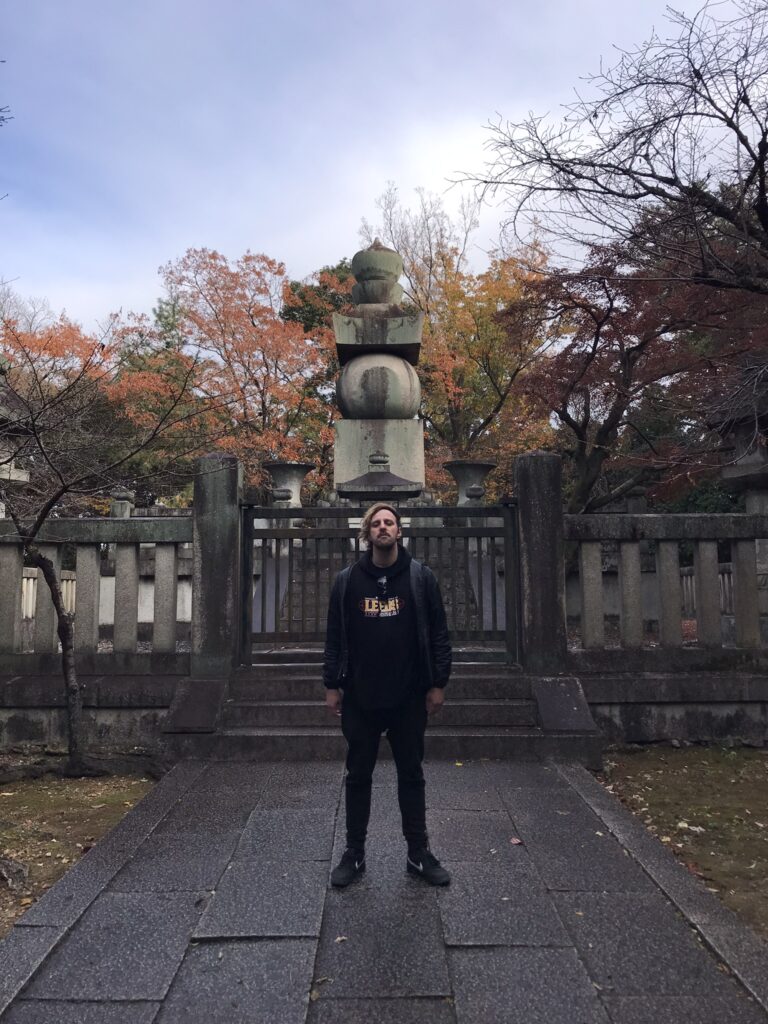
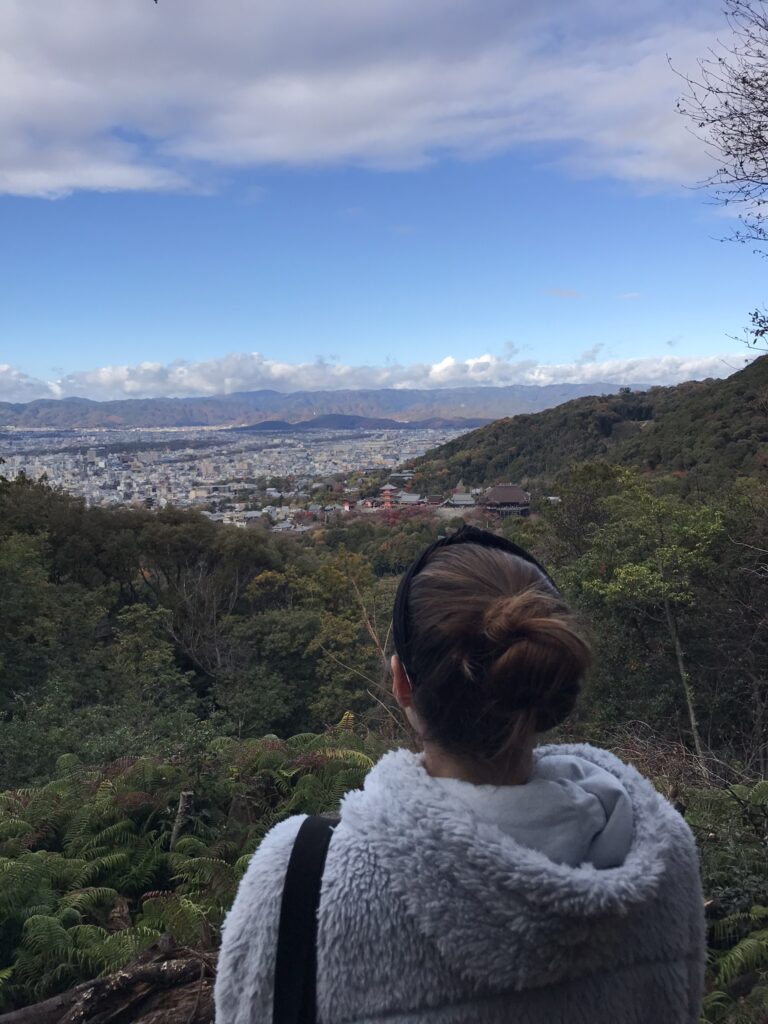
Skip the crowds at Kiyomizu-dera and get an aerial view from Hokokubyo
Kiyomizu-dera Temple – one of the most celebrated temples in Kyoto and, as predicted, brimming with tourist hordes. The temple is perched atop a small mountain, with the mountainside location said to offer commanding views over the city below. We walked here after visiting the mausoleum of Toyotomi Hideyoshi and opted to just meander around the courtyard below the paid admission section, as did seemingly many hundreds of other visitors. The surrounding streets were teeming with sightseers, shopping enthusiasts and culture-seekers; at points they were almost impassable with people surging in all directions.
Ninnenzaka and Sannenzaka – one of the most photographed areas of the city, these shopping streets are located on the route up to Kiyomizu-dera. Machiya houses crowd the streets, offering pottery workshops, artisan shops, traditional tea houses and sweet shops. Even Starbucks is housed in a wooden machiya dwelling in the area.
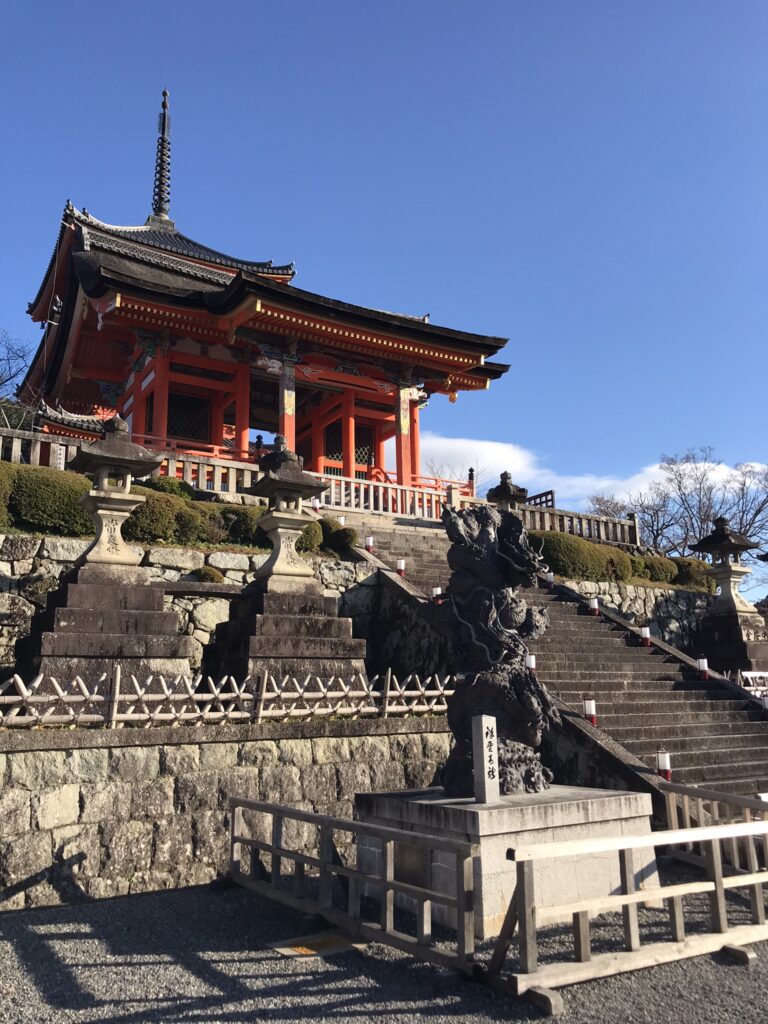
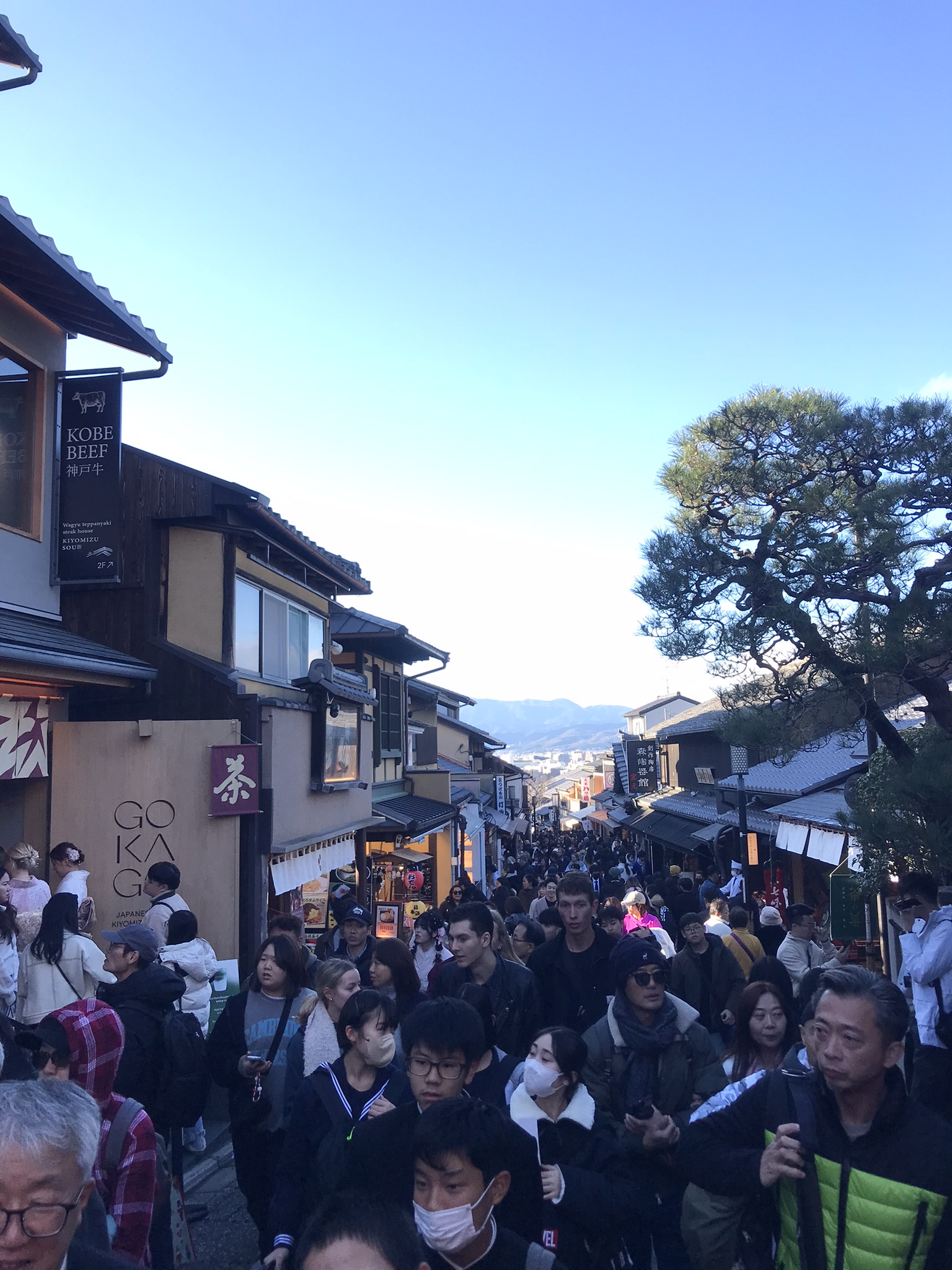
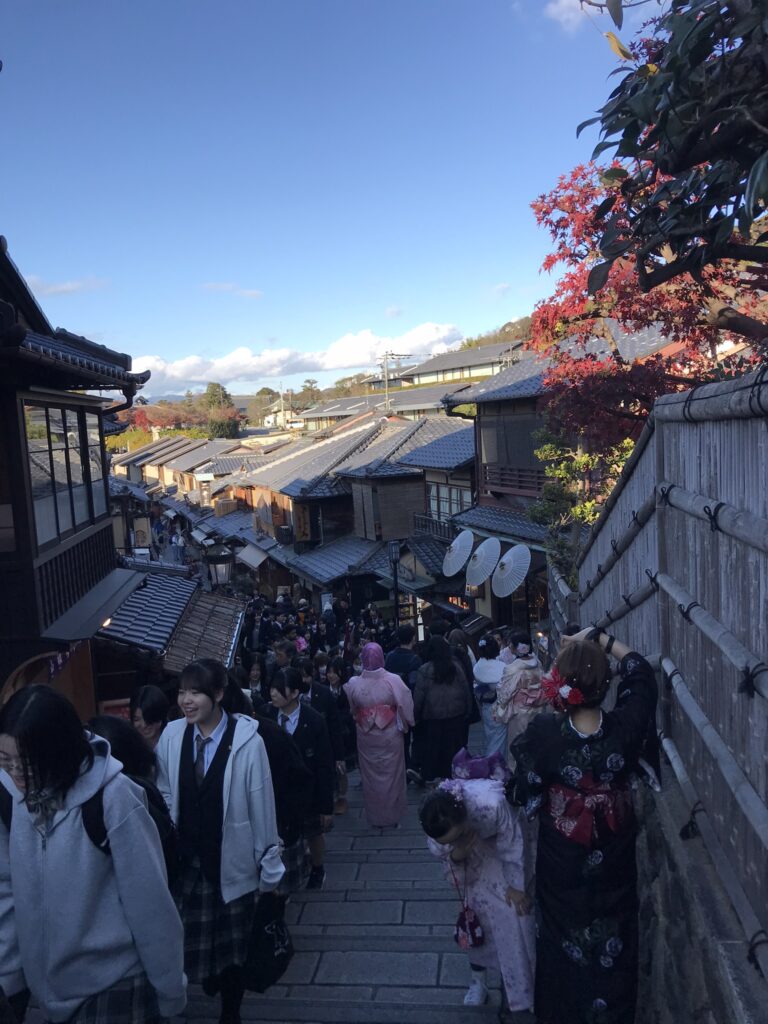
The areas around Kiyomizu-dera (especially Ninnenzaka and Sannenzaka streets) can be super busy
Yasaka Koshin-do Temple (monkey balls) – a memorable shrine in the Higashiyama district. The colourful balls adorning the shrine are said to represent monkeys with bound feet and hands, symbolising control over negative desires (which monkeys often are associated with). Devotees wish away a sin by dedicating a monkey ball at this shrine.
Hokan-ji (Yasaka Pagoda) – an iconic landmark near to the monkey ball shrine. This large pagoda is particularly stunning at sunset.
Rokudo Chinno-ji (gateway to hell) – this small temple complex is located within walking distance of Yakasa Shrine and contains a dark and mysterious secret. Have a peek through the grate in the door at the far end of the complex to catch a glimpse of the well that locals claim to be a gateway to hell.
Minatoya Yurei Kosodateame Honpu (haunted bakery) – according to legend, 400 years ago this candy shop was visited by a ghost who purchased candy every night for 6 nights, before being chased away and followed by the owner on the 7th night. She led the owner to the cemetery and a freshly dug grave, from which a baby was heard crying. Apparently the ghost was the deceased mother, who had been bringing the candy for the living baby. Afterwards the child was brought up and became the head priest. Spooky huh! You can still purchase some ‘ghost childcare candy’ from this same historic establishment.
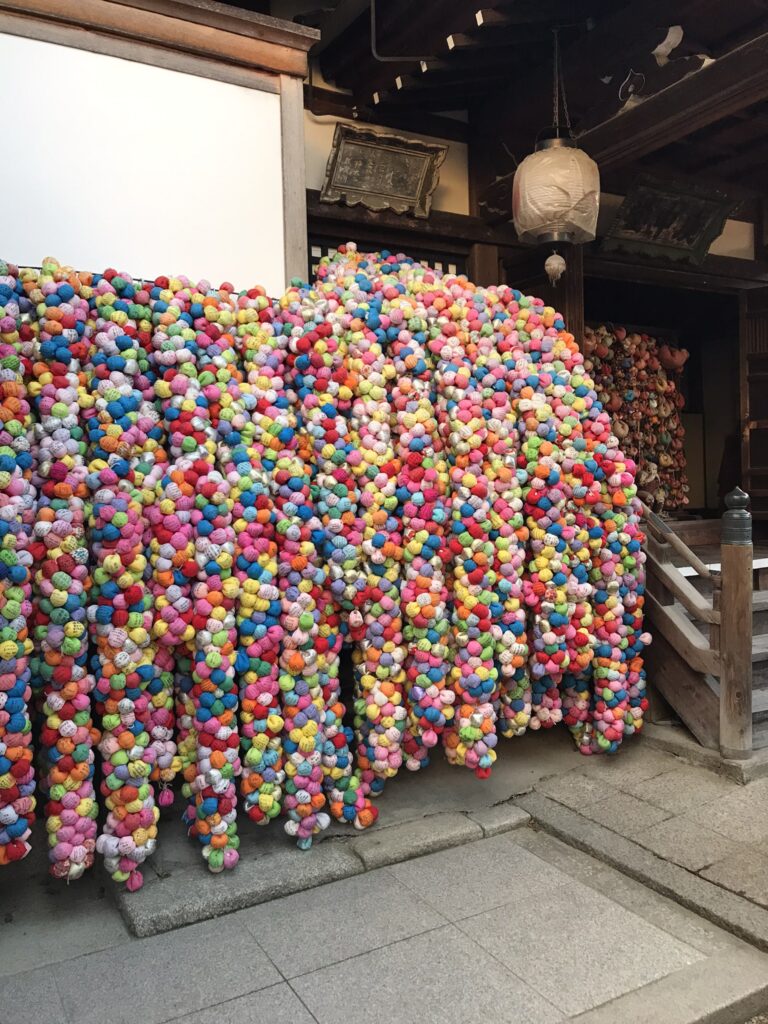
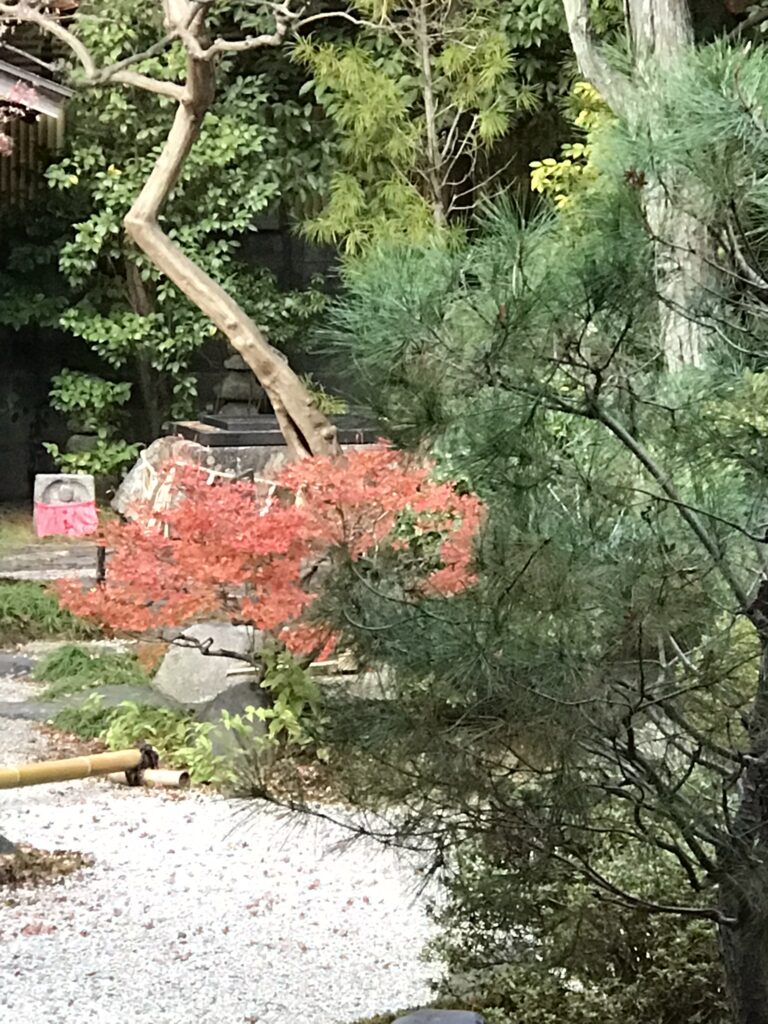
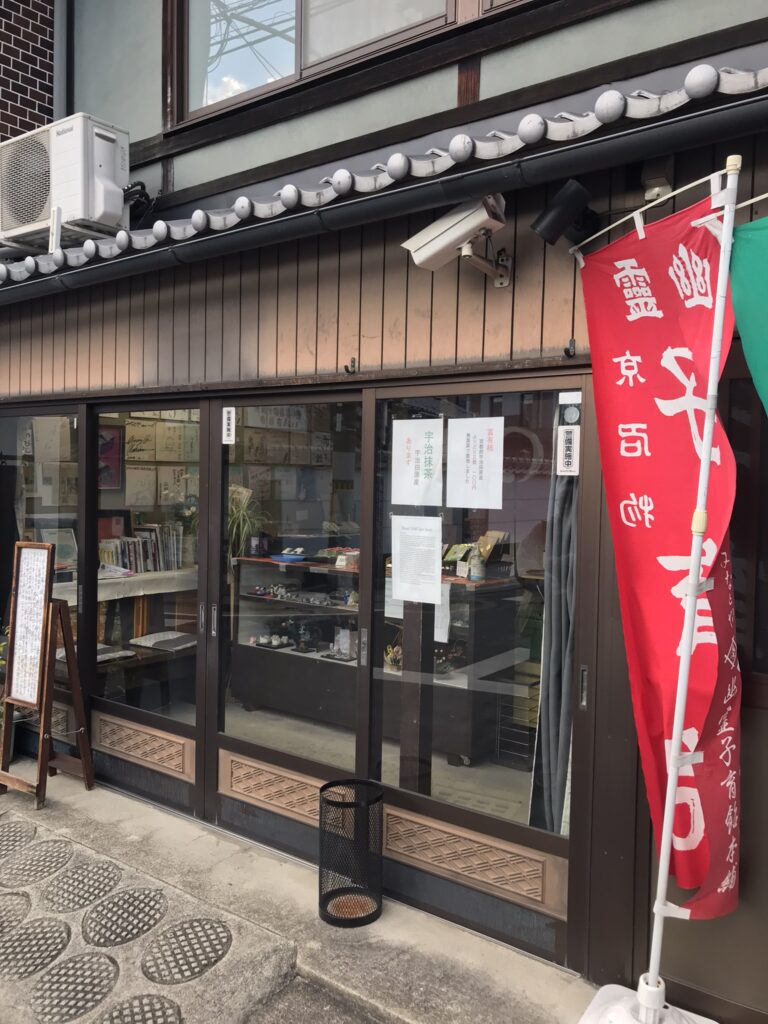
The monkey balls at Yasaka Koshin-do, the ‘gateway to hell’ well and a haunted bakery are all located in close proximity to one another
Yasaka Shrine – this shrine complex near to Gion district is best known as the location of the Gion Matsuri festival, a huge parade which takes place every July. Other than that, it’s a fairly standard large shrine. The wall of white lantern is particularly atmospheric after dark, and we also admired the smoke-puffing dragon statue.
Gion district – this is Kyoto’s historic geisha district. We followed a GPSmyCity self-guided walking tour here: top sites are Shirakawa Lane, Minamiza Kabuki Theatre, Gion Corner and Ichiriki tea house.
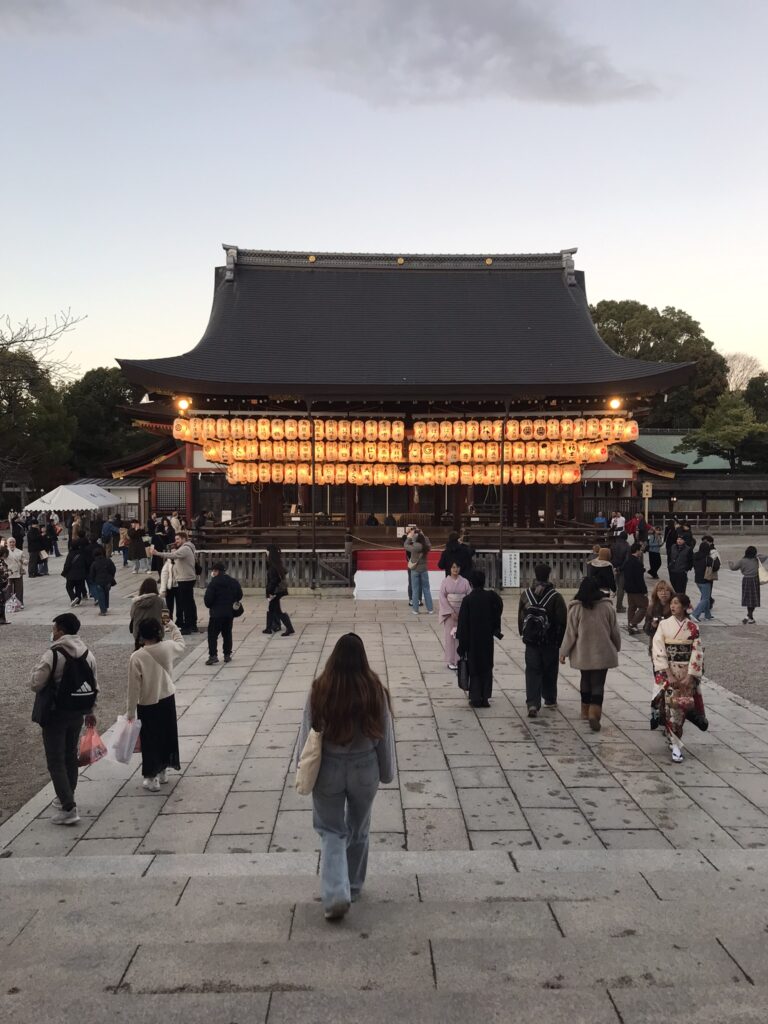
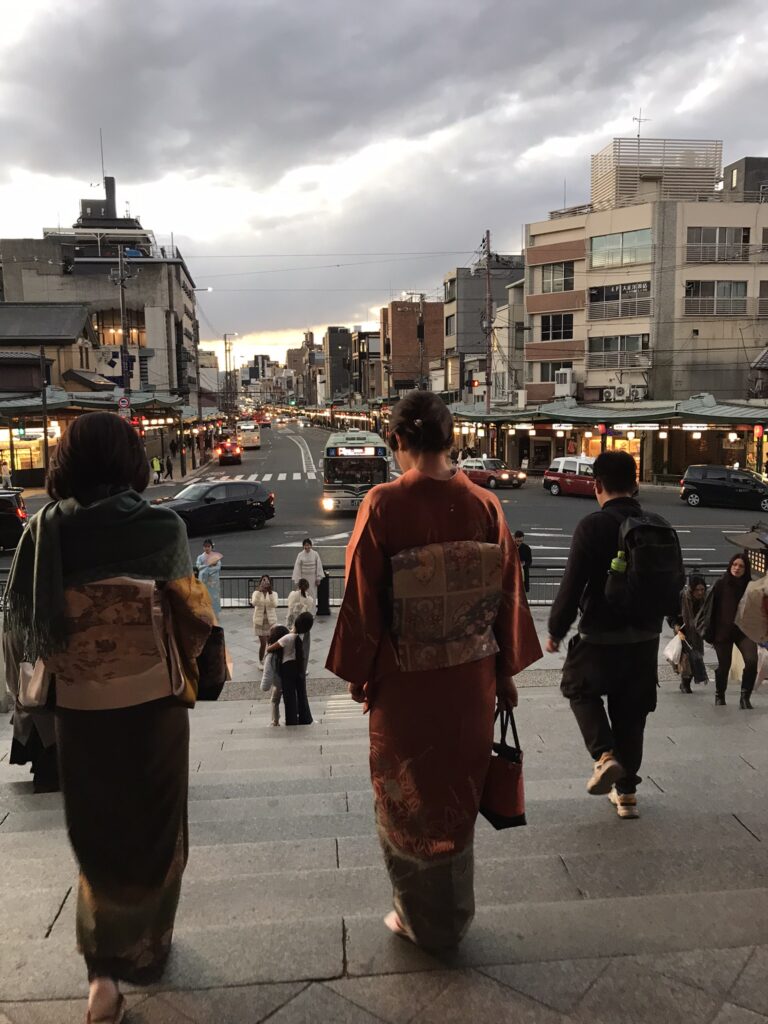
Yasaka Shrine is right next to the Gion district
Kyoto Pokémon Centre – a heaven for Pokemaniacs, this huge gift shop has an impressive array of plushies (including many obscure first-generation Pokémon like Tangela and Pinsir) alongside all sorts of other Pokémon memorabilia, stationary, bags and other accessories. They also had the famous Pikachu in a kimono – surely a must-have gift for Pikachu fans. We appreciated the very warm welcome from the friendly and enthusiastic greeter at the entrance here.
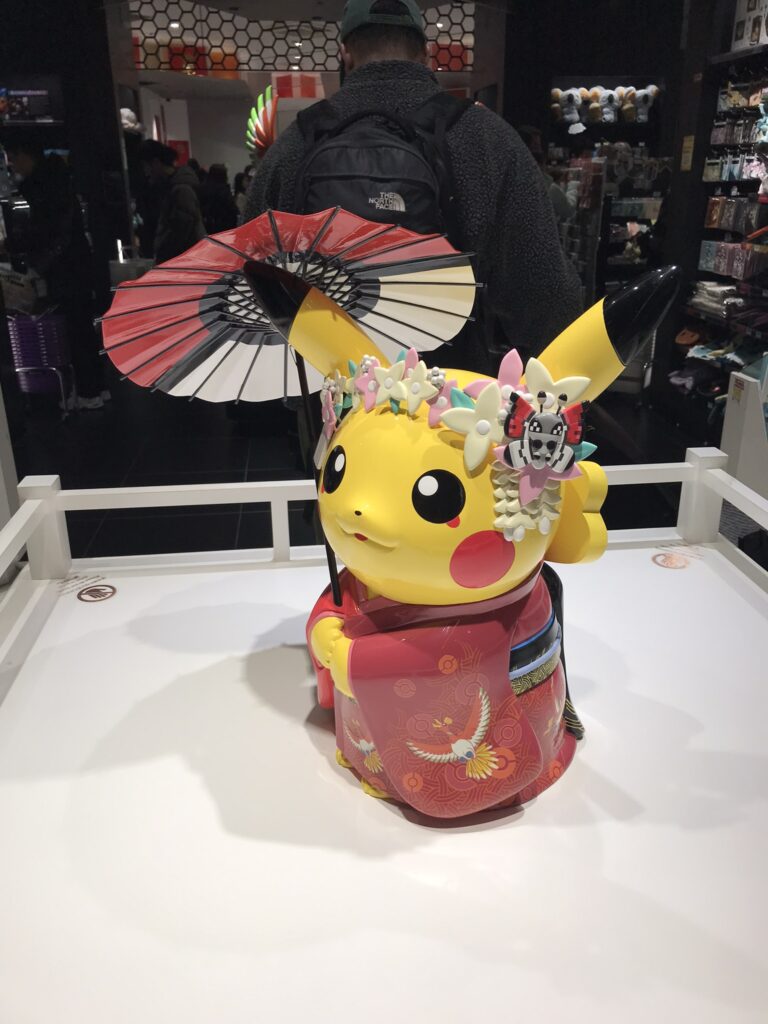
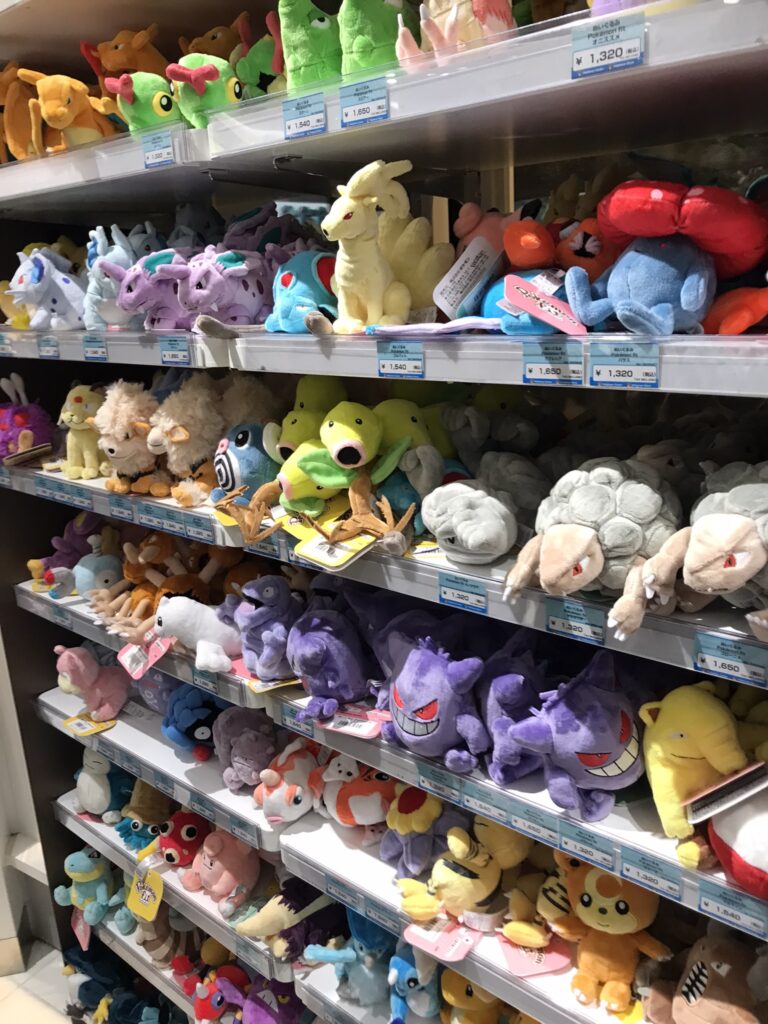
Nothing is more representative of Japan than Pikachu in a kimono at the Pokemon Centre
Yakuso-Jinshi Hippocratic Shrine – an illustration of the ‘8 million gods’ concept of Shintoism, this medical-themed shrine is dedicated to the legendary Greek doctor and philosopher Hippocrates and also contains some quite scary-looking figurines representing traditional gods associated with traditional Eastern medicine.
Go’o Shrine (wild boar) – the story goes that during the 8th century, a man called Wake no Kiyomaru was on his way into exile when he was ambushed and attacked by enemies. His leg was injured, but 300 wild boars appeared to save the day. This shrine is dedicated to this incident. Today, the shrine is popular with people who are looking to recover from leg injuries. It was quite strange to visit a place with so many depictions of wild boars. A very unique shrine which is located next to the Imperial Palace gardens.
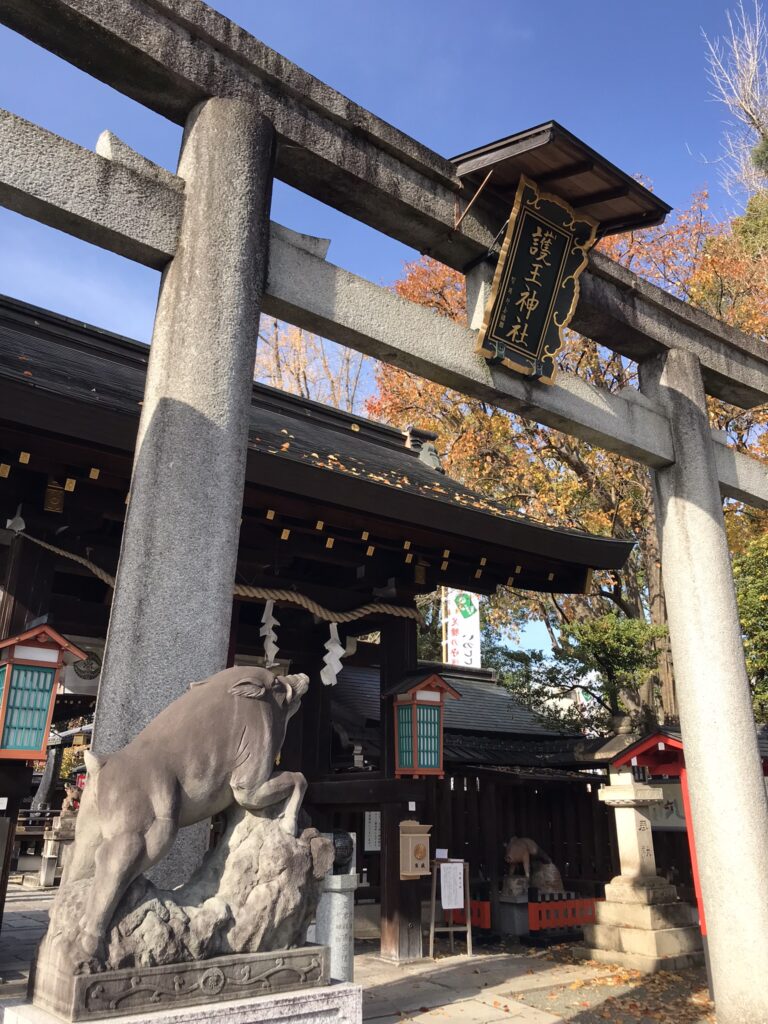
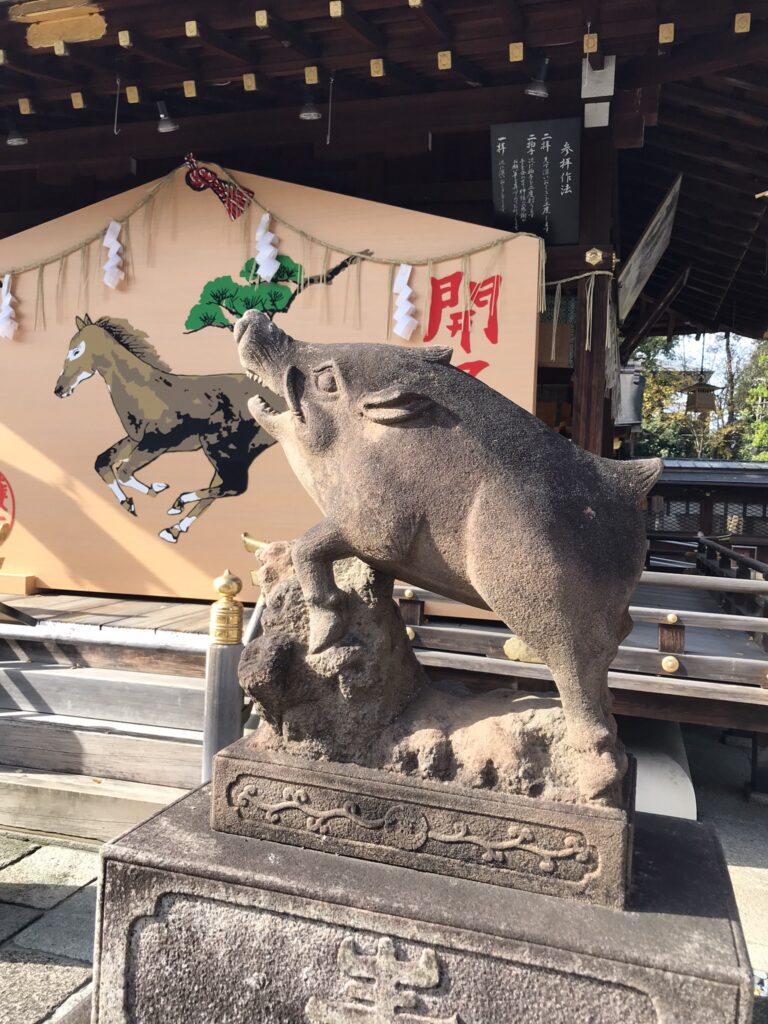
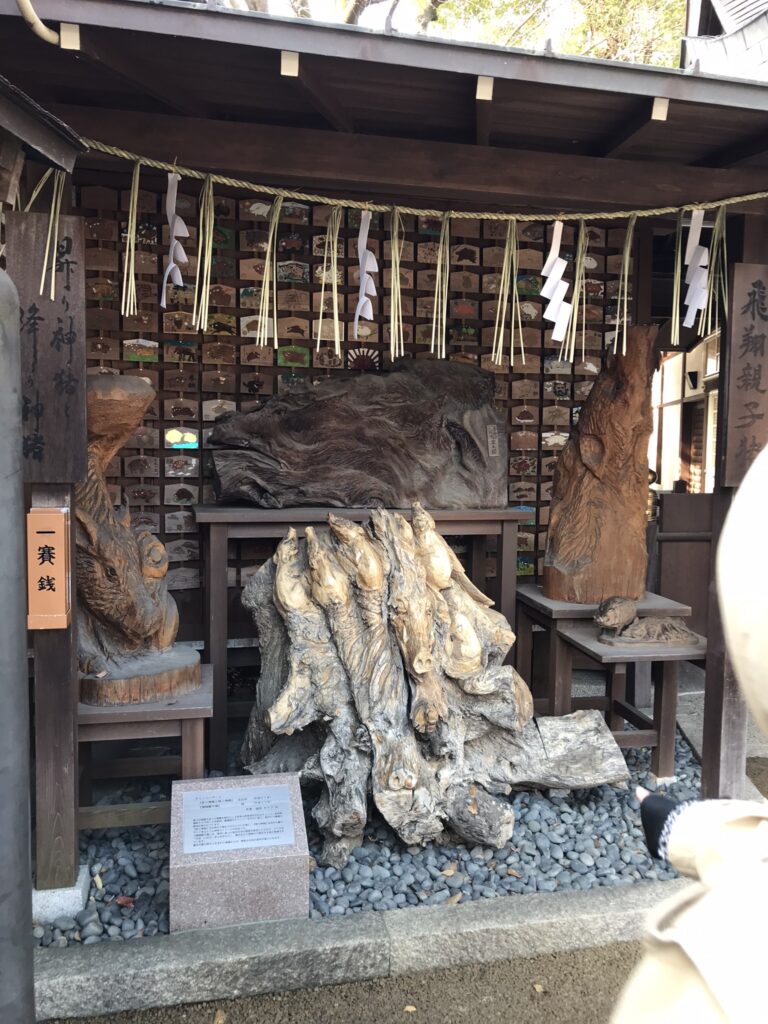
This shrine dedicated to wild boars is right next to the Imperial Palace grounds
Kyoto Gyoen National Garden & Imperial Palace – the grounds of the historic Imperial Palace, prior to the Meiji Restoration this was a bustling complex filled with luxurious residences of nobility. All that exists now within the large and prestigious park is the Imperial Palace complex itself, as well as the State Guest House (a modern construction which is used to host foreign dignitaries and officials) and the complex which used to house the Sento Palace, which was once a palace for retired emperors until it was destroyed by fire. The Sento Palace grounds also contain the now-reconstructed Omiya Palace – formerly a palace belonging to the Empress dowager, this is now used as a lodging for the imperial family in Kyoto.
Of these structures, visitors can enter the Imperial Palace complex without prior booking. Entry is free, although visitors are required to submit to a bag search before entering and wear a lanyard while inside. It’s then possible to freely walk around and explore the outside of the historic structure, which was the official residence of the Emperor of Japan until the imperial capital was moved to Tokyo following the Meiji Restoration in the 1860s. This is the location where the Emperor Meiji proclaimed the Charter Oath, essentially the first constitution of modern Japan – a pivotal moment in the country’s history. It was also the location of deliberations on what to do with the deposed shogun following the return of imperial rule. We found the various waiting rooms within the complex to be quite interesting – the different rooms indicated the hierarchy and status of visiting officials, right down to the colour of the tatami mats.
The palace continued to be used for imperial coronations following the move of the capital to Tokyo. Three Emperors were crowned here – Meiji, Taisho and Showa (Hirohito). As well as the historic buildings, the complex also contains a visitors centre with lockers and free wifi. We were surprised at how few tourists were inside, considering the complex’s historical value and also the fact that entry is free.
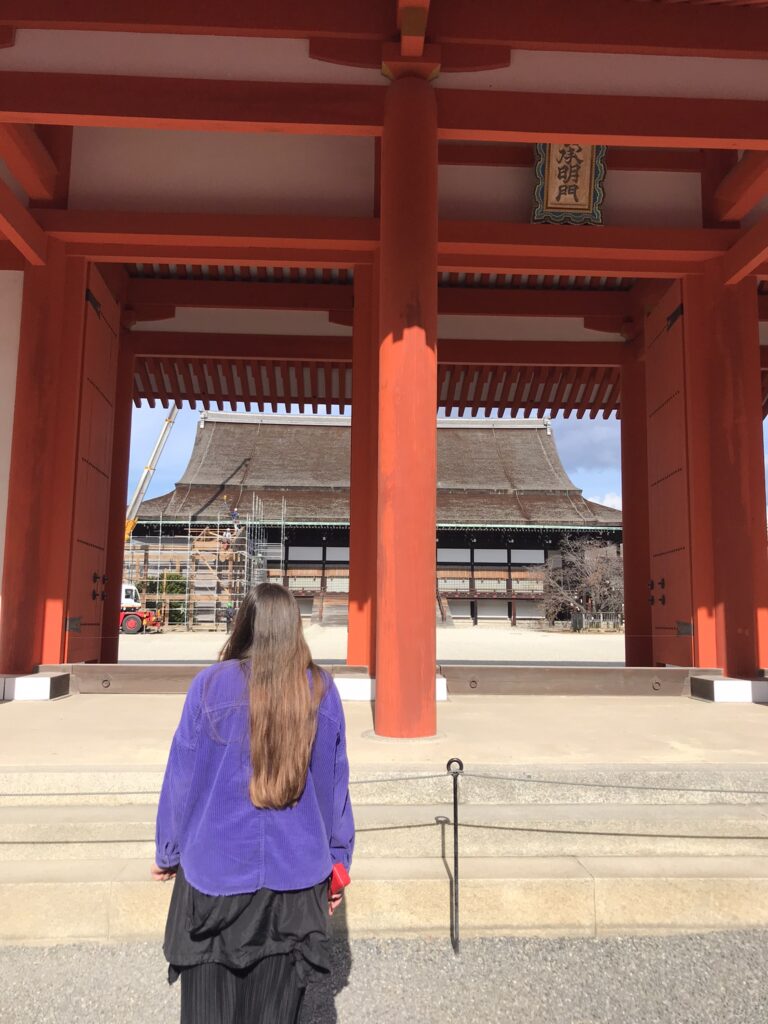
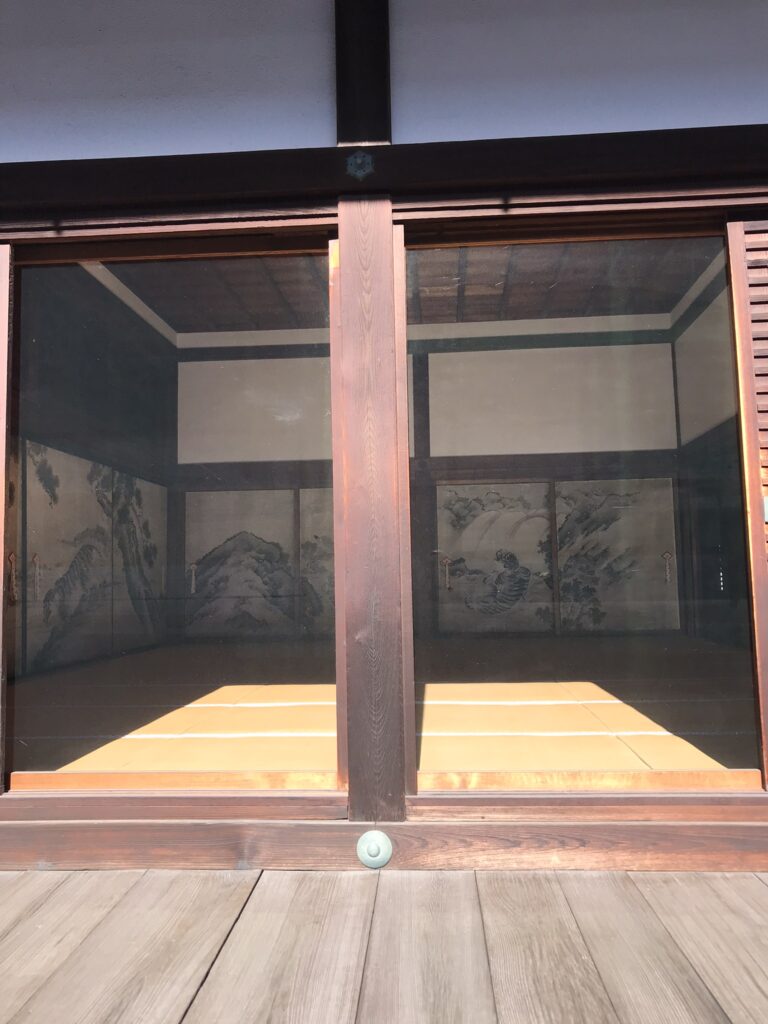
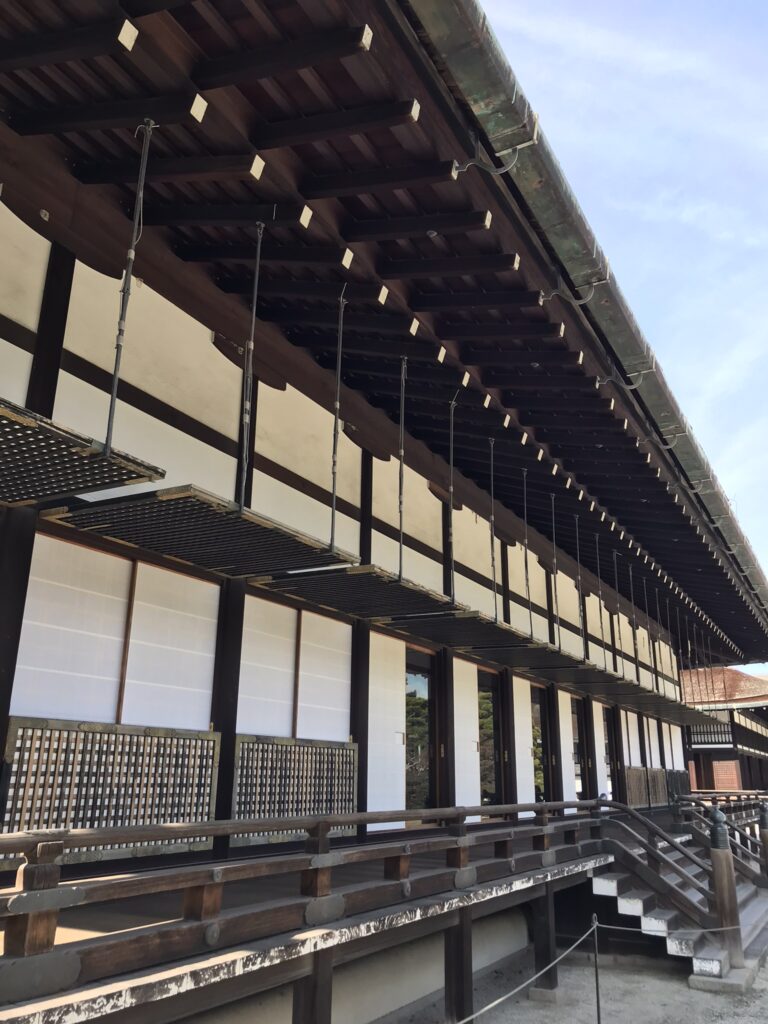
Inside the Imperial Palace complex in Kyoto
Elsewhere in the Gyoen garden, it may be possible to visit the Omiya Palace and Sento Palace grounds however visits must be booked in advance on the Imperial Household Agency website and short-notice reservations are hard (if not impossible) to come by. There are a few other remains within the park, which are all free to look at.
Kobe
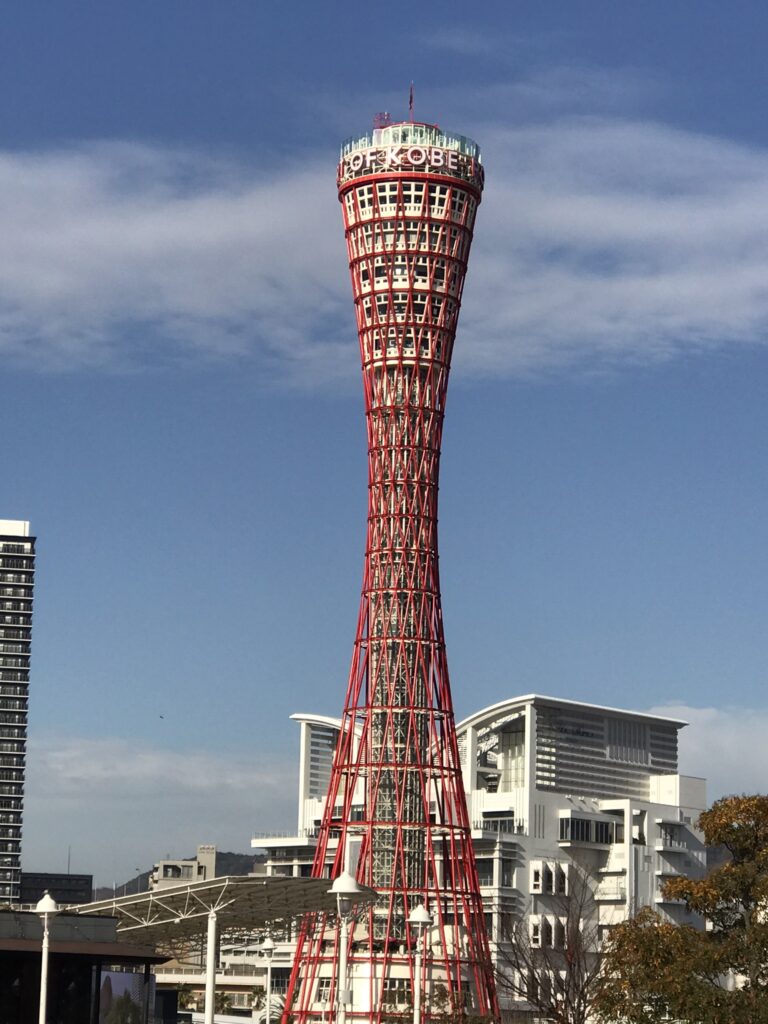
Kobe, the capital of the Hyōgo Prefecture, sits on the Osaka bay directly west from the goliath that is Osaka. The city is very narrow and elongated, hugging the coastline – squeezed between the sea and verdant Rokko mountains to the north. For those on a whistle-stop tour of Japan, it’s extremely easy to visit Kobe from Osaka – express train services from Umeda take as little as 25 minutes to reach Kobe. Travelling from Kyoto to Kobe is also possible on a day trip.
Most people have heard of Kobe for one reason and that’s Kobe beef. The city is synonymous with this high-quality, marbled beef product. Connoisseurs claim that Kobe beef is the best in the world due to the high fat content which melts during cooking. The eye-watering price (we’re talking hundreds of dollars for a top-quality A5 steak) can often put budget travellers off, but there are ways to enjoy Kobe beef without blowing the budget. Our top tip is to go to Kobe Beef Red One (located in Chinatown) and order their weekday lunch menu. It’s one of the few places around that offers an affordable deal for those wanting a taste of the prized meat. For under 4,000 yen we were able to try Kobe beef sushi, Kobe beef soup and salad, with the highlight being the mini steak cooked to perfection (you can pick how you want it cooked) served with roasted veg. There are additional add-ons for superior cuts of beef if you’re feeling particularly extravagant.
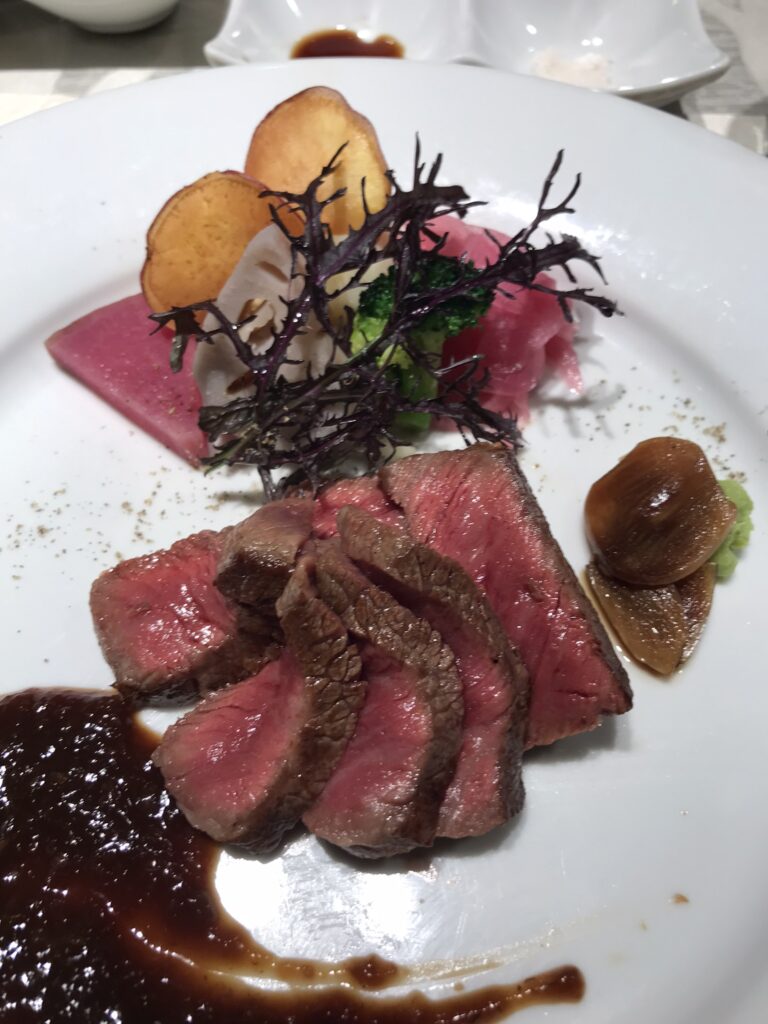
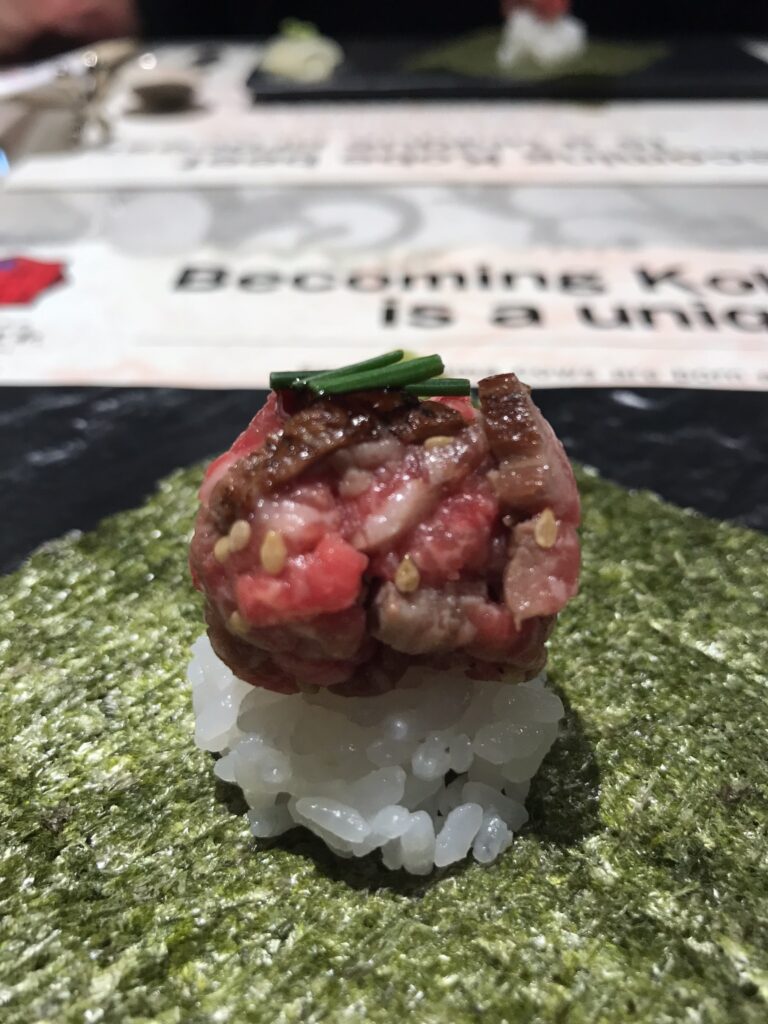
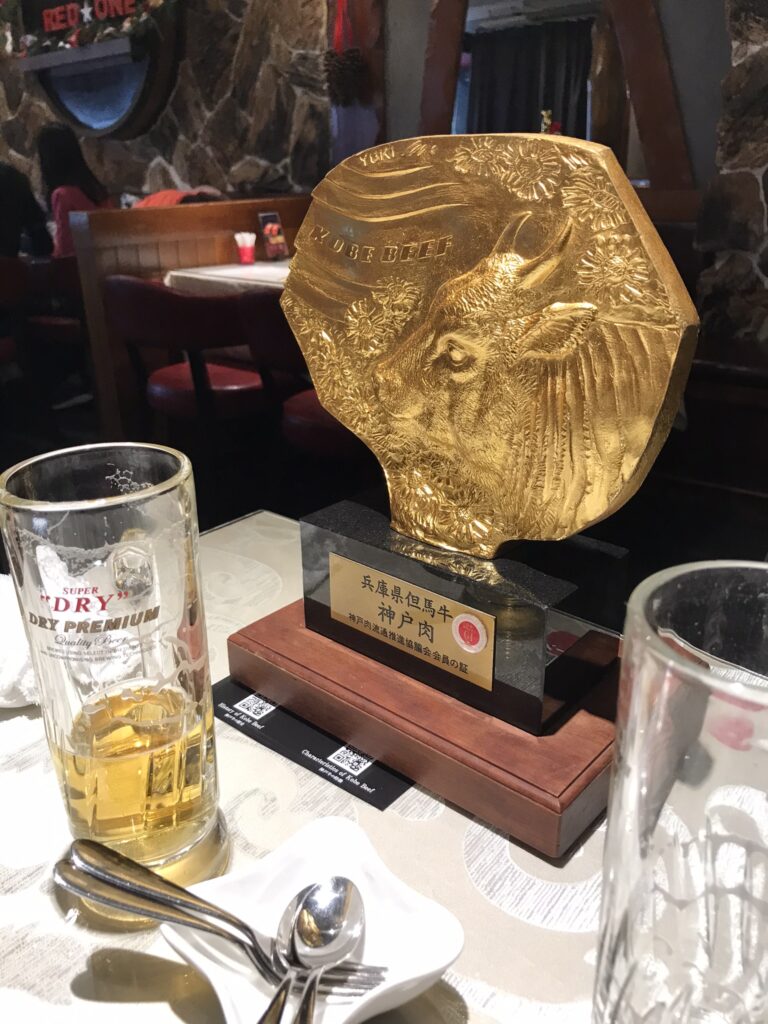
Trying rare Kobe beef should be a top priority when visiting Kobe
As well as beef, many Japanese associate Kobe with The Great Hanshin Earthquake of 1995, which destroyed much of Kobe’s harbour area, temporarily shutting down shipping operations and toppling the nearby expressway. There are quite a few monuments within the city to the damage caused and human lives lost in the tragedy. 5,000 people were killed and 200,000 made homeless by the natural disaster. Kobe was the closest urban center to the epicenter (20km out to sea), so experienced the worst of the tremors.
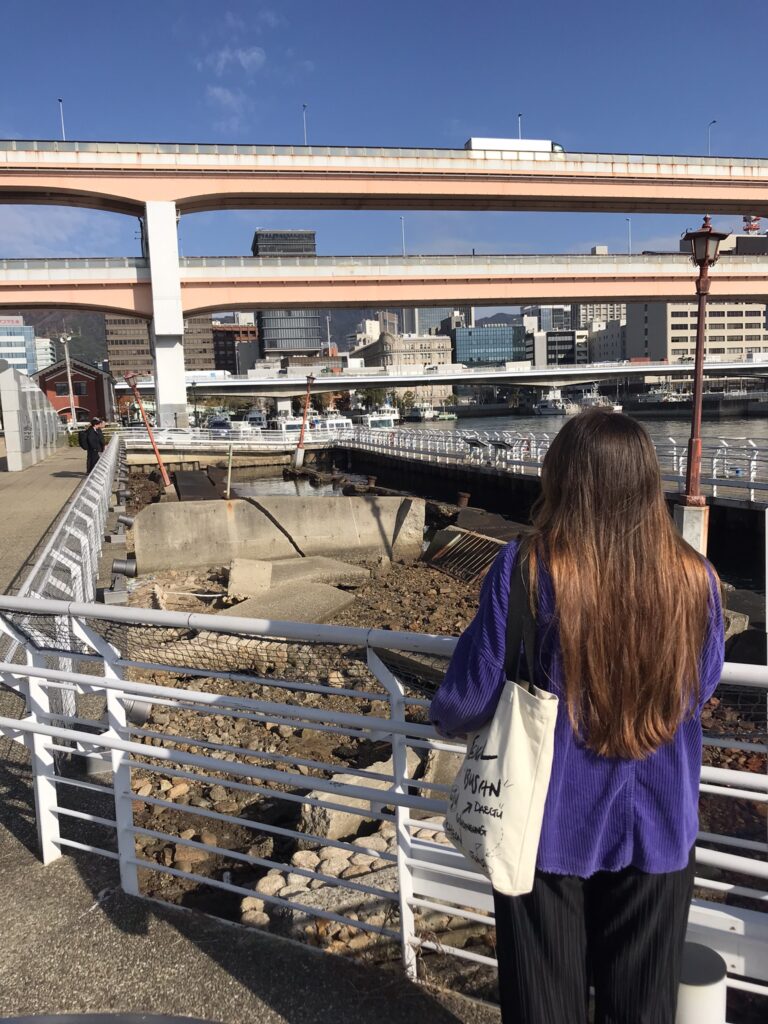
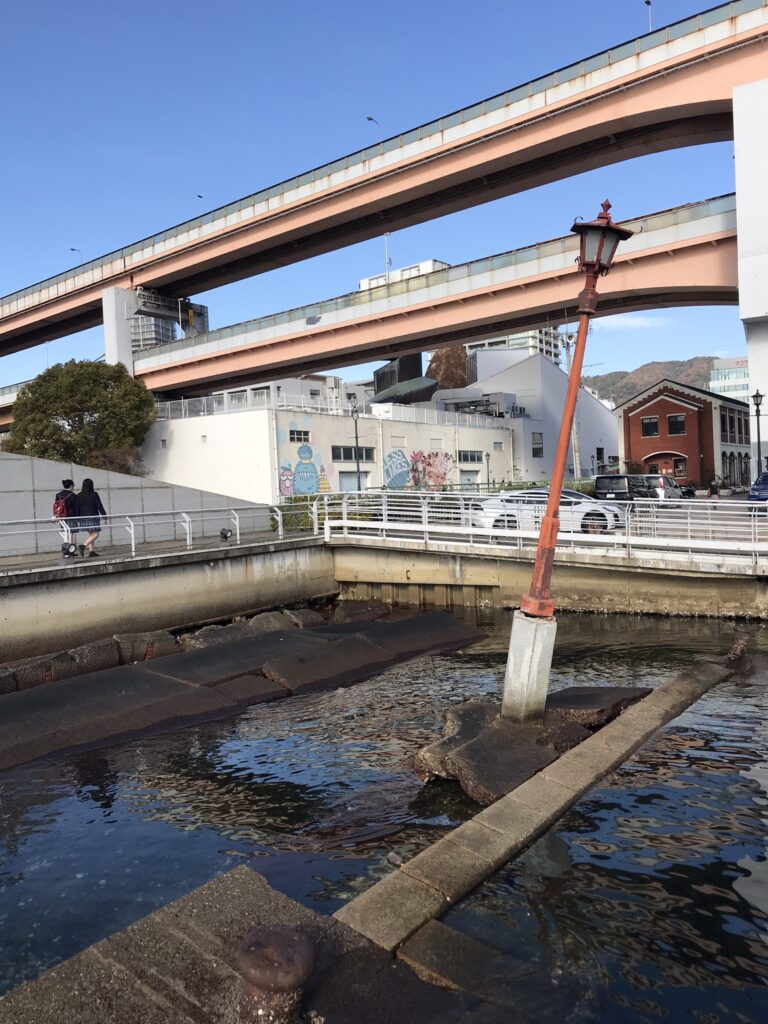
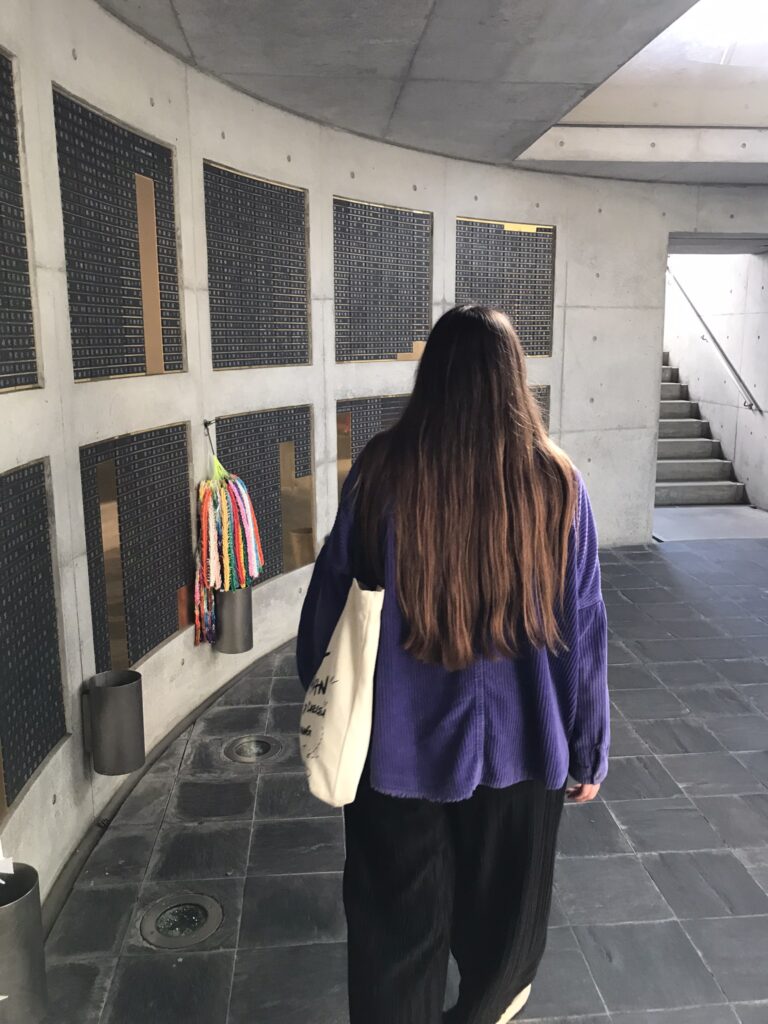
Visual reminders of the Great Hanshin Earthquake within Kobe
Kobe also has a distinctive history within the region. As one of the first Japanese ports to be opened to the world after the ‘black ships’ incident of 1853 – an incursion of American sailors which forced the Japanese to end their centuries-long policy of isolation – Kobe was one of the first places that foreign merchants and traders were allowed to settle on the Japanese mainland. Kobe’s designated ‘foreign settlement’ was centered around what is now the Kobe City Museum. Most of the original buildings here were demolished following the end of the era of ‘gunboat diplomacy’ at the turn of the 20th century, with a shiny business district now standing in its place. The foreign population of Kobe grew over time, leading to the introduction of ‘mixed residential areas’ (overfill from the foreign settlement) in which Japanese citizens lived side-by-side with foreigners – a unique aspect of Kobe during that time. Kitano Ijinkan, the former mixed residential area located in the hills to the north-west of town, retains its original cosmopolitan character to this day, with a smattering of western-style mansions similar to those we encountered in Motomachi in Hakodate.
We found it fascinating to learn about how these foreign settlements functioned. Between their establishment in 1868 and their abolition in 1899, the settlers were more or less left to run things themselves, build their own properties and recreate a slice of their homeland in Japan. Foreigners were exempt from Japanese laws and Japanese were not allowed to reside in these areas. These mostly Western traders brought many modern amenities to Kobe, such as electric street lighting, plumbing systems in houses and sewerage systems. The concept of ‘foreign settlements’ was ended in 1899 and these areas were incorporated back into their respective cities.
As a place of integration and openness long before most of the rest of the country, Kobe oozes cosmopolitanism. Areas such as Chinatown (Nankinmachi), selling duck bao buns, steamed buns and all manner of Chinese street food, as well as Meriken Park – named after the American consulate which once stood nearby – are testament to this.
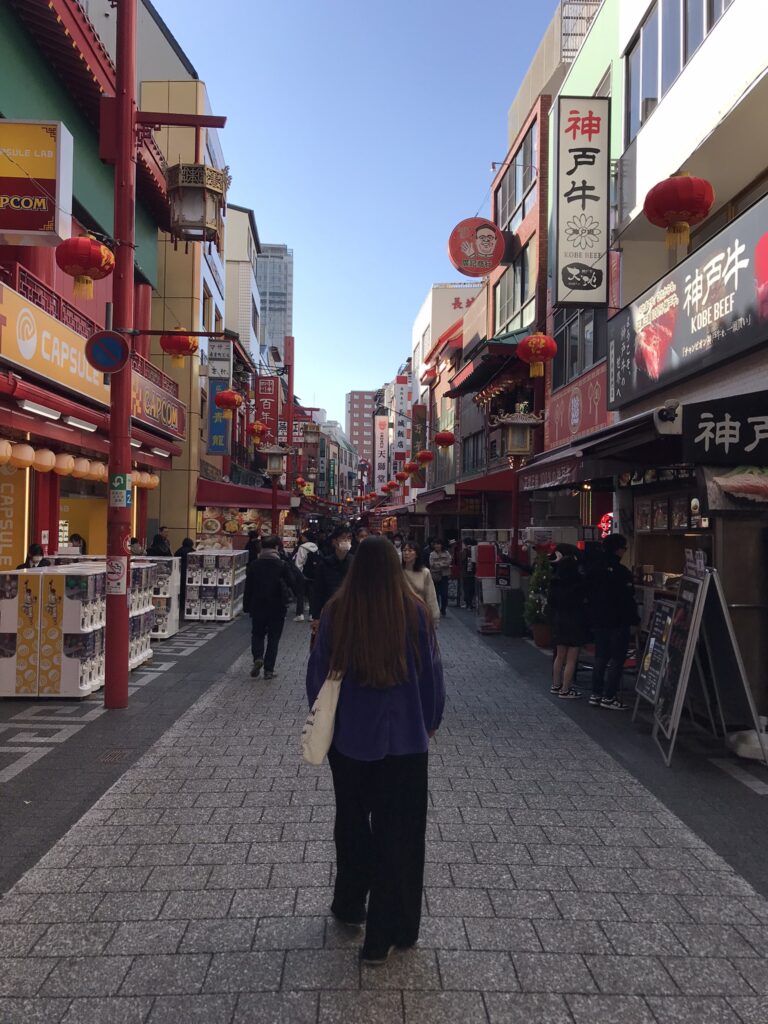
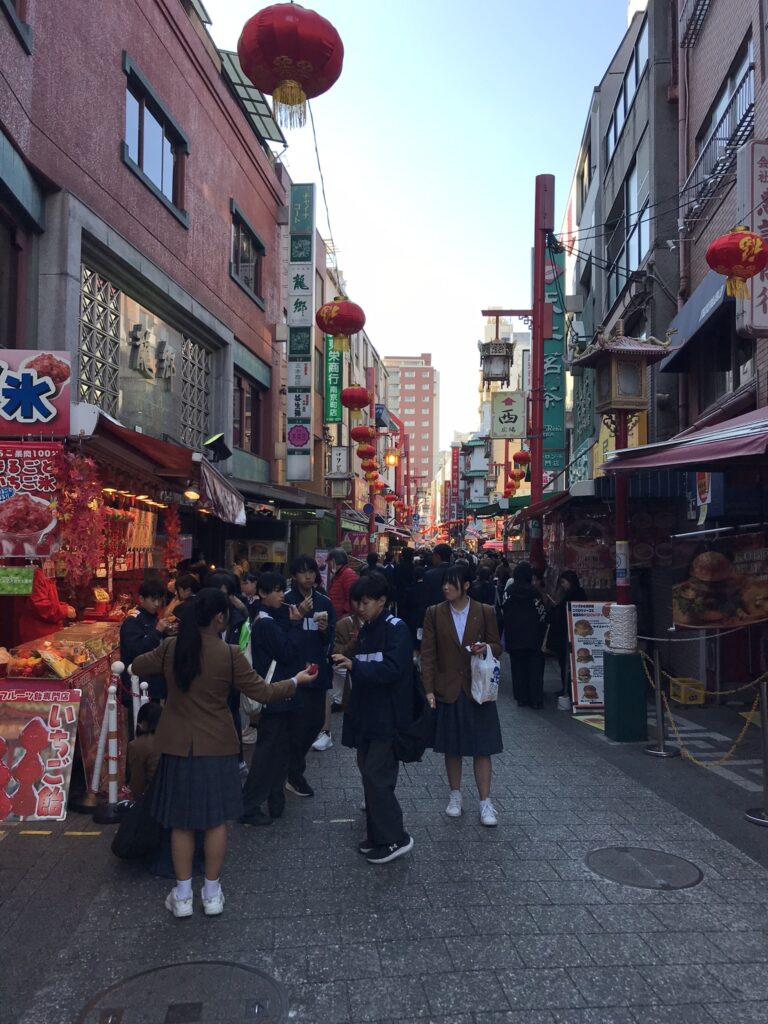
Nankinmachi (China-town) seemed to be a hit with school kids
Accommodation
Hotel Meriken Port Kobe Motomachi – situated in the Meriken area a short stroll from Meriken Park, this business hotel is exactly what you’d expect; cosy compact rooms which are impeccably clean, microwave in the lobby for bento box dinners and approachable front desk staff.
Foodie Places
Kobe Beef Red One – highly recommended Kobe beef restaurant with unbeatable lunch set deals.
Activities
Kobe is a compact city and the main sights are easily walkable. Click here to access our self-guided walking tour!
Kitano Ijinkan – this former mixed residential area contains numerous houses relating to the various nationalities who once lived here. The houses are very touristy, often showcasing stereotypical elements of their respective nation (such as clogs in the Holland House, or dressing up like Sherlock Holmes in the English House). Visiting the various houses seemed a popular activity for domestic tourists – we speculated that European culture for the Japanese is exotic and foreign, whereas for us it was a lot more normal and so less interesting. We found it amusing that the houses in this area tend to be named after their last occupants even if they’re not built in that style.
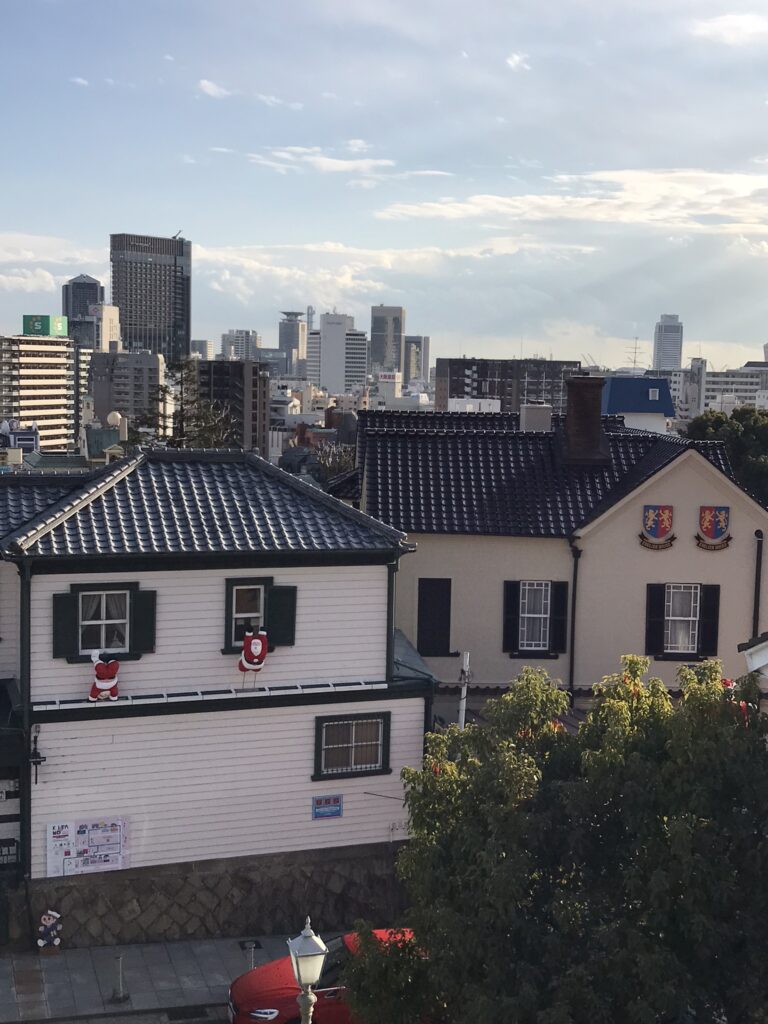
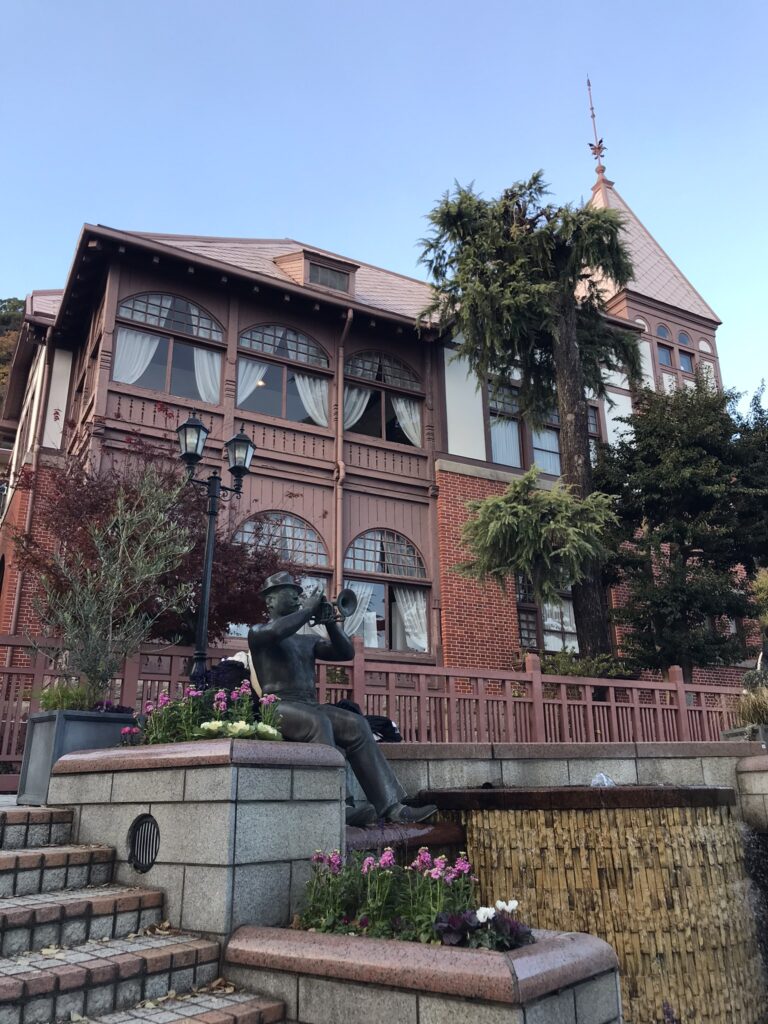
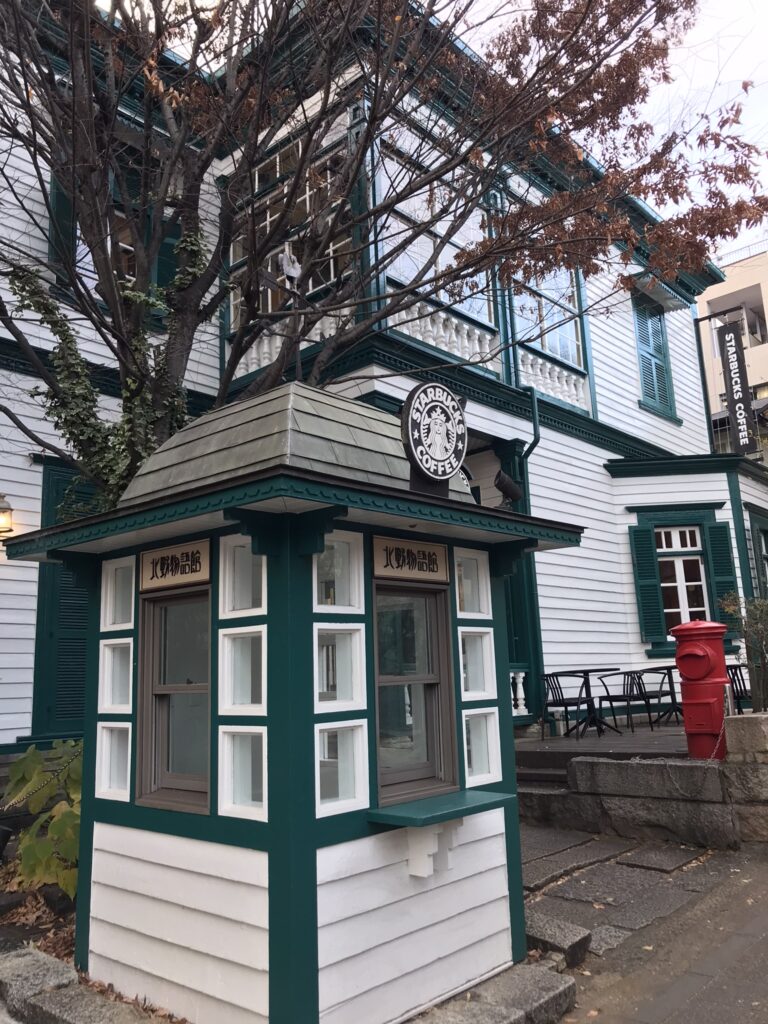
We really felt at home in the Kitano neighbourhood
Most of these historic properties require an entrance fee to visit – often the view of the building was obscured so we couldn’t peek from the outside. Maybe this is intentional so tourists have to pay the admission fee. For those that don’t want to pay fees to enter all the houses, Rhine House is free to enter and contains a small, non-kitschy exhibit related to the history of the area.
After Kobe, we headed to Himeji Castle en route to Okayama!