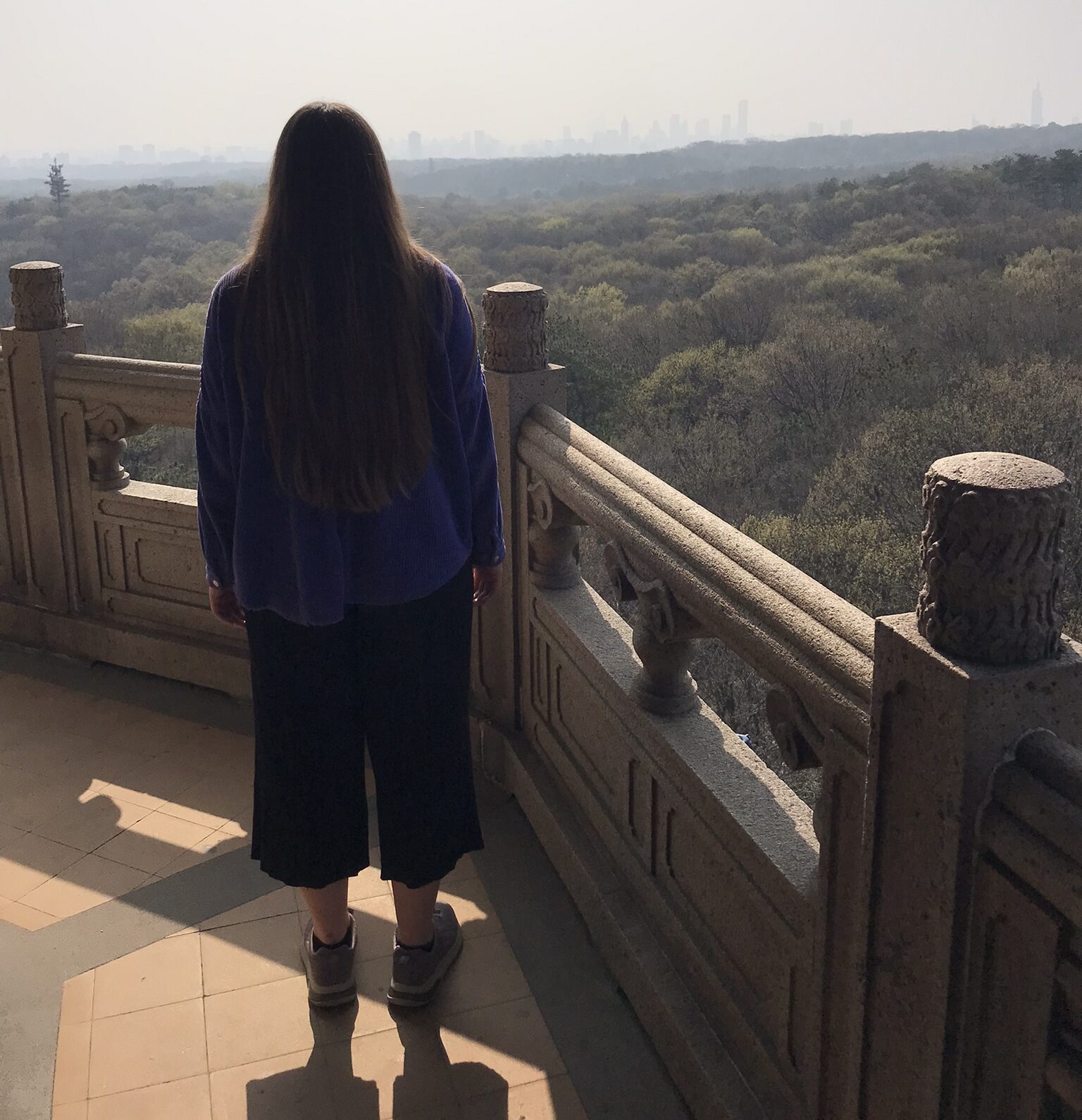
Purple Mountain (known in Chinese as Zijinshan or Zhongshan) is a 450 metre high mountain peak close to the centre of Nanjing. The mountain’s name comes from the ‘golden-purple’ clouds which can often be seen around the peak in the early mornings. In Chinese, the mountain was renamed Zhongshan after a pseudonym used by the revolutionary leader Sun Yat-sen, who is now buried at its foothills.
An auspicious site for centuries, Purple Mountain first came into the national spotlight when the tomb of the first Ming Emperor was constructed here in 1381. The area saw a renewed focus of attention when Nanjing again became the capital of China during the early 20th century, and it contains numerous structures related to the Republic of China government of the 1920s and 30s and the Kuomintang, the dominant political party of that time. With fantastic natural scenery, nationally significant cultural sites and easy transport links on the metro, this is a must-see area while visiting Nanjing.
Despite its name, most of the sites in this tour of the Purple Mountain scenic area are located at the foothills of the mountain and there isn’t too much uphill walking required (apart from the steps at the Mausoleum of Dr. Sun Yat-sen). Walking trails are paved and clearly marked. Those who want to ascend the mountain itself can do so via a cable car to the west of the main scenic area, which is not covered by this tour.
The main Purple Mountain scenic area encloses four distinct sites – Meiling Palace, the Mausoleum of Dr. Sun Yat-sen, the Linggu Scenic Area and the UNESCO World Heritage Site of Ming Xiaoling (also known as the Ming Tomb). Entry to the Mausoleum of Sun Yat-sen is free, while a combination ticket covers all of the other sites on this tour and is by far the best value option for those looking to fully explore the area. The combo ticket can be purchased from the ticket office close to the exit of Muxuyuan metro station, or any of the ticketed attractions – remember to bring your passport as this will be required for entry to the attractions.
After exiting the metro at Muyuxuan, head along Lingyuan Road and down the Lingyuan Lu pedestrian walkway.
This dramatic tree-lined boulevard runs for almost two miles, from the entry point of Zhongshan scenic area to the mausoleum of Sun Yat-sen. Built in 1929, the road was converted to a pedestrian-only route in 2026, although it may still open to allow entry and exit for staff and supply vehicles at the start and end of the day.
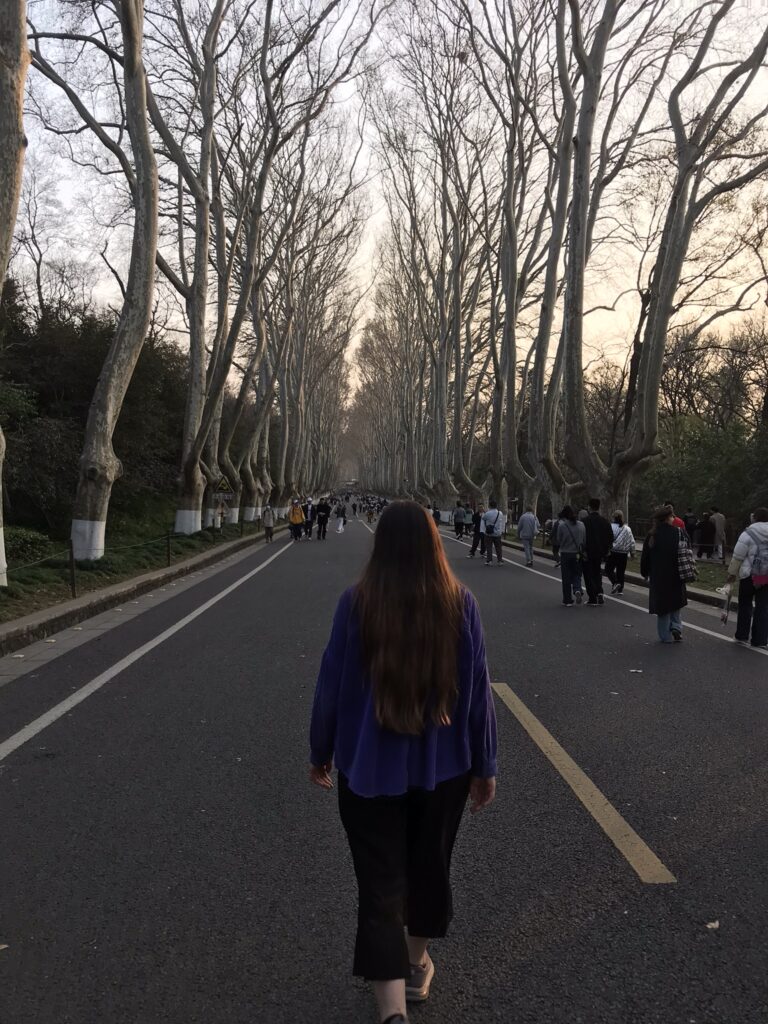
The imposing Lingyuan Road
Continue along Lingyuan Road, passing the entrance to the Ming Tomb. After a while you will reach Meiling Palace on the right-hand side of the road. Also known as Zhongshan Mansion, this opulent palace was originally built in the 1930s by the nationalist Republic of China government to house dignitaries visiting the nearby mausoleum of Sun Yat-sen. It was later repurposed as an official residence of Kuomintang and Republic of China leader Chiang Kai-shek and his wife Soong Meiling, after whom the palace is now named. Following the defeat of the Republic of China by the Chinese Communist Party in 1949, Chiang and Meiling were sent into exile and the mansion was then used as a local government office and a guesthouse, before being restored and opened as a museum in 2012.
The mansion includes guard/servants and secretary rooms in the basement, guest rooms and meeting halls on the middle levels as well as offices and private living quarters for Chiang and his wife on the upper floors. One interesting feature is the presence of a Christian chapel – Meiling was from a highly religious Christian family and Chiang also converted to Christianity in the 1930s, becoming more devout after being kidnapped during the Xi’an Incident of 1936. The palace contains period furniture and artefacts relating to the Republic of China era as well as an original 1930s Buick car used by Meiling and, strangely, an exhibition of old technological devices, including Edison-brand cameras and projectors from the 1800s. The building’s architecture is a fusion of cultural influences, with a Chinese-style exterior design but a very western interior. It’s clear to see how Chiang and the Kuomintang wanted to emulate western leaders of the time.
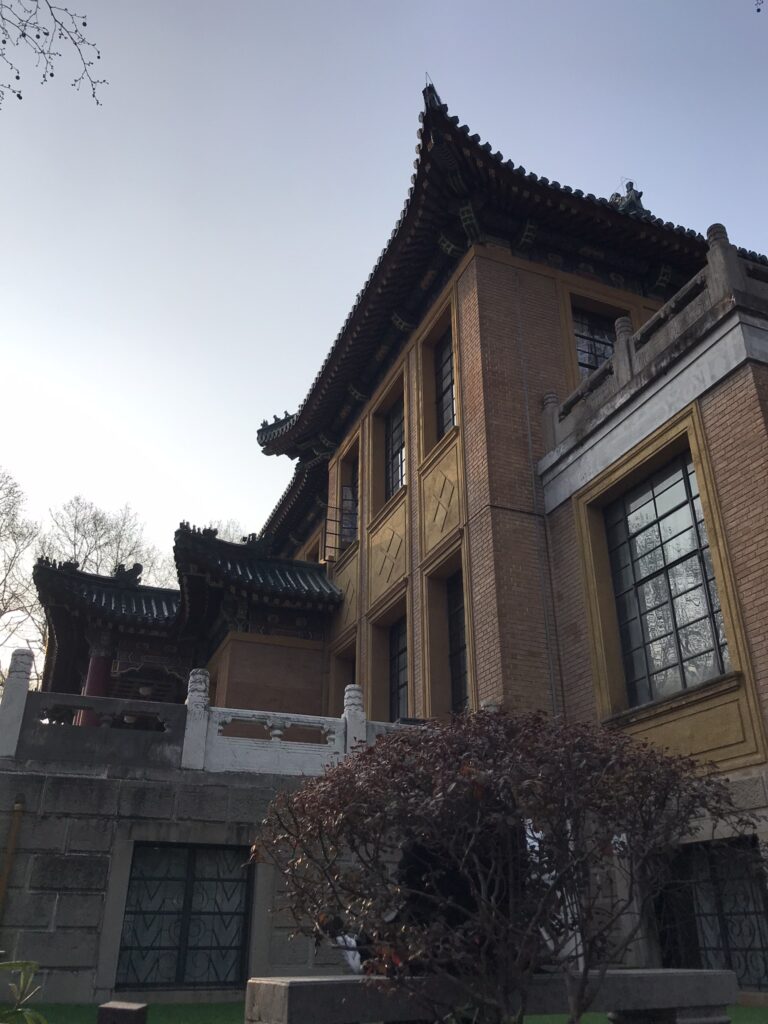
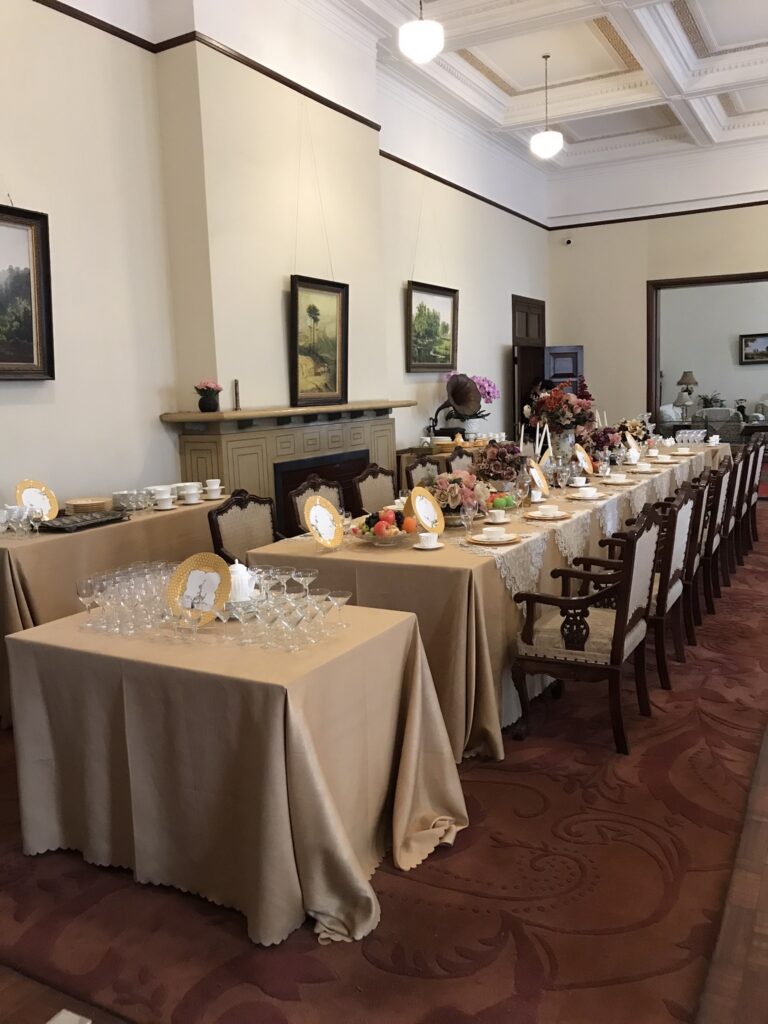
Chinese-style exteriors and opulent western-style interiors at Meiling Palace
After visiting the palace, head back westwards along Lingyuan Lu road and follow the signs for No. 5 Entrance of the Ming Tomb. Pass through the Great Golden Gate – this marks the entrance to the Ming Xiaoling complex (the Ming Tombs Scenic Area). Near the gate is the Ming Xiaoling Mausoleum Museum, for those that want to brush up on their history before entering.
Just behind the golden gate is Sifangcheng Pavilion (also known as ‘Square City’), a small structure which houses the celebrated Shengong Shengde Stele – a huge 15th century tablet which extols the virtues of the first Ming emperor. The stele is situated atop a plinth which appears to resemble a tortoise – this is actually a mythical creature called a Bixi, a tortoise with a dragon’s head which is famed for carrying heavy weights. After passing through this area you will find yourself on the Sacred Road, an 800m long winding path to the main Ming mausoleum complex. The path is split into two sections – the first, longer section is known as Shixiang Road and contains oversized pairs of carved animals. Present are carved pairs of lions, horses, camels, elephants, qilin (mythical Chinese unicorns) and horned beasts known as xiezhi, with each creature representing a different aspect of the first Ming emperor’s reign and virtues. The smaller path, Wengzhong Road, contains carvings of civil and military officials who act as guardians for the spirit of the emperor. The tree-lined route is said to be stunning during the spring when the plum blossoms are in bloom, and also during the autumn months when the autumnal foliage is on display. To the south is a plum blossom garden containing several small art galleries, museums and monuments.
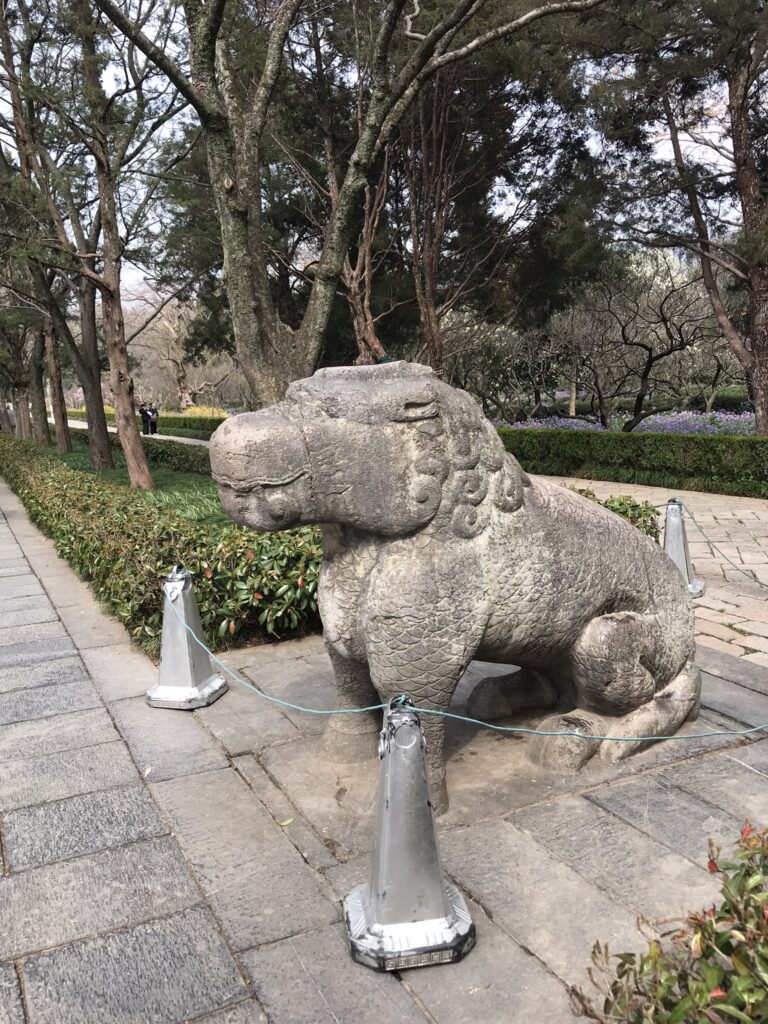
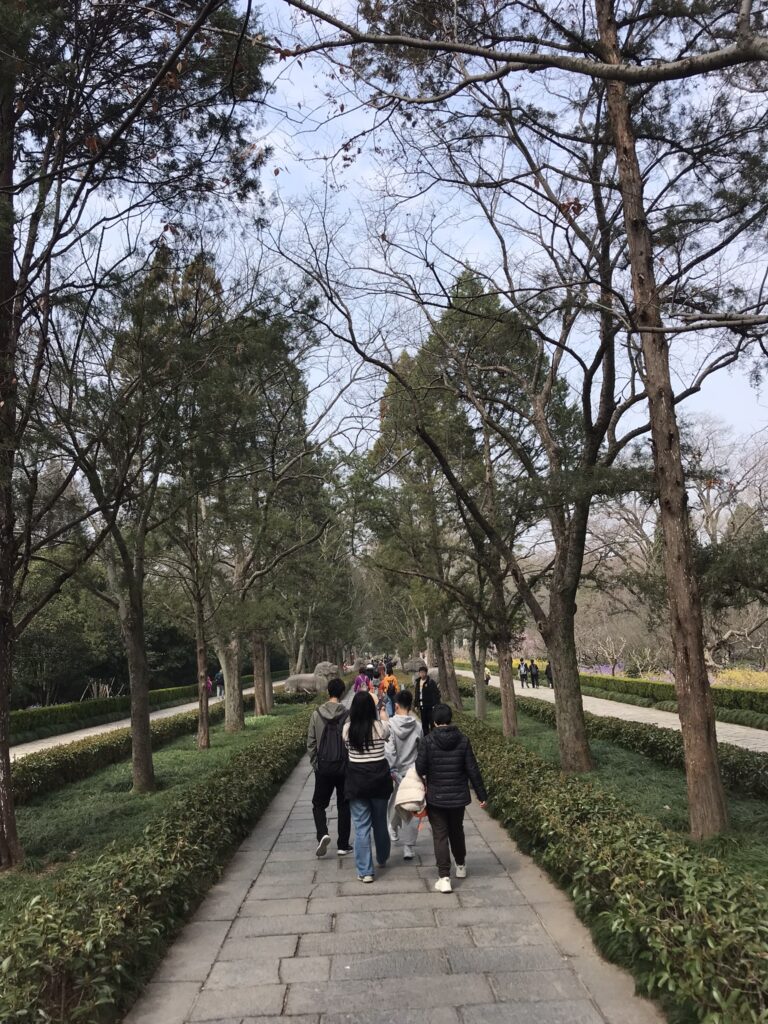
The two sections of the Sacred Road are lined with statues of animals, generals and officials
The Sacred Road leads to the mausoleum of Zhu Yuanzhang (also known as the Hongwu Emperor), the founder and first emperor of the Ming Dynasty. Born into a humble family in 1328 in a village in what is now Anhui province, Zhu was orphaned as a teenager and joined a rebellious movement against the ruling Yuan dynasty, quickly becoming a trusted general due to his skill, intelligence and leadership. After conquering the former regional capital of Jiqing and being awarded governorship of the Jiangnan region, he developed a base from which he expanded to eventually conquer and unify China under his rule. Adopting the imperial name Hongwu, he set about developing his capital city of Jiqing, which he renamed Yingtian and which later came to be known as Nanjing (the ‘southern capital’). Hongwu reigned for 30 years and was succeeded by his grandson following his death, thus establishing the Ming dynasty. The name Ming was chosen by Zhu Yuanzhang – he called his empire ‘da ming’, which means ‘great brightness’.
Construction of Zhu Yuanzhang’s mausoleum began in 1381 and it was not finished until several years after his death. The construction was a huge undertaking, said to have required over 100,000 labourers. As well as the Hongwu Emperor, the mausoleum is also the burial site of Empress Ma, Zhu Yuanzhang’s principal wife, key advisor and confidant. The complex is named after Ma – she was given the posthumous title ‘Xiao Ci’ (meaning ‘filial piety and kindness’), from which the name of the mausoleum (Xiaoling, meaning ‘xiao spirit’) is derived. Ma died 16 years before Zhu, so was the first to be buried in the mausoleum. The heartbroken Zhu vowed that he would not replace her, and other consorts were not elevated to the title of Empress following her death.
Along with the rest of the Ming dynastic tombs which are located near to Beijing, the Ming Xiaoling is a UNESCO World Heritage Site. This grand structure was a blueprint for future imperial tombs, although it is the only such tomb in Nanjing. The rest of the Ming Tombs are located around Beijing, which became capital of the China in the early 1400s during the reign of the Yongle Emperor (Hongwu’s fourth son), with Nanjing becoming an auxiliary capital.
Visitors today can explore the wider mausoleum complex, which contains a number of extant structures and the foundations of other halls and pavilions that have been destroyed over time. Of particular interest is the tablet hall, containing a tortoise/bixi stele erected by the Qing dynasty’s Kangxi Emperor in 1699 which somewhat sycophantically promotes Hongwu’s era as having been greater than the Song and Tang dynasties. There is also an early 20th century tablet from the very late stages of the Qing dynasty which warns visitors against vandalism of the complex and is signed off by a local official in numerous languages including English, German and Italian. The focal point of the complex is the enormous Ming Lou (soul tower), which serves as the entry point to the large imperial burial mound (or ‘treasure mound’, as it is described). This mound, which is roughly 400m in diameter, encloses the remains of Hongwu and Ma within an underground palace. The underground palace is strictly off-limits, having remained permanently sealed and untouched since its construction, but a simulated VR experience giving visitors the chance to virtually tour the burial chambers was being promoted within the soul tower when we visited (it seemed to be in Chinese only so we didn’t partake).
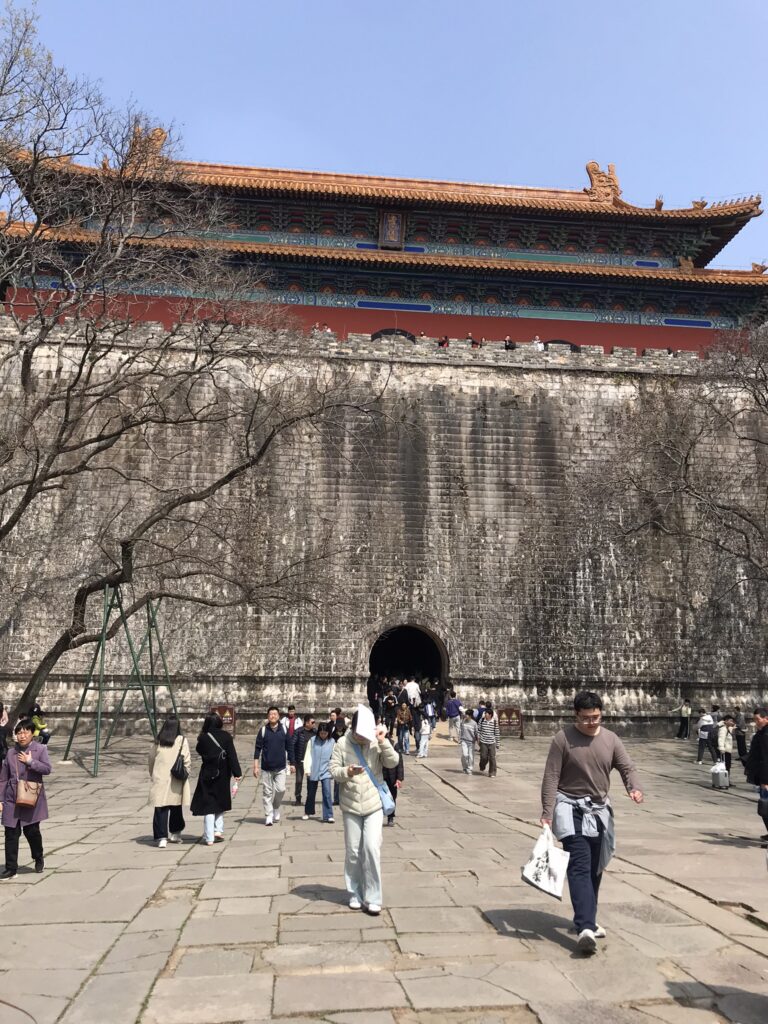
The focal point of the mausoleum – the huge Ming Lou
Just to the east of the main mausoleum complex is the tomb of Zhu Yuanzhang’s eldest son, crown prince Zhu Biao. The heir apparent to Zhu Yuanzhang, he unexpectedly died of illness at the age of 36 and was outlived by his father, so never became emperor. The Hongwu Emperor was succeeded by his grandson, Zhu Biao’s son Zhu Yunwen, who took the throne as the Jianwen Emperor following Zhu Yuanzhang’s death.
After visiting the Ming complex, exit the area via Gate 7. This road will lead to the Mausoleum of Dr. Sun Yat-sen. Along the way you will pass Xingjian Pavilion and Yongfeng Poetry House – a famed bookshop and poetry society which has been operational since 1933.
Mausoleum of Dr. Sun Yat-sen
This is the final resting place of Sun Yat-sen, a pivotal figure in early 20th century Chinese history and considered by many to be the father of modern China. Born into a poor family in Guangdong province in 1866, Sun moved to Hawaii as a teenager in order to live with his older brother, who had emigrated years earlier in search of better economic opportunities and become a successful businessman. While in Hawaii, Sun received a western education and learned about American values of democracy, converting to Christianity in the process. Upon returning to China, Sun went to study medicine in Hong Kong, where he began to participate in revolutionary movements to overthrow the faltering Qing dynasty and replace it with a democratic republic. He founded the Kuomintang, a nationalist political party which aimed to remove the emperor and install a democratic nationalist government in China.
After being forced into exile in 1895 following a failed uprising against the Qing, Sun adopted the pseudonym Sun Zhongshan (a mistranslation of the Japanese surname ‘Nakayama’ which was given to him by a Japanese supporter) and spent 16 years traveling the world in order to raise funds and gain support for his cause from expatriate communities. He formed subversive groups and secret societies, helping to inspire and organise the revolution that eventually succeeded in overthrowing the Qing. In 1911, Sun returned to China following the overthrow of the final Qing emperor Puyi and was elected as first leader and provisional president of the new Republic of China, ending thousands of years of dynastic rule in the country.
After drafting a constitution and selecting a cabinet, Sun stepped aside as leader in early 1912 in an attempt to prevent a civil war with power-hungry military warlords in the north of China and secure the permanent end of the Qing dynasty. This resulted in a period of instability and Sun was exiled to Japan once again, returning to China a few years later and himself becoming embroiled in military feudalism. Sun attempted to rejuvenate his political party (the Kuomintang) and briefly allied with the fledgling Chinese Communist Party in order to oppose the warlords before he prematurely died of cancer in 1925 at the age of 58. Following a power struggle, he was later succeeded as leader of the Kuomintang by Chiang Kai-shek.
Sun Yat-sen had requested to be buried on Purple Mountain following his death in order to emulate one of his heroes, the Hongwu Emperor of the Ming dynasty. Hongwu had overthrown the Mongol-led Yuan dynasty and restored dynastic power to the dominant Han ethnic group centuries earlier and so Sun felt some kinship with him, having been responsible for overthrowing the Manchu-led Qing dynasty and restoring rule of China to the Han people once again. Plans were made for a huge mausoleum to be built at Purple Mountain – Chiang Kai-shek and the Kuomintang officials at the time thought that the larger the mausoleum for Sun, the greater legitimacy of their own authority and rule. The mausoleum complex was completed in 1932, seven years after Sun’s death, and the mountain was renamed ‘Zhongshan’ (literally translating to bell mountain) in his honour.
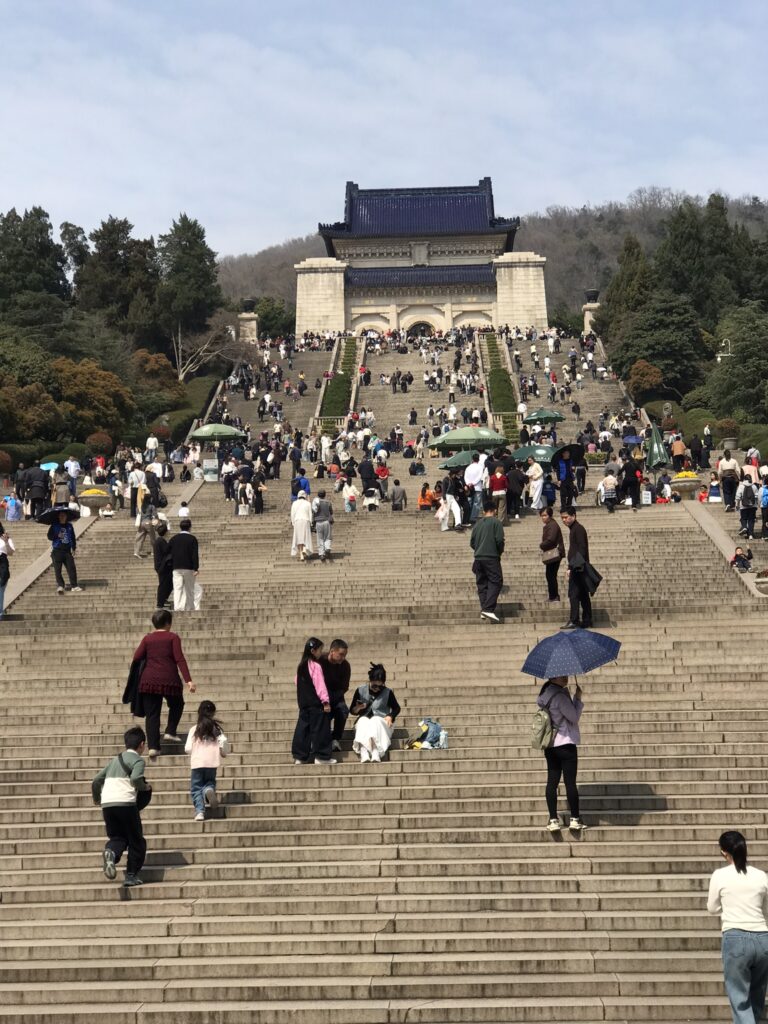
It looks like a tough climb but it’s really not so bad
Sun Yat-sen remains a universially popular figure in China. Despite being the first leader of the Republic of China and founder of the Kuomintang, he is also respected and revered by the Chinese Communist Party for his role in challenging and ending China’s millennia of dynastic rule, seen as an early forerunner to their own communist revolution. Sun’s mausoleum is the most visited attraction in the Zhongshan area as a result. Entry to the complex is free but an online booking is required, which can be made on the spot via QR codes outside the entrance to the mausoleum. Foreigners struggling with the Chinese apps can also obtain a free entry ticket from the information centre opposite KFC in the nearby square outside the entrance.
The mausoleum complex includes many features of traditional Chinese imperial tombs, including a stele pavilion and a large bronze ding. The main hall, known as the Sacrificial Hall, is situated atop an enormous staircase, with 392 stairs representing the 392 million people in China at the time of construction. Although it looks like an intimidating climb from the ground, the stairs are actually divided into smaller sections interspersed with flat platforms – they are designed in such a way that visitors can only see the stairs from the bottom when looking up and the platforms from the top when looking down. The top of the staircase provides panoramic views over the verdant landscapes surrounding Purple Mountain, with the towering skyscrapers of Nanjing visible in the distance.
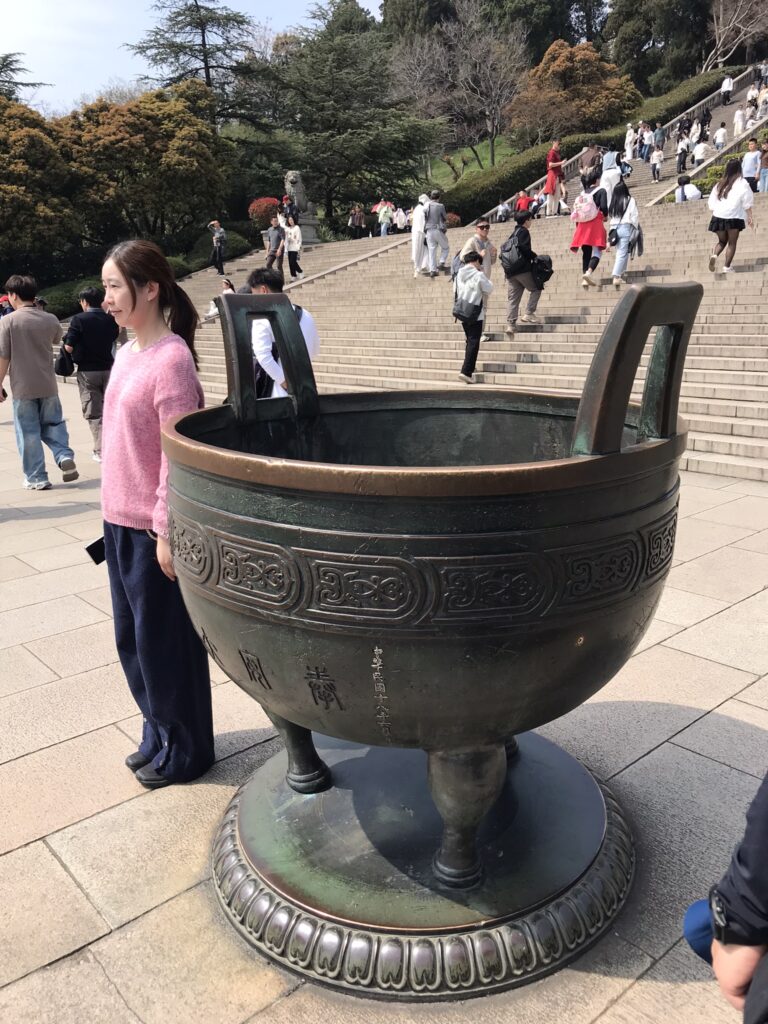
A bronze ding – a traditional symbol of power and status at Chinese tombs
The main Sacrificial Hall contains three arched doorways, which represent Sun’s ‘Three Principles of the People’ – nationalism, democracy and welfare. Within the main hall is a large marble statue of Sun, and the base of the statue features carvings depicting scenes from his life and revolutionary struggles. The ceiling of the Sacrificial Hall contains the blue 12-pointed sun logo of the Kuomintang, a symbol which is still visible on the Republic of China flag used in Taiwan today. Behind the marble statue of Sun is a small chamber containing a sarcophagus – Sun’s remains are kept directly below this chamber in an underground vault. Photography is strictly prohibited within the Sacrificial Hall, and the burial chamber containing the sarcophagus is not usually accessible for the public.
After visiting the mausoleum, head back out of the entrance and go south to the Sun Yat-sen Mausoleum Music Stage.
This open-air auditorium was built in 1932 as part of Sun Yat-sen’s mausoleum complex, located just to the south-east of the main mausoleum area. Resembling a Roman theatre with Chinese design elements including a lotus pond in front of the ceremonial stage, it was funded and constructed by members of the Kuomintang in order to host public speeches, outdoor performances and commemorative events. When events are not taking place, the theatre mainly serves as a seating and relaxation area for visitors to the mausoleum. Admission is paid, but entry is covered by the Purple Mountain combination ticket.
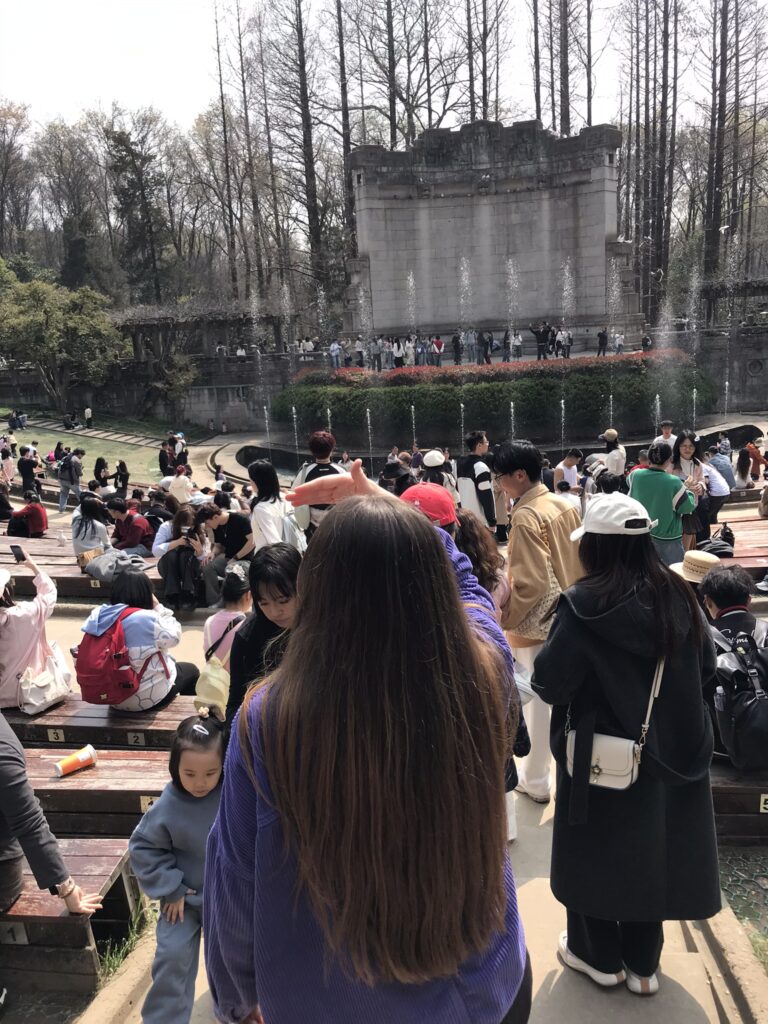
The music stage also features fountain displays
The outdoor music hall is perhaps best known for its flocks of white pigeons (doves), introduced to the area to try and promote a feeling of harmony and peace. The pigeons can often be seen in and amongst the theatre’s bleachers or flying overhead. To the rear of the ceremonial stage is a small pigeon sanctuary where visitors are able to feed and interact with the birds.
Exit the music stage to the east and head eastwards along the path, following the signs towards the Linggu Scenic Area. This path leads through the woods and there is some pleasant scenery along the way. After a while you will pass Liuhui Pavilion on the right-hand side – a tranquil pavilion overlooking a heart-shaped lake, it was built in 1932 as part of the Sun Yat-sen memorial complex. Paths run along the edges of the lake, making for a scenic stroll.
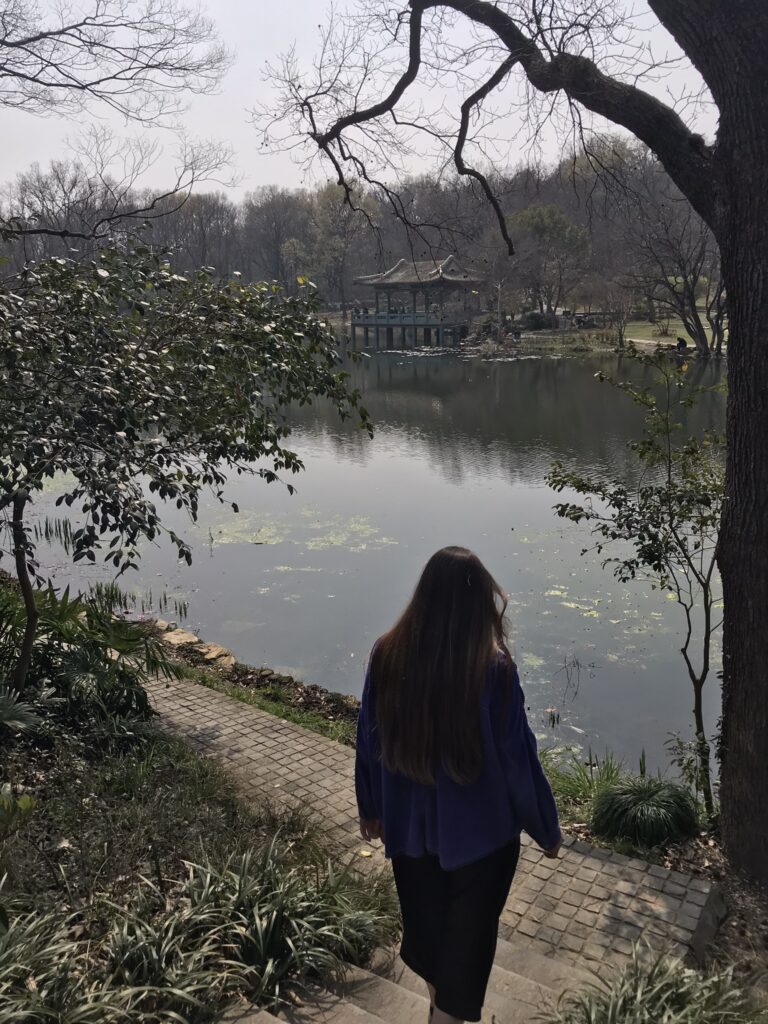
The picturesque Liuhui Pavilion
Continue to follow the signs until you reach Linggu Scenic Area.
This scenic area is centred around the Linggu Temple, an active Buddhist temple, and contains several notable buildings and structures representing a wide range of different eras and time periods. Admission to the scenic area is covered by the Purple Mountain combo ticket.
The original Linggu Temple was first constructed in 515 CE during the Southern Dynasties period. The temple was originally located on the current site of the Ming Xiaoling mausoleum, and was moved to its present location in 1381 in order to make way for the construction of the imperial tomb. Another of the area’s notable structures, the Beamless Hall, was also constructed at this time. More modern additions include the towering Linggu Pagoda, which was built in 1933, and the tombs of prominent Kuomintang figures Tan Yankai and Deng Yanda. The central axis of the scenic area was also constructed during the 1930s and serves as a patriotic memorial and cemetery complex for nationalist soldiers killed in various campaigns during the Republic of China era, including during the warlord period of the 1920s and the Japanese invasions of the 1930s. To the west of the complex is the Baogong Pagoda, which was constructed at the same time as the original Linggu Temple in order to venerate a notable Buddhist monk and has been moved, destroyed and replaced numerous times. To the north-west is the ‘Guilin Stone House’, a ruined 1930s villa for Kuomintang figurehead Lin Sen which was destroyed during the Japanese occupation of China during World War 2.
Entering to the Linggu area along its central axis, visitors will first pass through the Hongshan Gate and the Memorial Archway, which were erected during the 1930s. You will then reach the Beamless Hall. One of the oldest extant buildings in Nanjing, the hall was constructed entirely of bricks without any wood or nails – a rarity at the time, hence the name. Its unique construction style has allowed it to survive for centuries when most other wooden buildings from the period have collapsed or burned down. Originally built in 1381 in order to enshrine a Buddhist deity, in the 1920s the hall was converted into a memorial building for those killed while fighting for the Kuomintang in their battles against the northern warlords, a conflict known as the Northern Expedition. To the rear of the hall is a large memorial cemetery for soldiers who were killed while defending China against Japanese invasions in the 1930s.
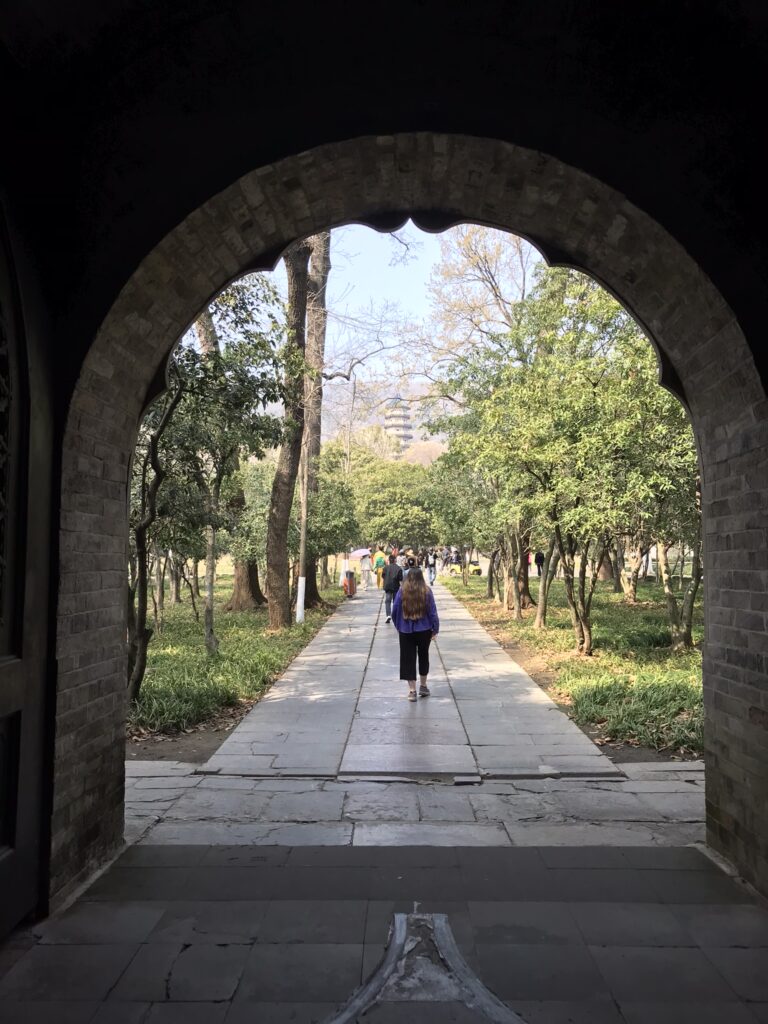
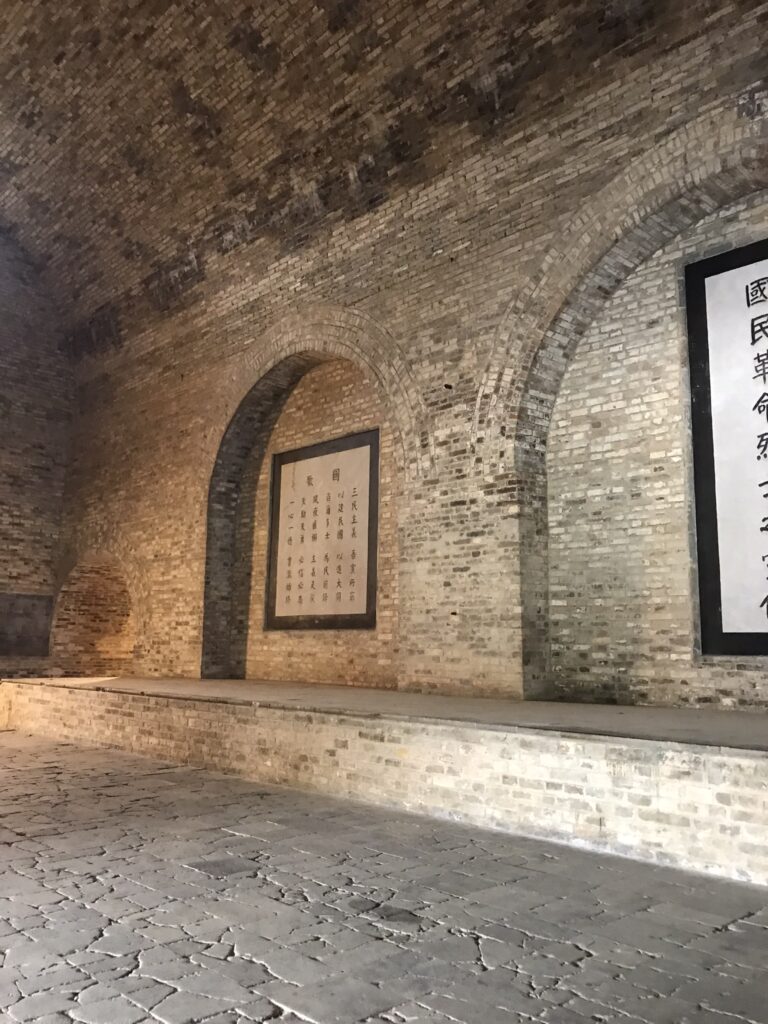
The Beamless Hall is part of Linggu’s central axis and oldest surviving building
Further behind the cemetery along the central axis is the Pine-Wind Pavilion (Songfeng). Built in 1933 as a patriotic and revolutionary display hall for the nationalist Republic of China regime, the hall now houses Chinese-language exhibits promoting the Chinese Communist Party.
Pass through the pavilion and you will reach Linggu Pagoda. Located at the northern end of the central axis, this towering 9-storey pagoda is the focal point of the nationalist memorial area, designed to honour the fallen soldiers of the Republic of China’s National Revolutionary Army. Inscribed with quotes and speeches by Sun Yat-sen and Chiang Kai-shek, construction of the pagoda was started in 1930 and was completed by 1933. The pagoda can be climbed via a single spiral staircase inside, with the higher floors providing great views over the dense woodland of Purple Mountain and the Nanjing skyline in the distance.
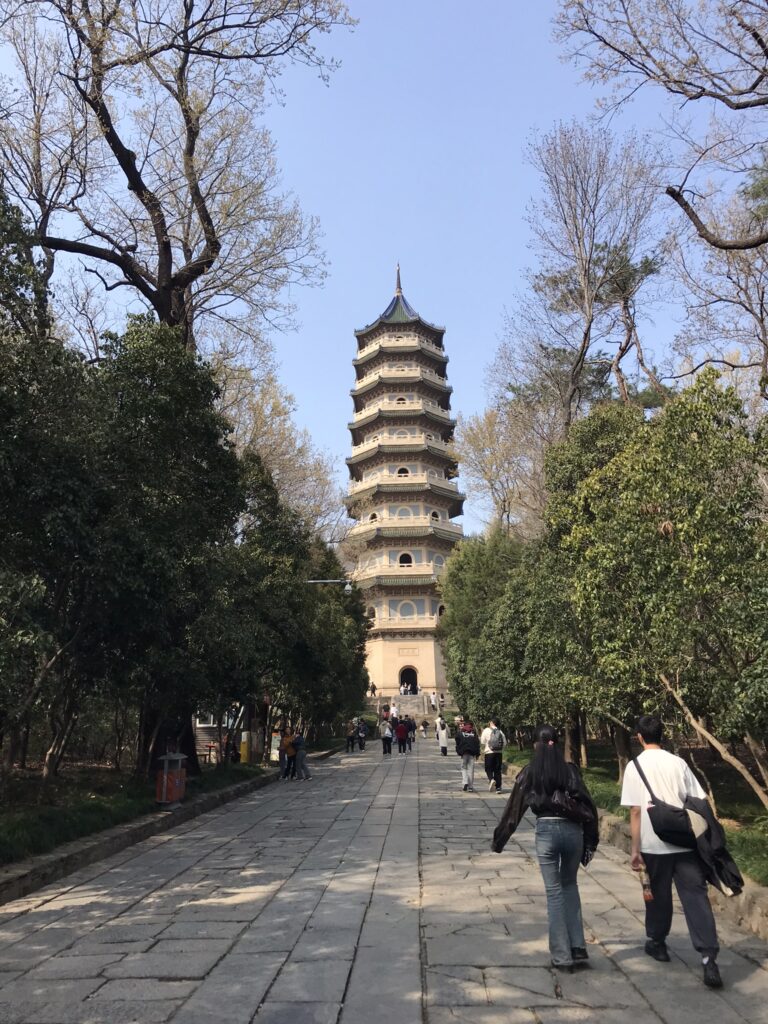
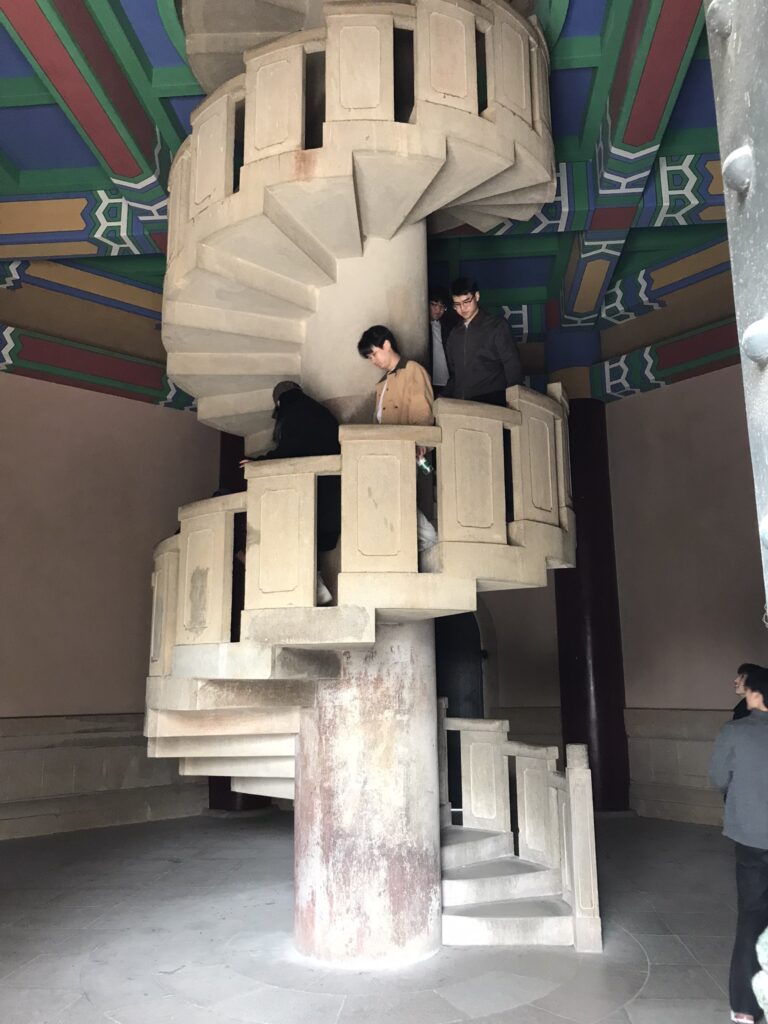
The spiral staircase leads to the top of the pagoda
After visiting the pagoda, follow the path to the east of the central axis and you will reach the Linggu Temple.
Linggu Temple was originally built in 515 CE to honour the burial site of Baozhi, an enigmatic Buddhist monk who was a teacher of Emperor Wu of the Liang Dynasty. The temple originally stood further to the west, on the present site of the Ming Xiaoling mausoleum – it was disassembled and moved eastwards to its current location in 1381 to make way for the construction of the imperial mausoleum. Originally known as Kaishan Temple, it was greatly expanded and renamed to Linggu Temple (Spirit Valley Temple) by the Hongwu Emperor following the relocation.
Most of the buildings at Linggu Temple were destroyed by the Taiping Rebellion of the 1850s, and it was rebuilt shortly afterwards during the later Qing dynasty. The current structures mostly date from that time. The temple’s layout was altered slightly and its total area was made smaller in the 1920s in order to make way for the construction of the nationalist memorial area along Linggu’s central axis.
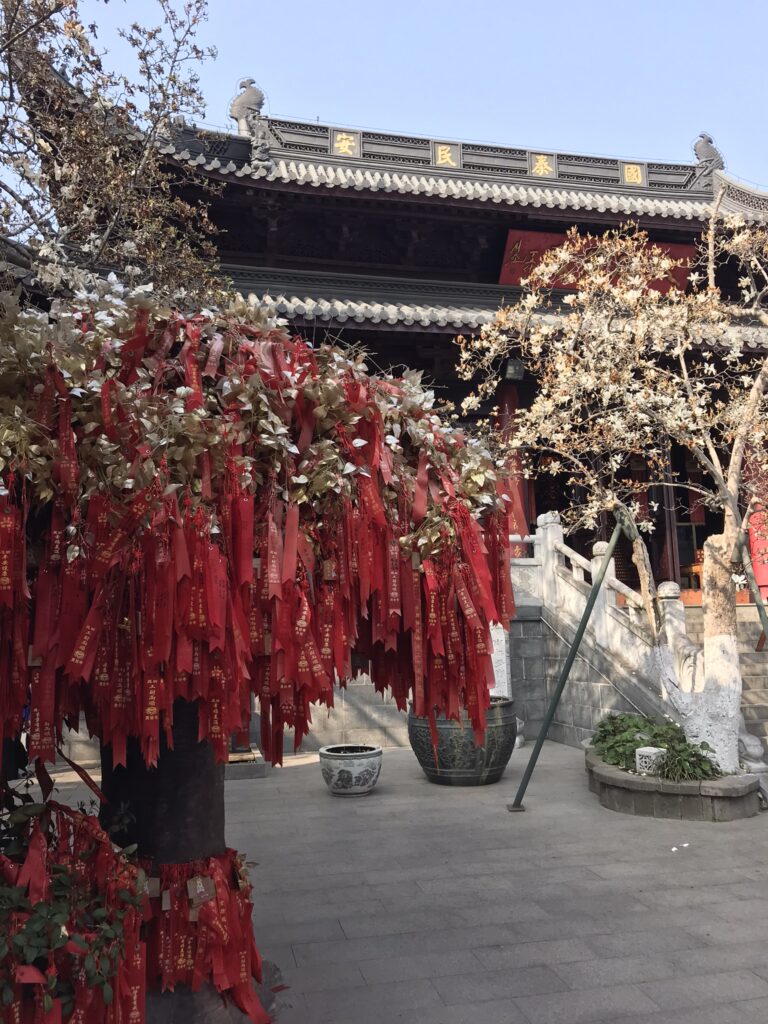
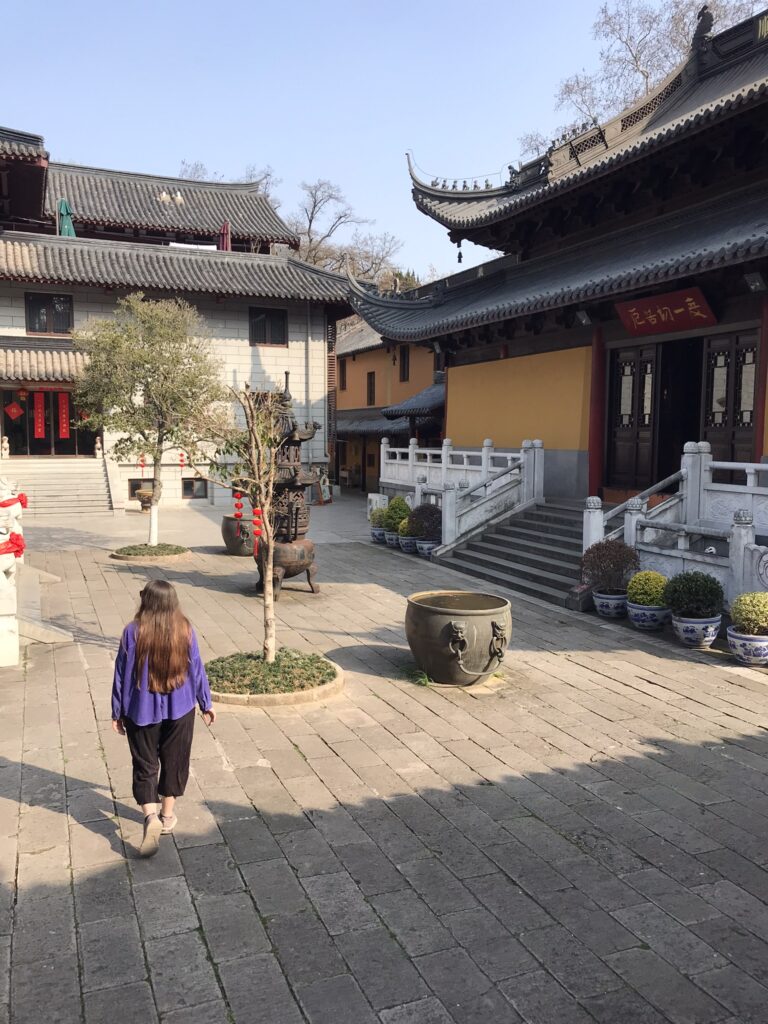
Linggu Temple has been moved, rebuilt and remodelled several times over the centuries
Linggu Temple is still a working Buddhist temple with a resident monastery, so respectful attire and behaviour is advised. The temple complex includes several halls, courtyards, pavilions and shrines. English-language info plaques within the complex contain helpful information about the various structures and deities enshrined within, and there are even English transliterations of Buddhist mantras and chants so visitors can follow along.
A notable feature of Linggu Temple is the Xuanzang Chapel towards the northern end of the complex. Xuanzang was a Buddhist monk who lived in the 7th century CE during the Tang dynasty and is known for his 17-year pilgrimage along the Silk Road to India in order to collect and translate Buddhist scriptures. Following his death, Xuanzang was buried in Chang’an (modern day Xi’an). During the Song dynasty his remains were transferred to Nanjing and stored in what later became the Grand Bao’en Temple, near to Zhonghua Gate and the Laomendong area in the south of the modern city. Grand Bao’en Temple was destroyed and razed to the ground during the Taiping Rebellion in the mid 1800s and Xuanzang’s remains were later discovered in the 1940s by occupying Japanese forces who were digging to build a Shinto shrine over the former temple site. His intact bone relics were divided up – some were stolen by Japan and later returned to the Republic of China government in Taiwan during the 1950s. Other pieces of the bone relic were transported to Beijing and some remained in Nanjing. In the 1970s, the Nanjing portions of the relic were moved to be venerated here at Linggu Temple.
Directly below the main Xuanzang Chapel hall is the Underground Palace, which contains the enshrined remains of Xuanzang as well as interesting relics and artefacts relating to the monk and his travels.
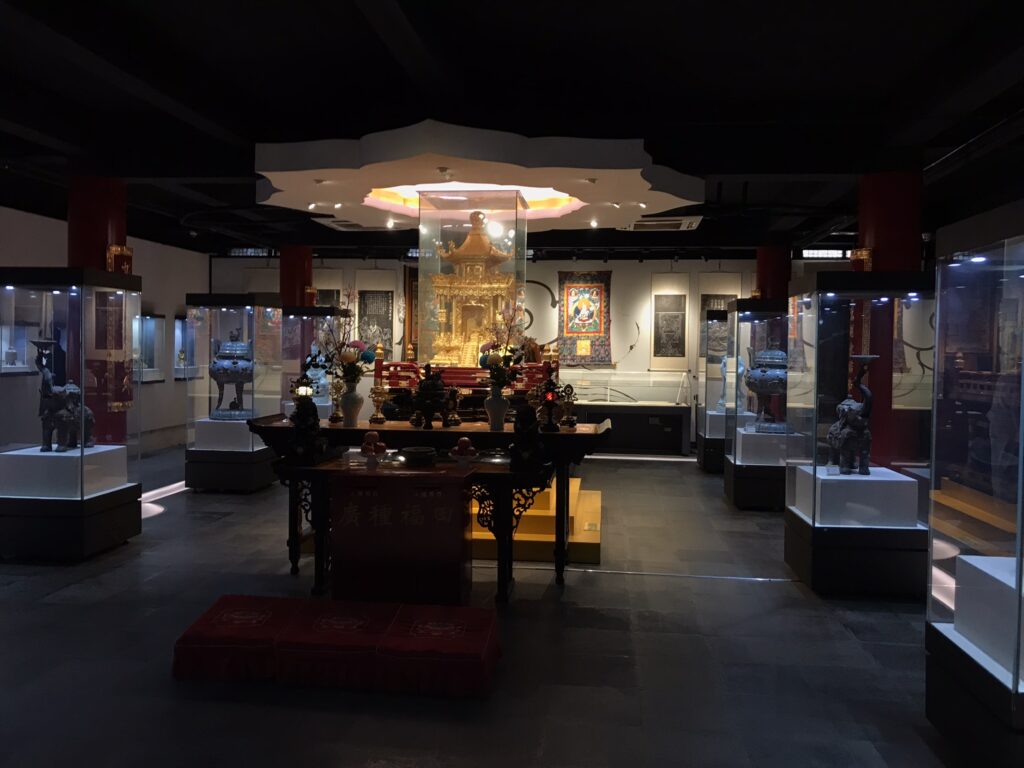
The ‘underground palace’ is well worth checking out
Further to the east of Linggu Temple are the tombs of Tan Yakai and Deng Yanda, two prominent Kuomintang figures who died in the early 1930s. Tan briefly served as a premier of the Republic of China and was given a state funeral after he died of a brain haemorrhage, while Deng Yanda is an interesting figure. A contemporary of Sun Yat-sen, he was a socialist who supported co-operation with the Chinese Communist Party and broke away from the Kuomintang due to the dictatorial tendencies of Chiang Kai-shek, later forming his own party which is still active in China today. Deng was executed as a traitor in 1931 for his opposition to Chiang, but his legacy was celebrated once the Chinese Communist Party took power in the 1940s and his tomb was relocated to Purple Mountain in 1957.
To the west side of Linggu scenic area, Baogong Pagoda and Zhigong Hall venerate the monk Baozhi. Baogong Pagoda dates back to the construction of the original Linggu Temple in 515 CE, and it was moved along with the remains of the monk and the rest of the temple complex in 1381 to make way for the Ming Xiaoling mausoleum. The pagoda was moved again in the 1930s to make way for the construction of the nationalist military cemetery along Linggu’s central axis, and Zhigong Hall was added during this time. As it had partly been restored by Japanese invaders in the 1940s, Baogong Pagoda was destroyed during the Cultural Revolution in the mid-20th century and rebuilt again with a new design in the 1980s.
Further to the north of Baogong Pagoda, deep in the woods, the so-called Guilin Stone House is the former villa of Kuomintang leader Lin Sen. Seen as a puppet administrator during the era of Chiang Kai-shek, Lin Sen was named Chairman of the Government of the Republic of China following Chiang’s brief deposal in 1931. He was therefore the official President of the Republic of China from 1931 until his death in 1943, but he was generally seen as a powerless ceremonial figurehead while actual authority lay with the military strongman Chiang Kai-shek. Lin Sen lived in this simple house rather than in the Presidential Palace, which was occupied by Chiang. Lin Sen later fled to Chongqing with the rest of the Republic of China government following the Japanese invasion in 1937, and the villa, which was only built in the 1930s, was by destroyed by the Japanese and left to ruin within the dense woodland of Zhongshan.
There are numerous other attractions, leisure sites, gardens, pavilions and pagodas around the wider Purple Mountain scenic area. An Indian tourist at Muxuyuan metro station asked us for directions to the aquarium (it’s near the entrance to the Mausoleum of Sun Yat-sen). There are also several hotels and guesthouses within the area. For more Nanjing and China content, click here!