You wouldn’t realise at first glance but the small, quiet town of Hiraizumi in northern Honshu was once the political and cultural focal point of northern Japan, rivalling Kyoto in size and importance. This was the home of the Northern Fujiwara dynasty, which ruled most of northern Japan at odds with the Kyoto court during the 1100s. Having been developed as a capital by the founder of the dynasty, Fujiwara no Kiyohira, the city prospered for almost a hundred years until it was destroyed in 1189 by the forces of Minamoto no Yoritomo, the founder of the Kamakura shogunate who took vengeance upon the Fujiwaras for sheltering his rebellious younger brother. Hiraizumi’s glory was lost and the city faded back into obscurity. Today, the few remnants of this brief boom period almost 1,000 years ago have earned UNESCO World Heritage status for Hiraizumi. Check out this self-guided walking tour of the sleepy town’s main sites!
Start and end at Hiraizumi train station, which is easily accessible on the Tohoku Line with direct trains from the Shinkansen hubs of Morioka or Ichinoseki.
From the train station entrance, take the first right and head north. After a few hundred metres, turn right along Iwate Prefectural Route 206. Passing out of the town and into the rural landscapes, you will soon reach the Yanagi-no-Gosho site on your left. During Hiraizumi’s peak in the 1100s, this seemingly nondescript field was the site of many important buildings relating to the Fujiwara clan, the administration of the city and wider domain. If was from here that the Fujiwara’s administrators and bureaucrats governed much of northern Japan. The locations of the former buildings in the field are marked by information plaques, giving visitors an opportunity to explore and visualise the size and layout of this former political hub.
Across the road from the entrance to the Yanagi-no-Goshi site is the Hiraizumi World Heritage Information Centre, a small museum with paid admission which contains comprehensive information about the town’s history and UNESCO sites. The museum is mainly targeted towards Japanese visitors with few English translations inside, so non-Japanese speakers may want to skip it in favour of the free museum later on.
When you’re finished in this area, retrace your steps back along the road into town and then continue north along Chusonji Street. On your left you will see the Muryoko-in Temple Site. This now-destroyed complex was typical of the Pure Land Buddhist temple design that Hiraizumi became known for. With their various islands, lakes, hills and green spaces, the temple gardens of this style were intended to represent a Buddhist ‘pure land’, a place of beauty, peace and tranquillity in order to create a paradise on Earth. These features can all be seen in the topographical layout of the former Muryoko-in site. The temple which once stood here was constructed by the third and penultimate Fujiwara lord, Hidehira, and was said to be aligned with the sunset over nearby Mount Kinkei on auspicious days of the year, creating a paradisiacal image. The buildings fell into ruin following the fall of the Fujiwaras and were eventually lost to time, with only the grounds remaining today. Exemplifying the Pure Land style despite the lack of any remaining structures, the Muryoko-in site is a component of the wider Hiraizumi UNESCO World Heritage Site.
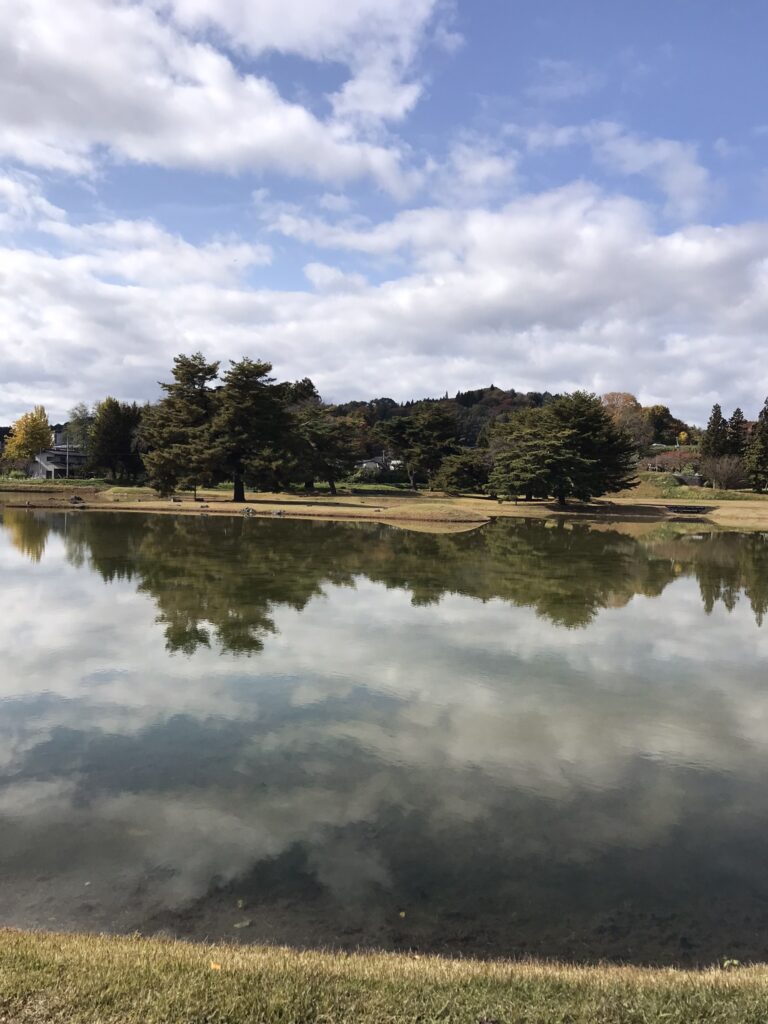
The site of the former Muryoko-in
From Muryoko-in, continue north along Chusonji Street and take the third right. Follow the road around until you reach the ticket booth for Takadachi Gikeido. This is the said to be the former site of Koromogawa-date, the castle in which Minamoto no Yoshitsune (the headstrong younger brother of the founder of the Kamakura Shogunate, Minamoto no Yoritomo) committed seppuku as part of a series of events which ultimately led to the downfall and destruction of Hiraizumi.
A military general during a period of upheaval at the end of the Heian period, Minamoto no Yoshitsune was said to have initially enjoyed a close relationship with his older brother, the powerful warlord Yoritomo, however the two fell out after Yoshitsune began to seek his own independence. Having been declared an enemy of the state, in 1185 he fled to the north and sought refuge with the Fujiwara clan, whose leader Hidehira accepted and sheltered him at Hiraizumi. Following Hidehira’s death two years later, his successor Fujiwara no Yasuhira had initially pledged to uphold his father’s wish to protect Yoshitsune. However facing pressure from the powerful shogun Minamoto no Yoritomo and his burgeoning Kamakura regime, in 1189 Yasuhira betrayed Yoshitsune, surrounding and attacking him at his residence, Koromogawa castle. This was known as the Battle of Koromogawa, an incident that was immortalised in Japanese folklore due to the brave performance of Yoshitsune’s loyal warrior Benkei, who was said to have died on his feet while defending the castle.
Facing capture, Yoshitsune committed suicide and his head was sent by Fujiwara no Yasuhira to Minamoto no Yoritomo as a way of trying to appease the vengeful shogun and prevent him from attacking Hiraizumi in the future. This offering had the opposite effect and the enraged Yoritomo attacked Hiraizumi anyway, killing Yasuhira, destroying the city and ending the rule of the Northern Fujiwara clan. Today on the site of the former castle is a small shrine and memorial which is dedicated to Yoshitsune. The site also features a tribute to the famous haiku poet Matsuo Basho, who visited Hiraizumi as part of his tour of Tohoku in the 17th century, as well as a viewpoint where visitors can look out over the Katakami River, the surrounding countryside and mountain peaks, just as Yoshitsune and Basho surely did many years ago.
Be aware that access to Takadachi Gikeido may be closed during winter months. After visiting, head back to Chusonji Street and turn right, heading north once again. Pass over the train tracks and you will reach the main road – turn right, cross the road and you will see the marker for the Grave of Musashibo-Benkei.
A fabled ‘warrior monk’, many legends surround Benkei and he is a prominent figure in Japanese folklore, said to be a fighter of great loyalty and strength. Having accompanied Minamoto no Yoshitsune in exile, Benkei was killed while defending his master in the Battle of Koromogawa. The legend goes that having been unable to defeat him in hand-to-hand combat, the enemy resorted to firing arrows at Benkei which seemingly had no effect, terrifying his opponents. They later discovered that Benkei had died on his feet, a testament to his valour and strength.
After the grave site, continue for a short distance until you reach the path marking the approach to Chuson-ji.
The most famous attraction in Hiraizumi, the Chuson-ji temple complex spans the upper reaches of Mount Kanzen. The first temple here was purported to have been founded by the prolific monk Ennin in the 9th century, but the complex was greatly expanded by the first Fujiwara lord, Fujiwara no Kiyohira, following his establishment of the capital in Hiraizumi at the start of the 12th century. Inspired by the concept of Pure Land Buddhism, Kiyohira sought to create a paradise on Earth which would be a peaceful realm for both friend and foe. This philosophy was also later adopted by his heirs and successors, Fujiwara no Motohira and and Fujiwara no Hidehira.
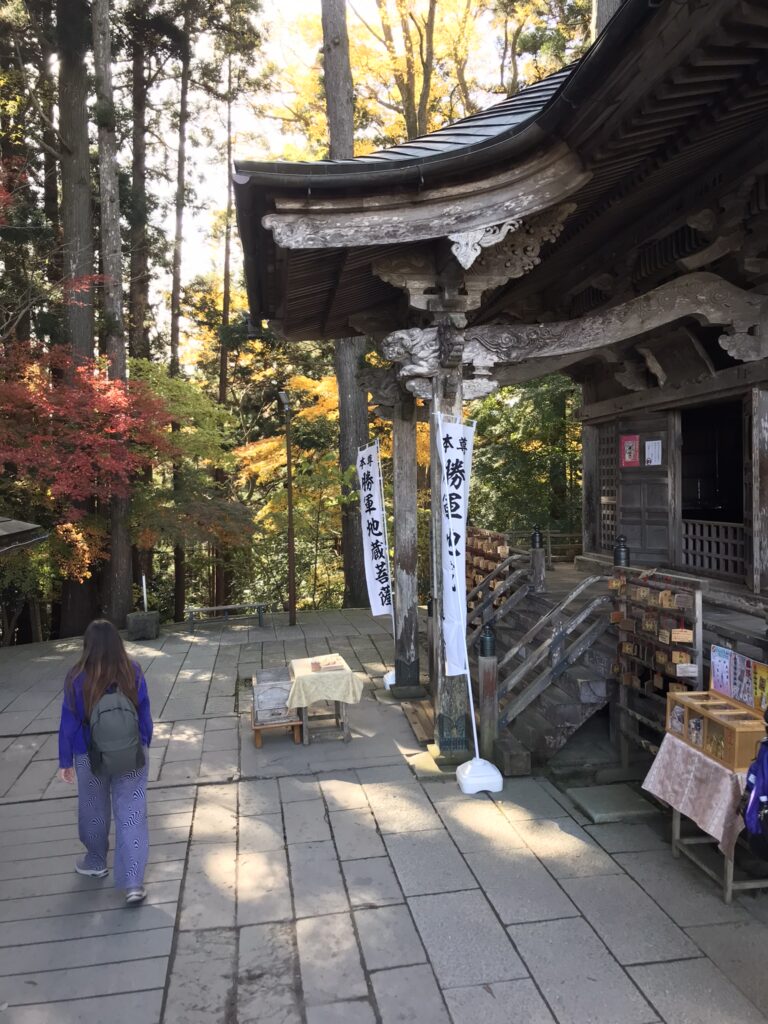
There are several smaller structures and shrines to explore within the Chuson-ji area
Originally consisting of over 40 structures, many of the buildings of Chuson-ji were destroyed by a devastating fire in the 14th century. Today only a small number of structures remain, most of which have been reconstructed over time. Nevertheless, this is considered to be an auspicious spot and a centre of Japanese Buddhism as well as a major tourist destination within the Tohoku region.
The most famous attraction at Chuson-ji is the Golden Hall, also known as Konjiki-do. This immaculate gilded hall was created in 1124 and serves as a mausoleum for the first three Fujiwara lords, as well as the head of the final Fujiwara lord (Fujiwara no Yasuhira) after it was returned by the Kamakura shogunate. Konjiki-do is one of the only remaining structures in Hiraizumi which dates back to the city’s 12th century heyday, providing a glimpse of the long-lost glory and wealth of this short-lived dynasty. Today, Konjiki-do is protected within a larger concrete structure and preserved behind a screen.
Another major attraction of Chuson-ji is the Treasure Hall (Sankozo). More than 3,000 National Treasures and Important Cultural Properties have been recovered from Chuson-ji and some of the most impressive can be found within this small museum, including a number of huge and finely-preserved Buddhist statues as well as artefacts from the Fujiwara clan.
As well as these two main attractions, there are a number of other shrines and buildings within the wider Chuson-ji complex including the Hondo (main hall), which was restored in 1909, and a stage for the ancient Japanese folk theatre, Noh. The small sutra repository near to the Konjiki-do is said to be the only other building which remains unchanged since the Fujiwara era in the 12th century, having been constructed in 1123.
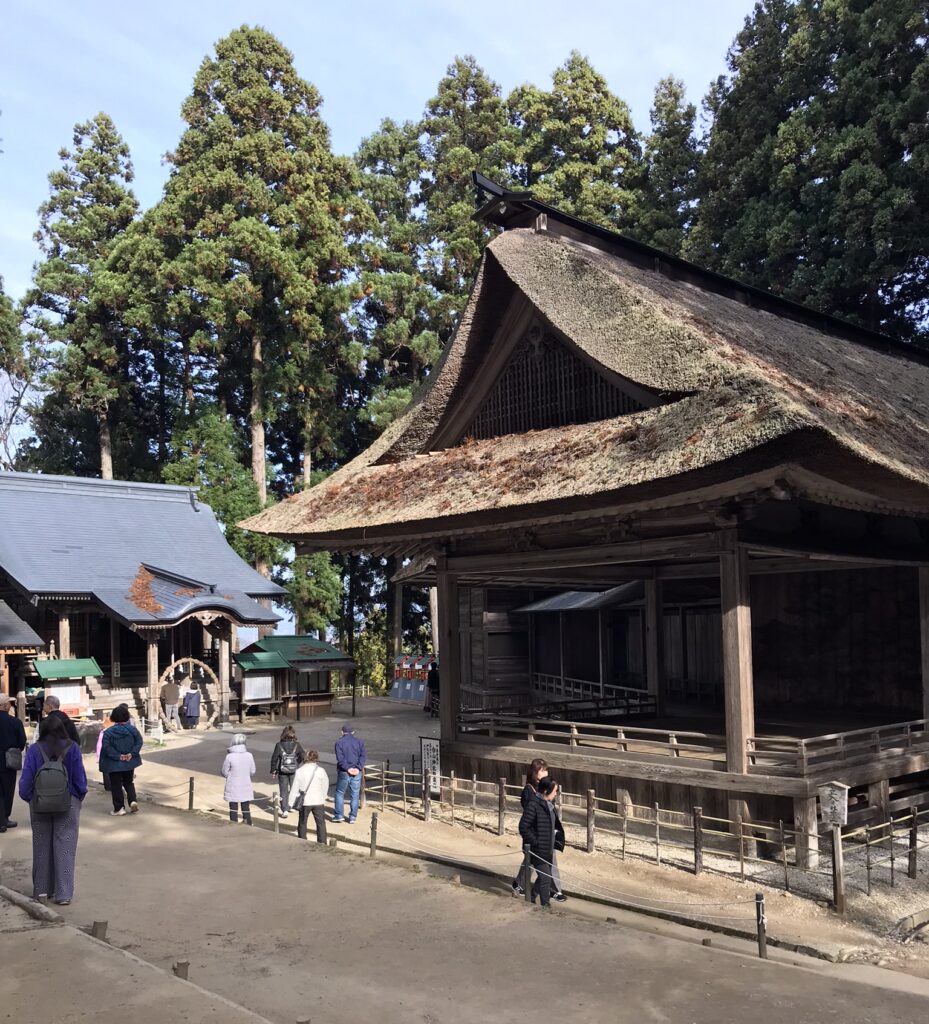
The Noh stage at Chuson-ji
Admission to the Konjiki-do and Treasure Hall is ticketed, while the rest of the Chuson-ji complex can be freely explored. Be aware when accessing the site that it is is a bit of a steep walk up Tsukimizaka Slope to the top, although there are plenty of places to stop along the way.
After exploring the Chuson-ji complex, head back down the slope to the main road. Go southeast along Route 300, take the second right and continue southwards up the slope. You will reach Hiraizumi Cultural Heritage Centre on your right hand side. This free museum contains information about the history of the Fujiwara clan, Hiraizumi, the local dynasty and the wider region. English-language leaflets are available here for non-Japanese speakers, making it an ideal place to gain more in-depth information about Hiraizumi’s fascinating history.
The museum is located in the midst of Mount Kinkei (Kinkeisan), an auspicious hill which was used as a sutra mound during the Fujiwara era and served as a focal point and shakkei (borrowed scenery) for the Pure Land temples built by the Fujiwara lords in the surrounding area. Legend has it that a golden cockerel was buried atop the hill by the second Fujiwara lord, Motohira, giving the mount its name. While the cockerel itself has never been found, excavations of the hill have discovered a number of sutra containers and other artefacts dating from the Fujiwara period and the hill has been included as part of Hiraizumi’s wider UNESCO World Heritage Site as a result.
From the museum, continue south along the road and down the hill. You will eventually reach the former site of Kanjizaio-in on your right hand side. On this site once stood a temple complex which was founded by the wife of the second Fujiwara lord, Motohira. Linked to the nearby Motsu-ji, the temple was lost to fire in 1198 (just a few years after the demise of the Fujiwara dynasty), and the final structures here were destroyed once and for all in the late 16th century. The temple that once stood here is described in chronicles and historical archives from the Kamakura period, with many of these descriptions having later been verified by archaeological excavations. Today nothing remains other than the immaculately-landscaped Pure Land gardens, which can be freely appreciated and explored. This style of Pure Land temple garden was prototypical of the more contemporary Japanese-style gardens which gained popularity throughout the nation and, later, acclaim throughout the wider world.
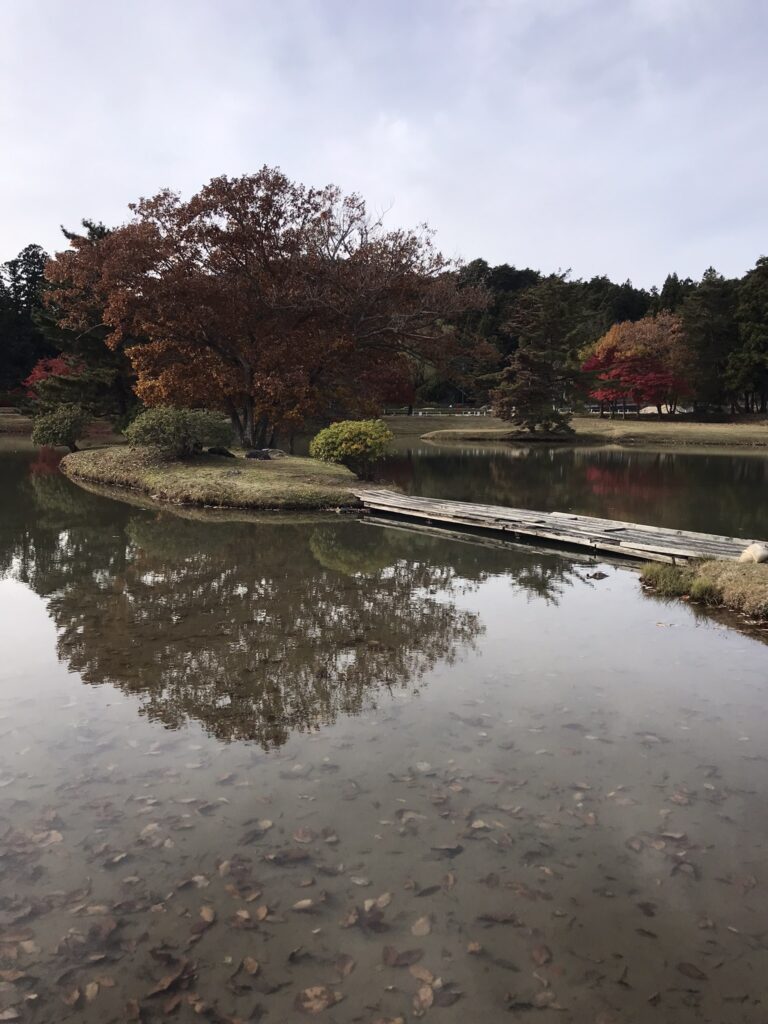
The sculpted pond of the former Kanjizaio-in
The gardens at Kanjizaio-in were restored to their original state in the 1970s, having fallen into disarray and been used as paddy fields for a time. A focal point is Maizurugaike (dancing crane pond), a 90-metre pond which is said to resemble a crane from above.
After walking through the peaceful grounds of the former Kanjizaio-in, turn right and head west along the main road. You will soon see the entrance to the Motsu-ji temple complex.
Motsu-ji was built by the second Fujiwara lord, Fujiwara no Motohira. Continuing his father’s Pure Land ideology following the construction of Chuson-ji, Motohira once again developed the site of a temple that was said to have been founded hundreds of years earlier by the wandering monk Ennin. On this site Motohira built a new temple known as Enryu-ji. This is said to have been one of the most spectacular structures in the land, covered with gold, silver, jewels and precious materials. After its completion, Motohira was so impressed that he ordered an exact replica to be built next door, known as Kasho-ji. Following Motohira’s death, Kasho-ji was completed by his son and successor Hidehira. Hidehira then began to develop his own temple complex with the construction of Muryoko-in across the city.
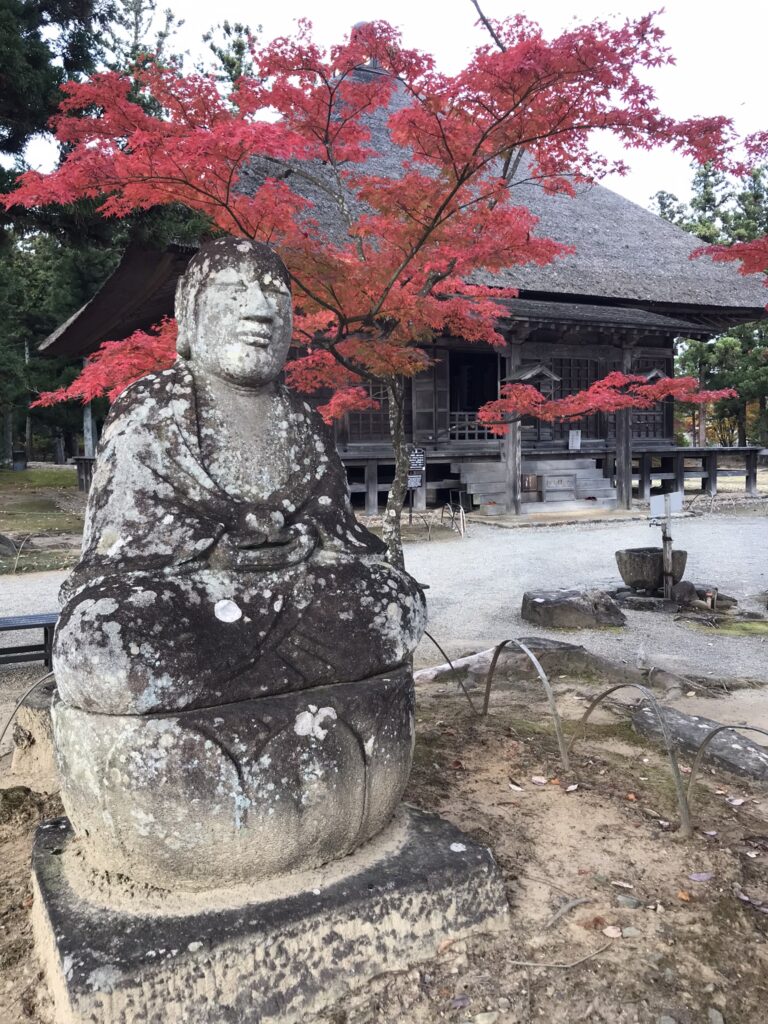
An old sculpture within the gardens of Motsu-ji
The Motsu-ji complex is said to have contained almost 40 buildings at its peak, centred around the sculpted Pure Land gardens and scenery. As part of the Pure Land philosophy, the temple buildings were said to have been designed and created in harmony with the landscape. When combined with nearby Kanjizaio-in, the whole area would’ve made for a magnificent sight. Sadly the temple buildings were not preserved, succumbing to fire and destruction in the years following the demise of the Fujiwara clan and the downfall of Hiraizumi.
Today, the Buddhist temples that do stand at Motsu-ji only date back a few hundred years and bear no relation to the earlier structures. However the Pure Land gardens and pond remain much as they were during Hiraizumi’s heyday. Depending on the season, this is a great place to enjoy the peace and tranquillity amidst the cherry blossom, summer greenery or autumnal foliage. The site is exceptionally pretty and atmospheric, providing a perfect illustration of the Pure Land garden concept.
Admission to the Motsu-ji site is ticketed. As well as exploring the gardens it’s possible to enter the temple buildings and the ticket also includes access to a small on-site museum with some displays and artefacts, although there are not many English translations inside.
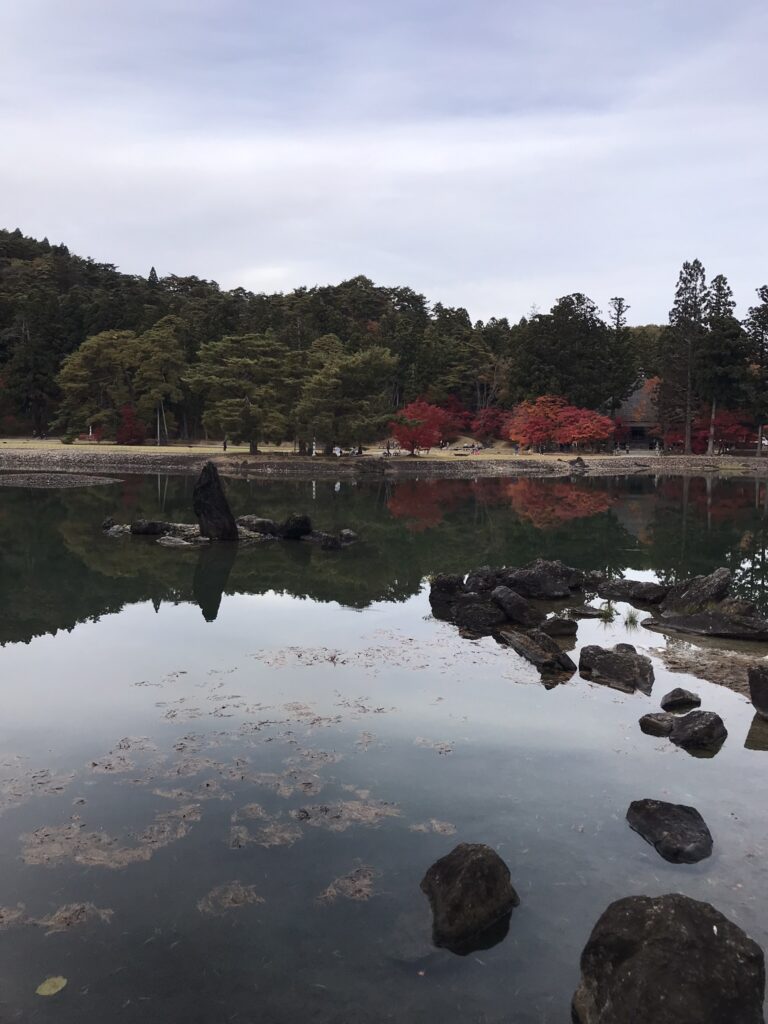
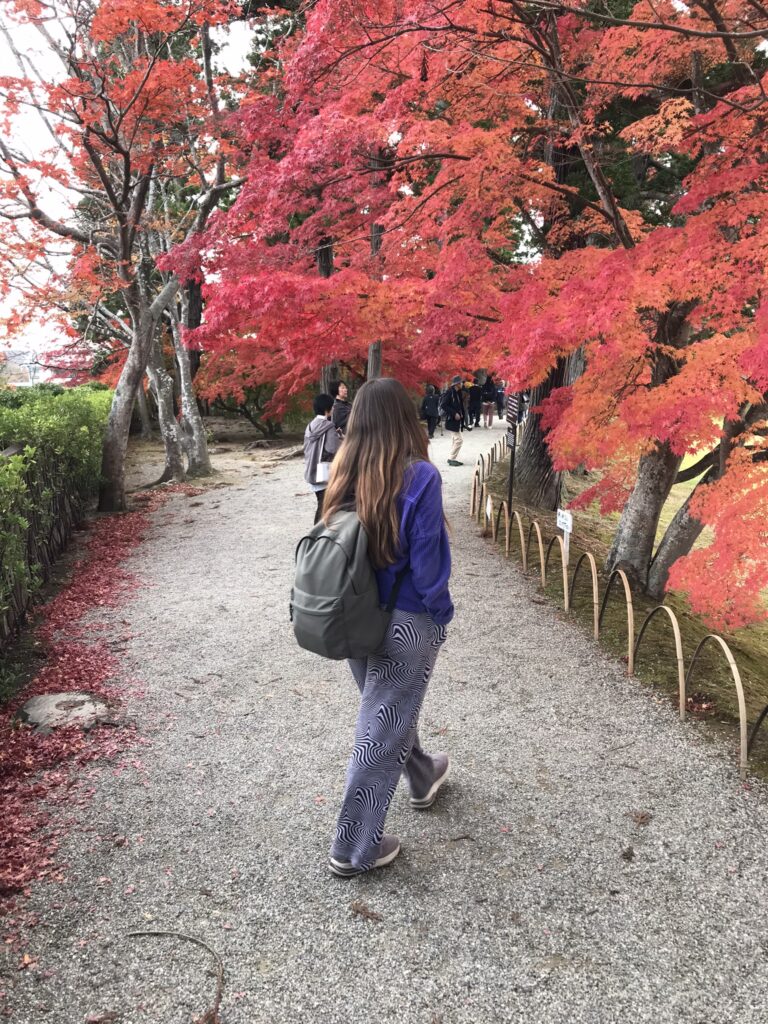
The Pure Land gardens of Motsu-ji
Centuries after the downfall of the Fujiwara dynasty, the famous 17th century haiku poet Matsuo Basho visited Hiraizumi, where he was inspired to compose one of his most famous haikus:
Oh, the summer grass
All that remains
Of a warrior’s dreams
From Motsu-ji, it’s an easy walk back to Hiraizumi train station. For more Tohoku and Japan content, click here!
This article is also featured on GPSmyCity. To download this article for offline reading or create a self-guided walking tour to visit the attractions highlighted in this article, go to Walking Tours and Articles in Hiraizumi.