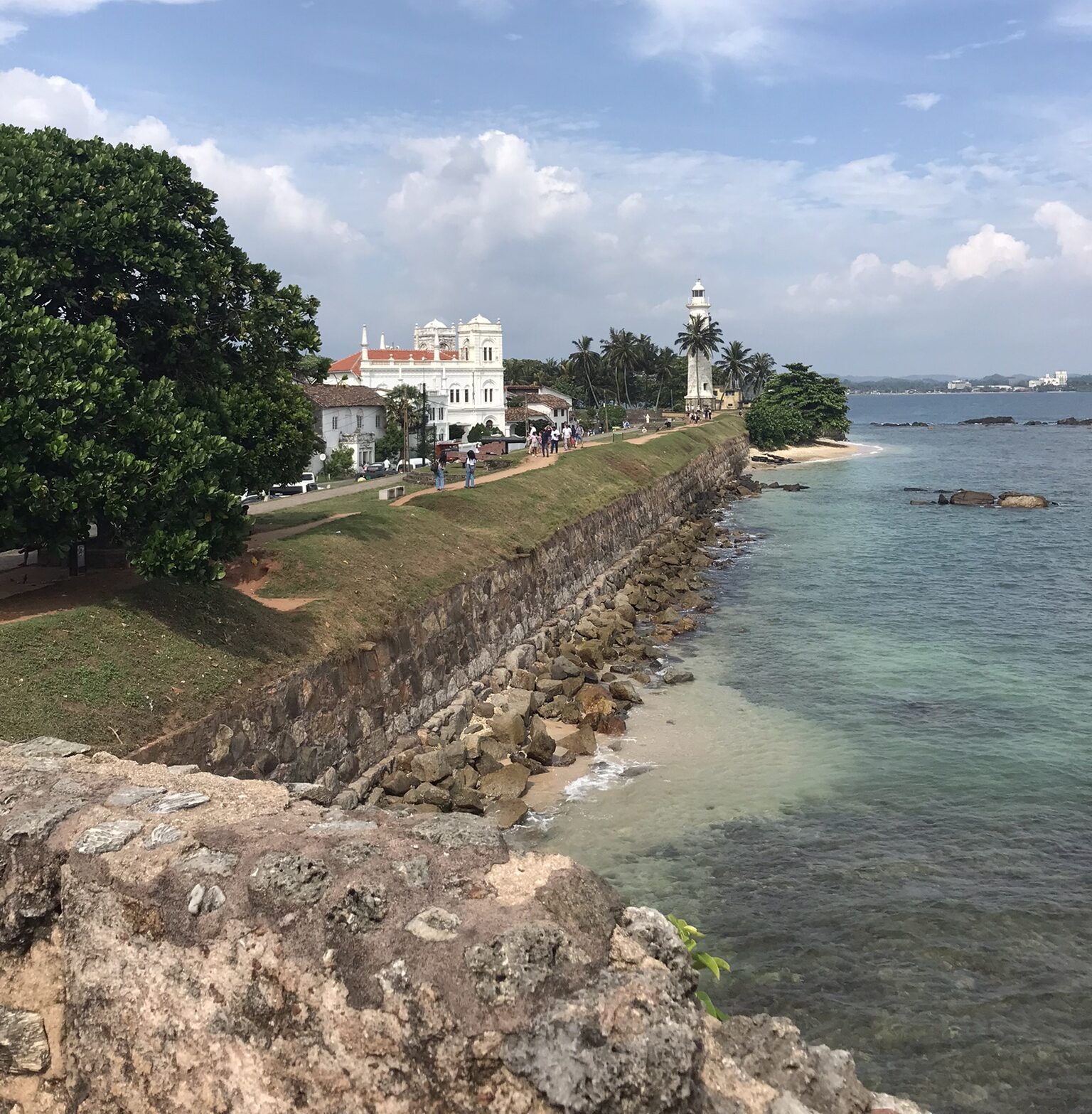
By far the most intact colonial fortified city in Sri Lanka, Galle marks the location of the first Portuguese landing on Sri Lanka in the early 1500s. Following its capture by the Dutch in the 1640s, Galle was heavily fortified, briefly functioning as the capital and then becoming the major port of the Dutch East India Company (VOC).
What remains today is a picturesque remnant of a bygone era. The imposing walls surrounding the city make a great place for walking, watching the sunset or just admiring the views across the shoreline and Indian Ocean, while the narrow interior streets are filled with colonial delights. Exceptionally preserved and restored over time, Galle Fort is both a UNESCO World Heritage Site and also a functioning settlement. People live and work within Galle Fort, while it also serves as a popular and romantic destination for both domestic and international tourists.
When visiting Galle Fort, part of the joy is just meandering through the backstreets and stumbling across the various hidden gems and colonial relics. This walking tour provides an overview of some of the key sites within the fortified city that should help you get started.

Start at the Dutch Reformed Church.
Also known as ‘Groot Kerk’ (meaning Grand Church), this unmistakably Dutch protestant church was completed in 1755. The floors and walls inside the church are filled with elaborate grave markers from both the Dutch and British eras, some of which are ominously decorated with skull and crossbones. The small graveyard outside is also filled with colonial graves. A groundskeeper was providing explanations and short tours of the church to tourists for free when we visited, but I can’t guarantee that this is always the case.

One of the many foreboding grave markers inside the Dutch Reformed Church
Across from the Dutch Reformed Church you can find the Maritime Museum, situated in a mustard-yellow former Dutch warehouse building. The warehouse dates back to the late 1600s and has been used for various purposes over the years, becoming the Maritime Museum in 1992. Interestingly, this is one of the few buildings in the fort which is actually built into and makes up part of the outer wall fortifications.

The mustard-coloured museum/Dutch warehouse building is pretty difficult to miss
Head east down Queen Street and you’ll come to the Old Gate. Otherwise known as the Portuguese or Dutch Gate, this is the original entrance to the fortified city and was the only entrance until the construction of the current Main Gate by the British in the 1870s. The Old Gate actually bisects the warehouse building which is now the Maritime Museum. Interestingly, the exterior face of the gate displays the British coat of arms, while on the interior side of the gate you can still find the Dutch ‘VOC’ logo and a reference to the year 1669.

This Dutch insignia remains on the inside of the gate, while the British emblem is displayed on the outside
Head further along Queen Street and you will reach Court Square. As the name suggests, this square contains Galle Magistrates Court and various administrative judicial buildings. This is very much an active court – during weekdays you can usually find lawyers, their clients and/or family members of those involved in the proceedings milling about outside. The square serves as a reminder that Galle Fort is still a living and working part of the city.
Walk south down Leyn Baan Street from Court Square and you’ll come to the Historical Mansion Museum on the left. Located in a former Dutch townhouse, this is more of a collection of curiosities than a real museum. Entry is free and it’s an interesting place to peruse the many antique items on display. There is also an 18th century well in the central courtyard, which you may or may not be invited to use by the jovial guards.
After visiting the Historical Mansion Museum, head left down Pedlar Street. The road will emerge onto Hospital Street and on the left hand side is the Dutch Hospital. One of the most grandiose colonial structures in the city, the former hospital building has been used for many purposes over the years, including a military barracks during the British period and later as Galle’s town hall. In recent years it has been converted to a luxury shopping precinct, now featuring a range of high-end shops, restaurants and bars within the old colonial building.

The old hospital building is now the place to go for a fancy evening out
Head south down Hospital Street and you will eventually come to Galle Lighthouse. Established in the 1840s by the British, this is the oldest lighthouse in Sri Lanka, although the original building was destroyed by fire and rebuilt in 1939. Near to the lighthouse you can find the diminutive Lighthouse Beach, which is one of the only beaches accessible from Galle Fort. The beach is very small and surrounded by jagged rocks, but you’ll probably find locals in the sea regardless.

Galle Lighthouse with Meeran Mosque in the background
Heading west along the walled fortifications from the lighthouse, you’ll pass Meeran Mosque. This mosque is very interesting as it looks more like a colonial church – the only giveaway is the Arabic writing and small crescent moon designs on the façade. Galle Fort has a significant Muslim population, historically linked to Arab traders and merchants who visited and settled in the area. There is some evidence within Dutch chronicles of a mosque on this site since the 1790s, although the current structure dates back to 1904.
Continue on to the south-western corner of the fort where you’ll reach Flag Rock Bastion. The name derives from the days before the construction of Galle Lighthouse, when Dutch maritime workers would wave flags and shoot muskets to alert passing ships. Today, Flag Rock provides picturesque views of the fort as well as a great (but busy) spot for watching the sunset. A ‘Professional Crazy Jumpers’ sign proclaims that a group of daring locals cliff dive from the rock head-first into water that is only 1.5 meters deep. I don’t advise attempting this yourself.

Don’t follow the example of these guys
Walk northwest along the wall fortifications and you’ll pass Triton Bastion. There are 14 named bastions in total around the external walls of the fortified city. Continue along the walls and you’ll eventually come to Clippenberg Bastion. Also known as ‘turtle hotspot’, this is a great place to spot sea turtles and tropical fish in the waves below, as well as the odd monitor lizard on the land.

Clippenberg Bastion may be ‘turtle hotspot’ but there are plenty of tropical fish to be spotted too
Continue north along the wall past Aeolus Bastion and you’ll spot the Grave of Bathri Waliyullah on the outside of the walls next to the sea. This is the grave marker of an unnamed Muslim Sufi saint who is said to have washed up on the shores and been buried in the spot he was found. Bathri Waliyullah or Bathiri Zirayam roughly translates to ‘Saint beside the batteries (fortifications)’. His actual name is unknown. References to this site can be found in Sufi literature dating back to the 1880s, although it is speculated that the grave is much older. The site is maintained by the local Muslim community as part of an annual ceremony but is largely off-limits for visitors.

The grave of the mysterious Bathiri Zirayam
Passing the Sufi grave and continuing north, you will eventually reach Star Bastion. From here you’re able to see the prominent northern wall of the fort, which contained some of the heaviest fortifications. Head east from the Star Bastion and you’ll come to the Clock Tower, one of the iconic sites of Galle which was constructed by the British in 1883.
Near to the clock tower is Moon Bastion, the largest and most prominent bastion at the forefront of the fort’s historical defences. Model soldiers and cannons can still be found manning the bulwark and it’s possible to explore the inner and outer walls, ramparts and two-storey fortifications here. The bastion also provides views out over Galle International Cricket Stadium towards the new town. The cricket stadium is said to be one of the most scenic international cricket venues in the world.

These cannons look like they could still pack a hefty punch
Heading east along the walls from Moon Bastion passing over the British-built Main Gate and you will finally arrive at Sun Bastion, the last of the fort’s three major northern bastions. This bastion provides great views over Galle Harbour to the east.
Finish! For more Galle and Sri Lanka content, click here!
This article is now featured on GPSmyCity. To download this article for offline reading or create a self-guided walking tour to visit the attractions highlighted in this article, go to Walking Tours and Articles in Galle!