
Aqaba is Jordan’s only port city, occupying a small sliver of land at the northern extreme of the Red Sea. As a seaside town surrounded by dry rocky valleys and deserts, Aqaba sits at the intersection of a variety of different terrains as well as no less than four different countries. There are direct views from Aqaba’s waterfront into the neighbouring Israeli city of Eliat, the Egyptian settlement of Taba and the Sinai peninsula beyond, while the border with Saudi Arabia lies less than 20 miles to the south-east. As well as its interesting geographical location, Aqaba is probably best known for the prominent role it played during the Arab Revolt in the early 20th century, leading to the eventual independence of the modern state of Jordan as well as several other countries. Today, Aqaba is a popular resort destination for both foreign and domestic tourists and remains a vital maritime hub as the only seaport for the nation of Jordan. Check out this walking tour for some of the city’s historical and cultural highlights!
Start at the Early Byzantine Period Church
Although the modern city is mostly associated with Islamic period and 21th century history, the area around Aqaba has been inhabited for millennia and this lesser-known archaeological site is evidence of the long-forgotten Roman and Byzantine-era settlement of Aila which once stood here. Constructed between 293 and 303 CE, this now-ruined church is in fact considered to be the oldest purpose-built Christian church in the world. By all accounts, the church was not active for very long – it was destroyed by an earthquake in 363 CE and remained buried under the sand for centuries before being unearthed by archaeologists in 1998. Today, the ruins have been conserved and a roof has been installed. The site contains some helpful information plaques to provide context, as well as a walkway for visitors to circumambulate the ruins. Admission is free – just walk through the gate.

The oldest purpose-built church in the world
After visiting the church, head south to King Hussein Street. Cross the main road and then head east – you will see the ruins of the Ancient Islamic City of Ayla on your right hand side.
The early Islamic caliphate took control of the Roman city of Aila around 630 CE. It’s said that the Prophet Muhammad himself visited the area around this time. A new walled city was established close to the decaying Roman settlement by Uthman ibn Affan, the third Rashidun Caliph, around 650 CE. With its strategic location on the Red Sea, the new city of Ayla became a trade hub for the burgeoning Islamic Empire and is notable as being the first Islamic city to be established outside of the Arabian Peninsula.
Today, the walled city lies in ruins. It was destroyed by the 12th century. Don’t expect a polished tourist attraction – this is a raw, partially-excavated archaeological site. Often overlooked by visitors to Aqaba, those who do find themselves here are free to wander around and explore the ancient remains – providing the gate is open! Signage and information around the site is limited, but it’s possible to get a real visualisation of the layout, size and scale of the ancient city which played such an important role in the early spread of Islam.

Among the city’s ruined gates and walls can also be found the remains of one of the world’s oldest mosques
From the ancient city, head south along the main road, passing the small port on your right before heading down the stairs to Al-Ghandour Beach.
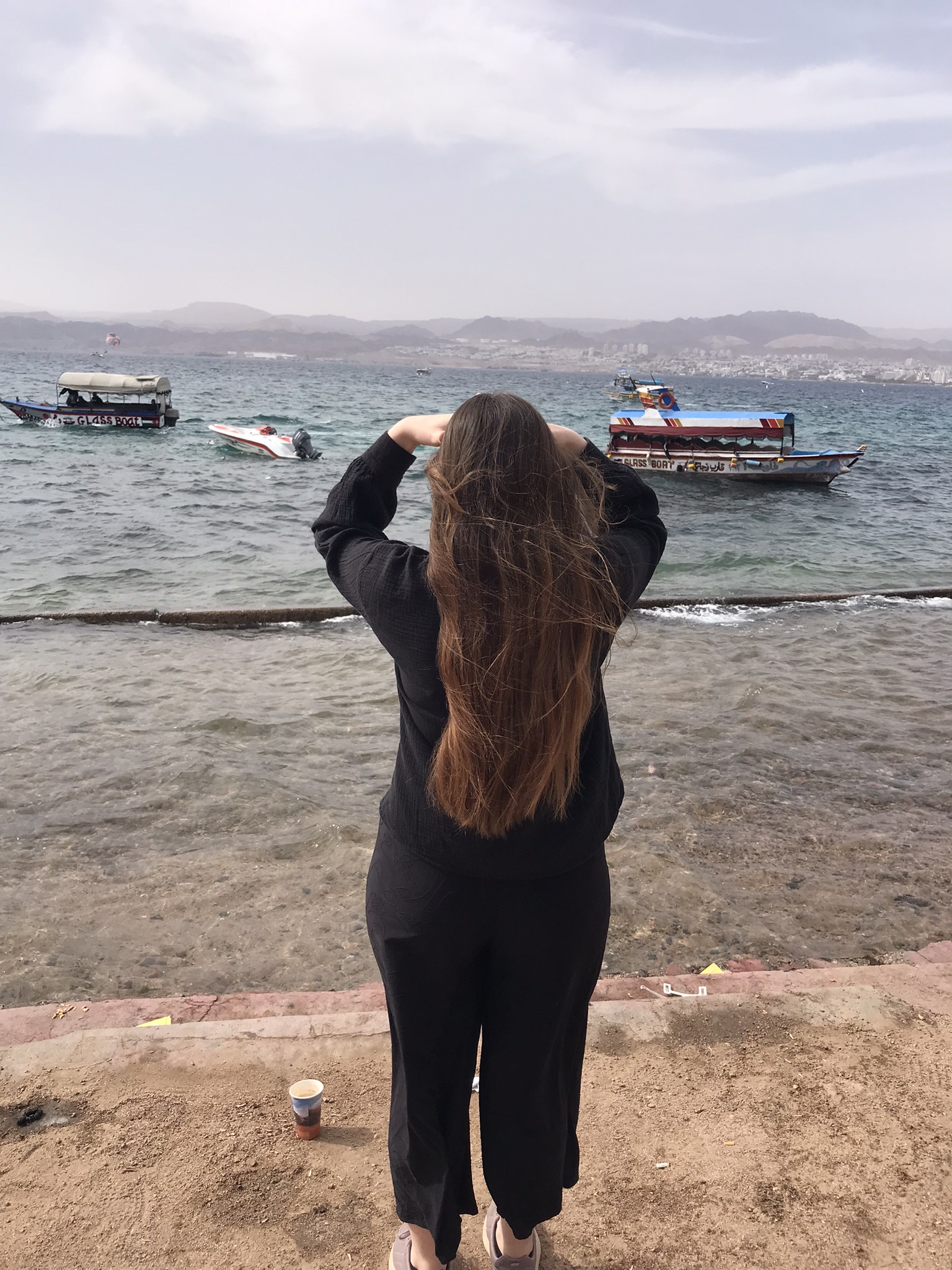
Al-Ghandour is the main public beach in Aqaba, running between the small port to the north (where ferries depart for Taba in Egypt) and Arab Revolt Plaza to the south. This is a central tourist spot in Aqaba, popular with both locals and regional visitors. At weekends there is a jovial atmosphere at the beach, with families enjoying picnics and shisha in the shade of the swaying trees, local children and grown-ups paddling in the Red Sea and hustlers offering ‘glass-bottom boat’ rides at every turn. The beach isn’t the cleanest and probably isn’t the best place for swimming or relaxing, but it is a great place to take a stroll and experience the vibrant and festive atmosphere.

You can find all manner of people enjoying the seafront at Al-Ghandour
Walk along the beach until you reach Arab Revolt Plaza to the south. This modern square is best known for its huge flagpole, which was said to be the tallest in the world at the time of its creation. Although at first glance it appears to be flying the Jordanian flag, on closer inspection you will see that it’s actually slightly different. This is in fact the Pan-Arabic flag, which was adopted during the Arab Revolt of 1916 and serves as the inspiration for the flags of many modern countries including Jordan, Kuwait, Palestine, U.A.E. and Sudan. The plaza was inaugurated in 2004 to commemorate the Arab Revolt, in which Aqaba played a consequential role as the site of a key battle and, later, as an important supply hub. The plaza itself has a laid-back and genial atmosphere. You can find locals and tourists alike milling about, eating and drinking in the nearby cafes, enjoying the sea views and watching the world go by.
On the east side of Arab Revolt Plaza is Sharif Hussein’s House Museum. The founder of the Hashemite dynasty, Sharif Hussein bin Ali al-Hashimi is a pivotal figure in Arabian history. Said to be a direct descendent of the Prophet Muhammad, Sharif Hussein was a symbolic leader in the Arab struggle for independence from the Ottoman Empire in the early 20th century. As the Emir of Mecca, his proclamation of Arabian nationalism in 1916 sparked the Arab Revolt, ultimately contributing to the downfall of the Ottomans in the region and the eventual independence of the plethora of Arab states in the Levant following the conclusion of World War 1. Hussein’s sons Ali, Abdullah and Faisal went on to become the rulers of Hejaz (now part of western Saudi Arabia), Jordan and Iraq & Syria respectively. Although things didn’t work out for the Hashemites in Iraq, Syria or Hejaz, the lineage of Abdullah continued in Jordan – today, he is recognised as King Abdullah I and the current Jordanian royal family are his direct descendants.
As for Sharif Hussein, he continued as a figurehead but had some disagreements with the British authorities that controlled the region in the aftermath of World War 1. The Hejaz territories were lost to Ibn Saud as a result and Hussein was eventually exiled, briefly living in this building in Aqaba for a few months during the early part of 1925 before being moved on to Cyprus. Inside the building, a modern museum tells the story of Hussein and the Hashemites, the Arab Revolt and the events leading to foundation of the modern state of Jordan. The museum is free to enter for foreigners. Be aware that the museum may be closed during the afternoons – at the time of our visit it was closed between midday and 5pm, but remained open until 10pm after that.
Directly to the east behind Sharif Hussein’s House Museum is Aqaba Fort. Although small, this fort has great historical value as the focal point of the Battle of Aqaba during World War 1. It was here in 1917 that the Arab Army, a collection of horse and camel-mounted Bedouin warriors led by Auda abu Tayeh and the British military officer T. E. Lawrence, attacked and seized the fort (and subsequently control of Aqaba) from the Ottomans that were garrisoned there – an event that was famously depicted in the classic film Lawrence of Arabia. This was a pivotal moment in the Arab Revolt as it allowed British supply ships to utilise Aqaba’s port in order to aid the Arabs in their northern push against the Ottomans, eventually culminating in the taking of Damascus and the Ottomans being expelled from the region.

Aqaba Fort is small in size but big in historical significance
The fort itself dates back to the Mamluk period, having been initially constructed around the 14th or 15th century as a caravanserai for use by passing merchants and pilgrims. During this time, the settlement began to be referred to as Aqabat Ayla (meaning ‘mountain pass to Ayla’, a reference to the difficult route to reach the area for pilgrims heading to Mecca from Egypt). This was later shortened to just Aqaba – the name by which the city is known today. The caravanserai was later redeveloped and repurposed as a fort by the Ottomans. Plaques outside the building provide information on its layout and design. Admission is free – most of the rooms inside are now empty, but visitors can climb to the top of the old watchtowers for views over Arab Revolt Plaza and the Red Sea beyond.