After announcing that we would be traveling through Japan, the first question most people asked us was ‘isn’t it expensive?’ The answer is yes and no! While it’s fair to say that hotels and transport can be considered quite pricey in comparison with countries like Thailand or India, there are always ways to cut costs by simply knowing some insider tricks. We spent several months in Japan, traveling from Sapporo to Hiroshima on a strict backpacker budget. Below are some of our tips to avoid breaking the bank when travelling in Japan on a budget – all tried and tested by us:
Accommodation
Japan is a bucket-list destination for many people and foreign tourists tend to flock to a handful of the most high-profile places. While there is ample cheap and comfortable accommodation within the country, the sheer demand means that it can still often be difficult to find decent budget-friendly places to stay, particularly at short notice. We therefore highly, highly recommend booking your accommodation as early as possible to avoid being left with a limited number of options – usually expensive hotels in less desirable locations.
Although this may be counter-intuitive especially for long-term travelers who want more flexibility, you’re definitely going to run into trouble or find yourself forking out over the odds for somewhere below average if you don’t book well in advance. At one point we were limited to staying in accommodation an hour outside of central Tokyo, and we booked almost a month in advance. Trying to find decent budget accommodation was a real minefield even during the shoulder month of November, so I can only imagine how much worse it gets during peak times like cherry blossom season.
Due to the popularity of domestic tourism, hotel prices in many places tend to skyrocket at weekends. You’ll often find rooms being advertised for almost double the regular rate on a Friday and Saturday night, or during a national holiday. It pays to be flexible enough with your itinerary to work around this. On one occasion we spent an extra day in cheaper accommodation in Hakodate to ensure that we arrived in Aomori on the day after a public holiday, reducing the rate of our room there by almost 50%. On another occasion, due to a lack of affordable accommodation in Tokyo over a weekend we split up our time in the city, spending the Friday and Saturday nights in Kamakura before returning to Tokyo on Sunday evening. We spent another weekend outside of Tokyo in the small town of Manazuru. There is so much to see in the country, so don’t be scared to get off the beaten track for a few days over a weekend if there is cheaper accommodation to be found.

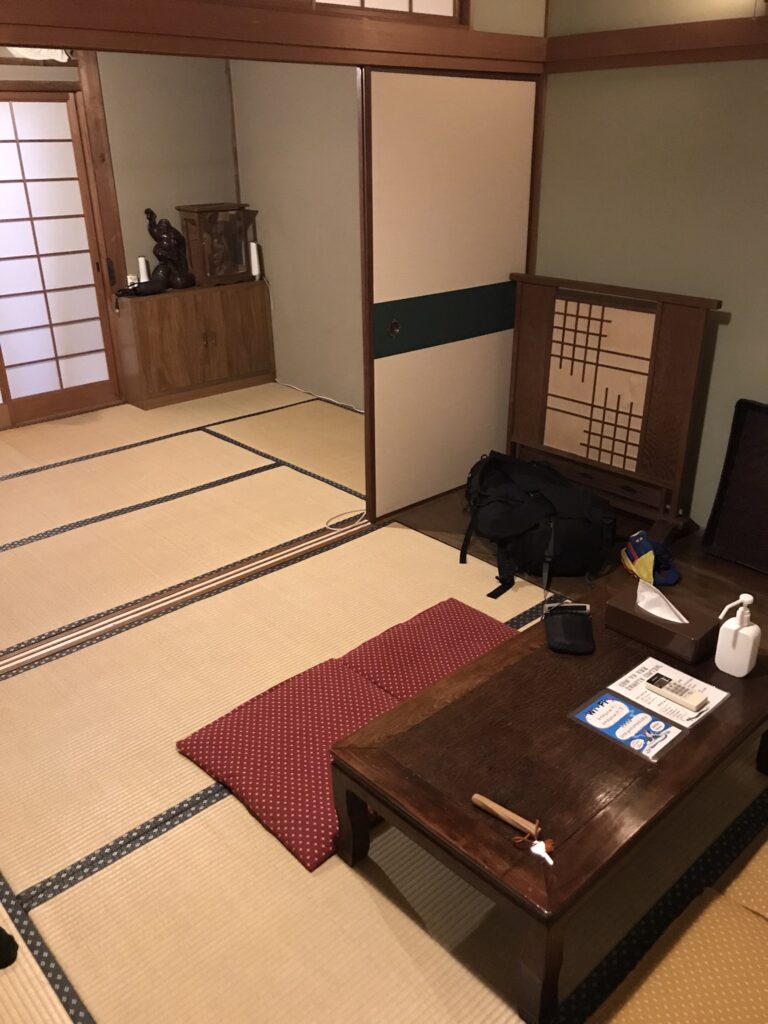
Our tatami room in Onomichi was actually very spacious and comfortable
Unlike in many countries, staying in a dorm room in a hostel isn’t actually the most affordable option for backpackers in Japan. It’s usually much cheaper to get a hotel room in a business hotel and split the cost between two people. Unfortunately this doesn’t work out if you’re a solo traveller, but even then it may still be a negligible difference in price between a dorm and a room in a business hotel!
Hotel rooms in Japan are usually pretty small in comparison with Western hotels, but the services provided more than make up for it. Most business hotels have laundry facilities onsite which are very affordable. Be careful about booking a small double room to save money – you might end up with a bed that’s only slightly wider than a single, so check the reviews beforehand. We stayed in some small double rooms and myself and Dan could just about squash into a small double bed (bearing in mind we are much wider than the typical Japanese couple) – when there wasn’t enough room in the bed for both of us we used the extra bedding provided to create a tatami bed on the floor. Many hotels also offer smoking rooms which can be cheaper than non-smoking rooms, however I recommend against booking a smoking room purely in order to save money – they can be quite smelly and unpleasant unless you’re a smoker yourself!
Transport
Most travel guides and blogs about Japan talk about taking the shinkansen (bullet train) and picking up a JR Rail Pass. This, frankly, is outdated information. The JR Pass massively increased in price in 2023, making it no longer a cost-effective or viable method for getting around the country. The most cost-effective JR Pass (the 21-day pass) works out at ¥4,761 yen (around £22 GBP or $30 USD) per day. That’s much, much more than the majority of people are likely to be spending on transport during their trip. You would have to be making a shinkansen journey from Kyoto to Tokyo roughly every three days to make this worthwhile.
Think hard about whether getting the JR Rail Pass is the best solution for you. Some people like the freedom of being able to ride the shin whenever they want and all the blogs we read recommended getting the pass, but we saved so much money by not doing this. Local (non-shinkansen) trains cover the length and breadth of the country and are a fraction of the price. Usually it’s not a huge time saving either unless you’re making a cross-country trip. Do your research and compare the price of local transport with the JR Rail Pass.
For some travellers, taking the shinkansen is an activity itself and a highlight of their trip. However Japan has excellent transport links in the form of local trains, inter-city buses and metro services. The shinkansen is far from your only option to get around, and it is by far and away the most expensive. A tip to find the best transport options is to use Google Maps – the public transport directions are super-accurate in Japan and you can use filters to find the cheapest way to get between places both within inter-city and within cities themselves. We used this religiously in Japan – it really does work! Private buses (which are not displayed on Google Maps) are another great way to get cheaply between cities – check out Willer Bus which we found to be a helpful platform for searching and booking intercity bus travel on many routes. And if you want to take the shinkansen for fun and the novelty value, then do so – although if you also plan to visit South Korea, bear in mind that they also have a bullet train that you can ride for a fraction of the price.
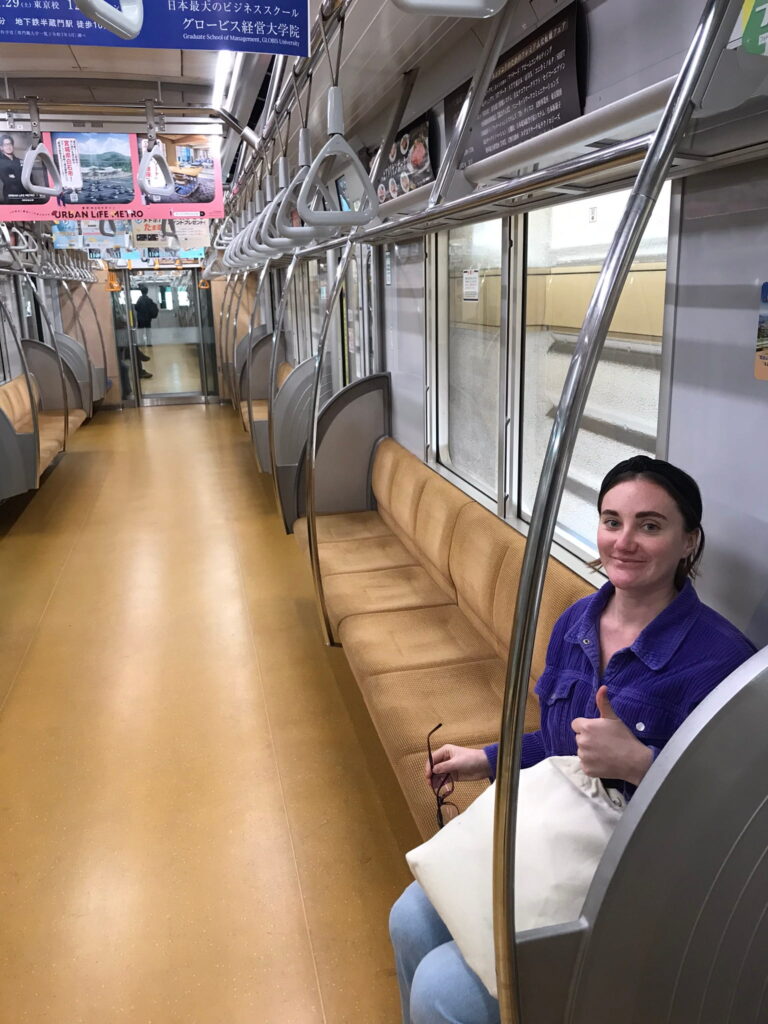
A rare empty metro car in Tokyo
IC cards can be a source of confusion for travelers in Japan – essentially these are travel cards which are used to pay for the metro, trains and buses throughout Japan, as well as being valid for use in some vending machines and shops. Having an IC card is a massive help in big cities where you’re likely to be using the metro a lot. However you don’t actually need an IC card to get around. We traveled from Sapporo to Sendai and from Kobe to Hiroshima without a valid IC card and it didn’t really hinder us much at all. In the big cities though it would’ve been a major drawback.
If you’re arriving in Tokyo, you can grab a free IC card known as ‘Welcome Suica’ at Haneda or Narita airports, at the tourist information centres at Tokyo station, Shibuya station or Shinjuku station. You can also pick up a Welcome Suica at Sendai station or using an online app for iPhone users. The Welcome Suica not only means you don’t have to pay the small fee to purchase the card, but you can also preload it with funds from your own debit or credit card when you pick it up. IC cards are usually topped up using cash only, so this can prove to be a decent saving if you have a bank which charges fees for overseas ATM withdrawals. The drawback of the Welcome Suica is that it’s only valid for 28 days.
Cities in Japan are so well-connected that there’s no need to get a taxi anywhere. We didn’t take a single taxi during our time in Japan. Instead, opt to ride the local buses, trams or metro – they are very straight-forward to use and so much cheaper.
Food
While some restaurants in the country can be expensive, if you know where to look you can always find affordable dining options and cheap on-the-go lunches in Japan.
To get the best value for money when eating out, keep an eye out for lunch deals at restaurants. Lunch deals tend to be a fraction of the price of the dinner menu and often include a meat/fish main dish, rice and soup. Lunch deals are aimed at office workers who only have a short lunch break and want to get away from the office; they also therefore happen to be ideal for budget travellers.
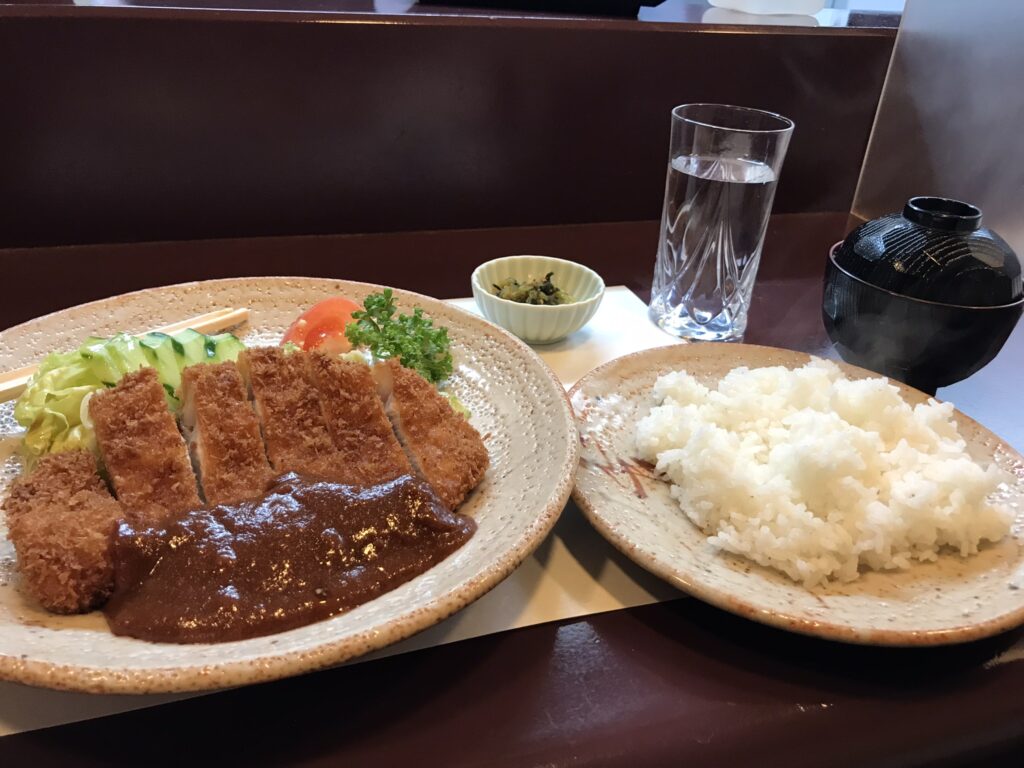
A standard lunch deal of tonkatsu with curry sauce, rice and miso soup
Water is free at all restaurants so you don’t need to order a drink – usually there is a water jug nearby and cups so you can serve yourself, or the server will bring a glass of water over to you. Tap water in general is safe to drink in Japan, so remember to bring a refillable water bottle to avoid purchasing unnecessary beverages from convenience stores as well as reducing plastic wastage.
The konbini (convenience store) is your best friend for cheap on-the-go lunches such as onigiri or sandwiches. Dan lived off rice balls during our time here. Alternatively you can grab baked goods from a local bakery. There are usually quite a few cheap food options at railway stations and major transport hubs, all catering to hungry commuters in search of a convenient bite to eat.
With anything more than a fleeting visit to Japan, it’s definitely worth buying bento boxes (packaged microwavable ready meals) for dinner instead of always eating out. There are a myriad of different bento box options in konbinis to suit every taste, such as rice dishes, tonkatsu cutlets and various pasta dishes. In addition, every single hotel that we stayed at in Japan had a public microwave for guests to use – it’s completely normal to see people heating up bento boxes in hotel lobbies. Hotel rooms also typically contain fridges, so you can buy lunch and snacks for the following day too!
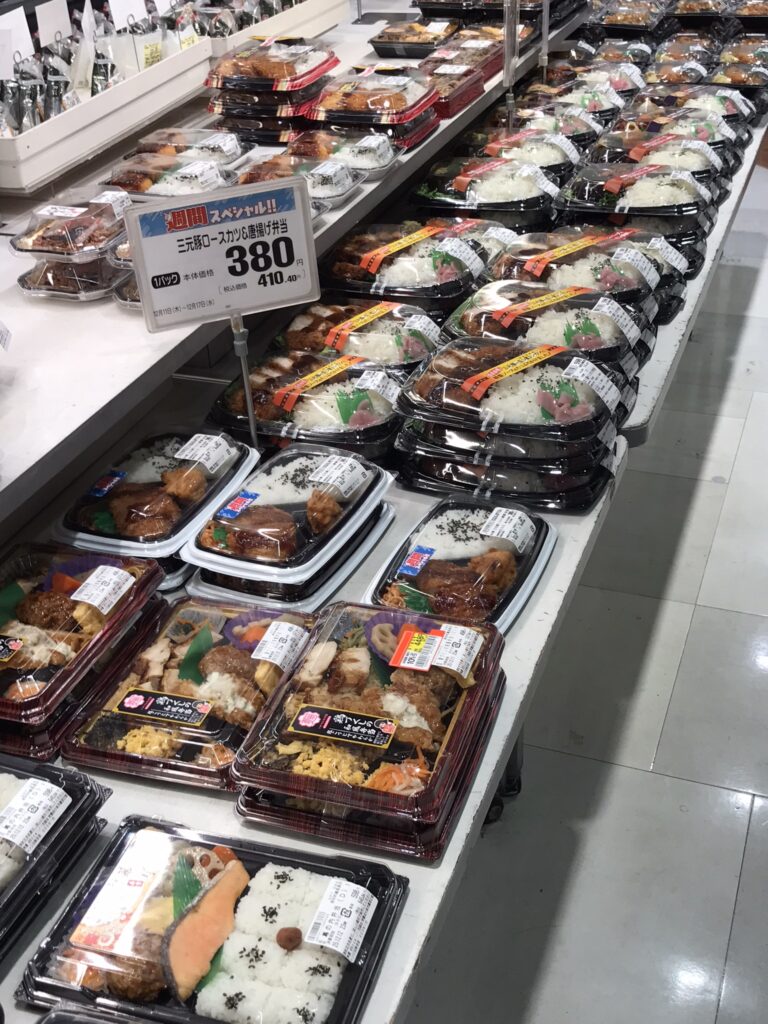
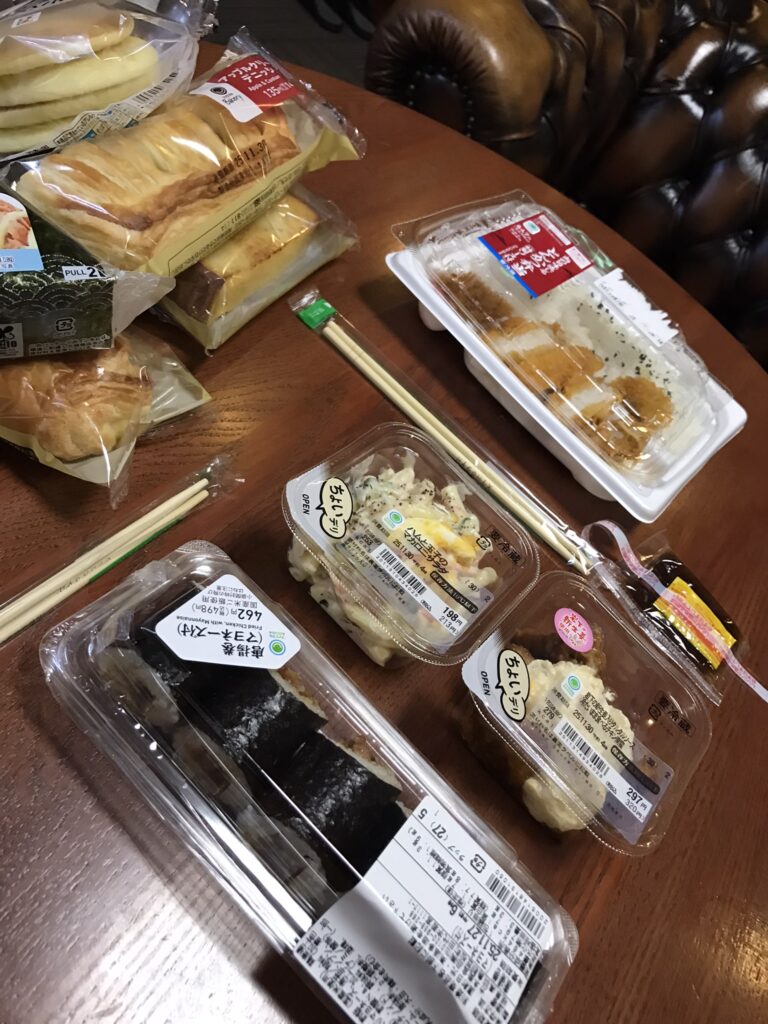
Bento boxes in a supermarket and a typical ‘konbini’ dinner
However it’s important to say; don’t go too crazy in the konbini – all the snacks add up. We often found ourselves spending much more than we wanted to in convenience stores. Sometimes it’s cheaper to grab a cheap bowl of ramen at a local joint than splurge on a bento box, dessert and snacks from a konbini.
Supermarkets slash prices towards the end of the day for fresh produce. We got some great deals at the LIFE supermarket near to Keikyu-Kamata station in Tokyo. If you’re staying near a major supermarket, it’s definitely worth checking out at the end of the day to see if you can get some cheap sushi or other treats.
In every city, you will always be able to find good and relatively cheap restaurants serving ramen (rich noodle soup with meat), tonkatsu (breaded pork with rice and miso soup) or katsu curry (a Japanese twist on the Indian version). Depending on where you are, you might also be able to find regional delicacies such as okonomiyaki (savoury pancake with meat and vegetables), takoyaki (doughy balls with squid piece at the centre usually a street-food snack) and different varieties of soba noodles. These are typical staple meals for the Japanese, and from our experience you should always be able to find somewhere serving these meals without costing an arm and a leg.
As always, restaurant prices in central locations and tourist hotspots tend to be much higher, so always plan where you’re going to eat to avoid being caught out. Some of our most memorable meals were in small local eateries rather than fancy high-end restaurants.
Business hotels sometimes offer free snacks for guests in the evening – make sure you keep an eye out for signs about this or random queues forming. We managed to swipe quite a few free meals this way, which was very much appreciated.
Activities
Attractions in Japan are, for the most part, surprisingly cheap. The admission fee to the vast majority of museums, temples, galleries, historical sites and tourist attractions in the country is only a few hundred yen at most. If you’re paying an admission fee of more than ¥1,000 yen then it’s likely that the attraction is either overpriced or aimed at foreign tourists. In that case, you can make your own mind up about whether or not to visit.
As always, we recommend using GPSmyCity for self-guided walking tours – we find that these self-guided tours can give you a great introduction to the city and allow you to explore at your own pace without trailing after a guide. In some cases Dan painstakingly created his own walking routes for us to follow, and these are now available on GPSmyCity too! Most of the free walking tours (Guruwalk etc) that we came across in Japan did not seem to be led by Japanese locals, so we decided not to go on any of these. We speculated it might have something to do with the tipping culture (non-existent and considered offensive) and the fact that Japanese society values stable employment and 9-5 jobs rather than insecure work.
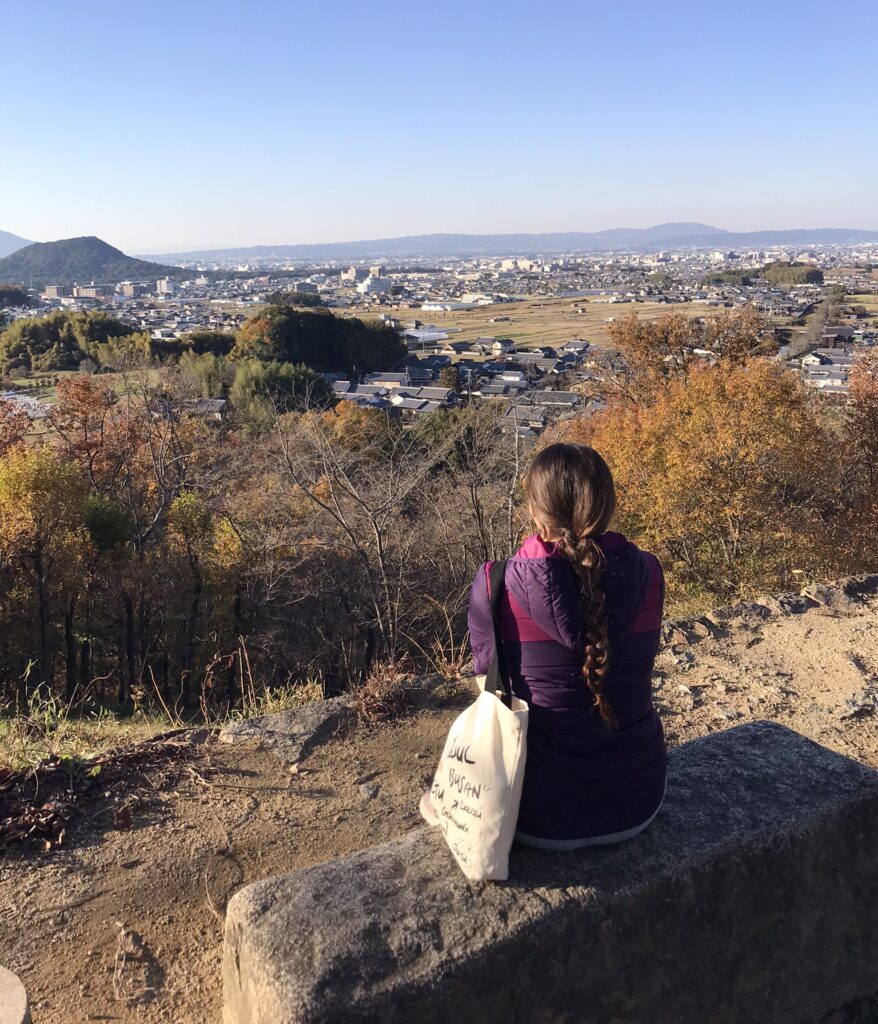
Taking a breather during Dan’s self-guided walking tour around Asuka
We discovered that at every attraction, be it a museum, castle, garden or temple complex, there are almost always free leaflets available which provide very detailed information and allow you to explore the place without needing a guide. This means you don’t have to splurge on expensive tours to fully understand the subtle nuances and history of each place you visit. You’re not missing out if you opt to skip on using a guide. You can also find volunteer guides (often elderly retirees complete with branded hi-vis) at many attractions who may be able to assist, or will point you to the local tourist information point if not.
It’s okay to skip expensive attractions and instead go to free or cheaper ones. Just because something is expensive it doesn’t mean that it’s necessarily better, and just because a travel guide or website has told you to do something or go somewhere it doesn’t mean you have to go. There are so many unique museums, galleries and activities in Japan that there are always other options for budget-conscious travellers without breaking the bank.
Don’t get sucked into the ninja stuff in Japan. You can find a number of self-professed ‘ninja museums’ in tourist spots throughout the country, however the black-clad ninja assassins as they are often portrayed in modern media did not really exist. They are a modern Hollywood creation which was developed from illustrations of the dark-clothed assistants in Kabuki. The ‘museums’ promoting this depiction are not historically accurate and a total gimmick. In many cases the owners are not actually Japanese. I would go as far as to call them a tourist scam. Just don’t bother unless you want to try throwing plastic shuriken and pay over the odds to do that.
There are free observation decks all over Japan, often located on the top floor of city halls and private skyscrapers – you just need to do your research to find them. We visited free observation decks in Sakai (Osaka), Kobe, and Morioka. There’s no need to pay to visit expensive observation decks, just look for the free ones. Our top tip is to visit the Asahi headquarters in Tokyo and purchase a beer ($4 each) for amazing nighttime views of the Tokyo skyline rather than splurging on the extravagant Tokyo Skytree. You can even see the Skytree from the Asahi Headquarters. The added bonus of a beer doesn’t hurt either!
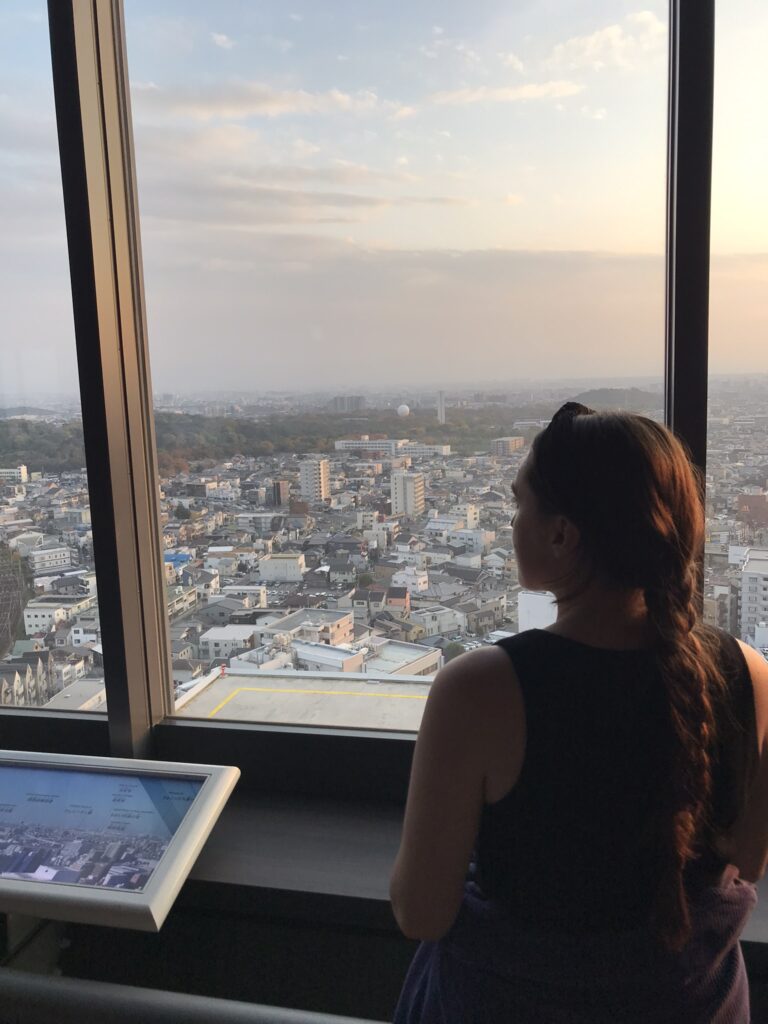
Taking in the sunset is a great thing to do at free observation decks
Japan is known for its plethora of art galleries – one handy piece of advice is that many art galleries have free or cheap permanent exhibitions alongside much more expensive temporary exhibitions. These temporary exhibitions are constantly changed, whilst the permanent exhibition is often much smaller and remains in the gallery. You can usually purchase a ticket for the permanent exhibition for a much lower cost, without needing to add on the pricey temporary exhibition which could cost up to five or six times as much.
For commission-free cash withdrawals, always use the 7-Eleven ATMs. Japan is a cash-based society, luckily every single 7-Eleven in the country contains an ATM which foreigners can use without incurring fees.
One great thing about Japan is that it’s possible to go on an array of day trips from the larger cities to other nearby towns for relatively affordable prices, as long as you take public transport and walk around independently. You can even store your luggage in lockers at train stations and bus stations, so you can visit attractions as you move from one city to the next – prime examples of this are Himeji Castle (between Kobe and Okayama), Shirakawa-go (between Takayama and Kanazawa) and Horyu-ji (between Osaka and Nara).
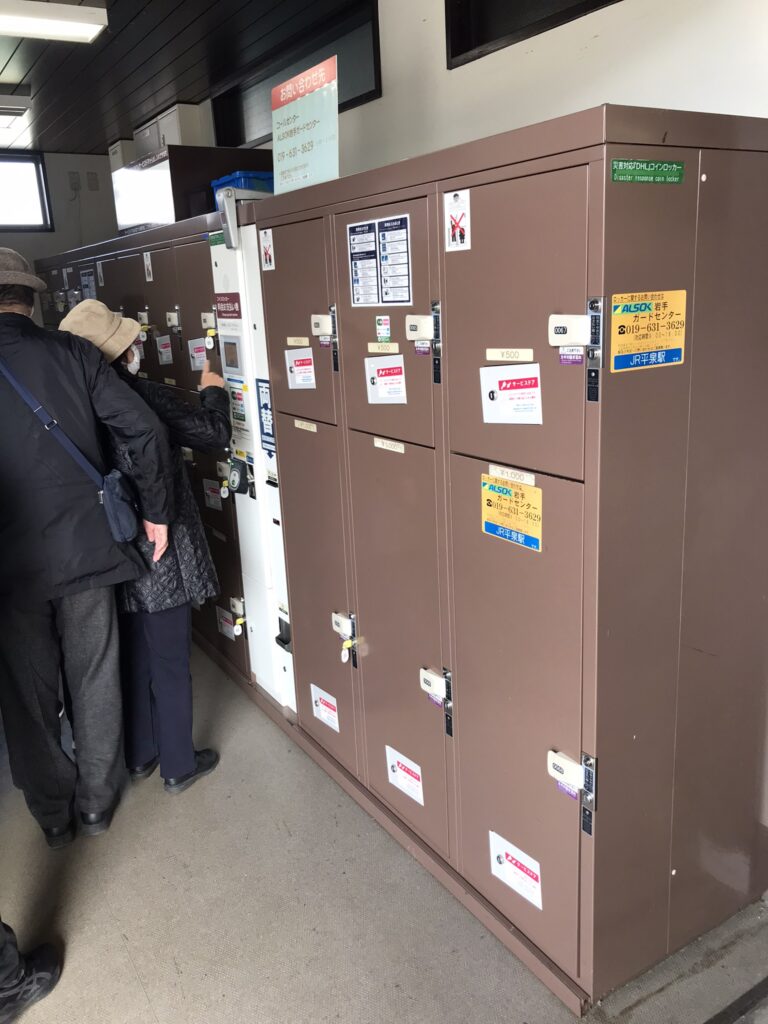
You will always find lockers at transport hubs – just look out for a sign