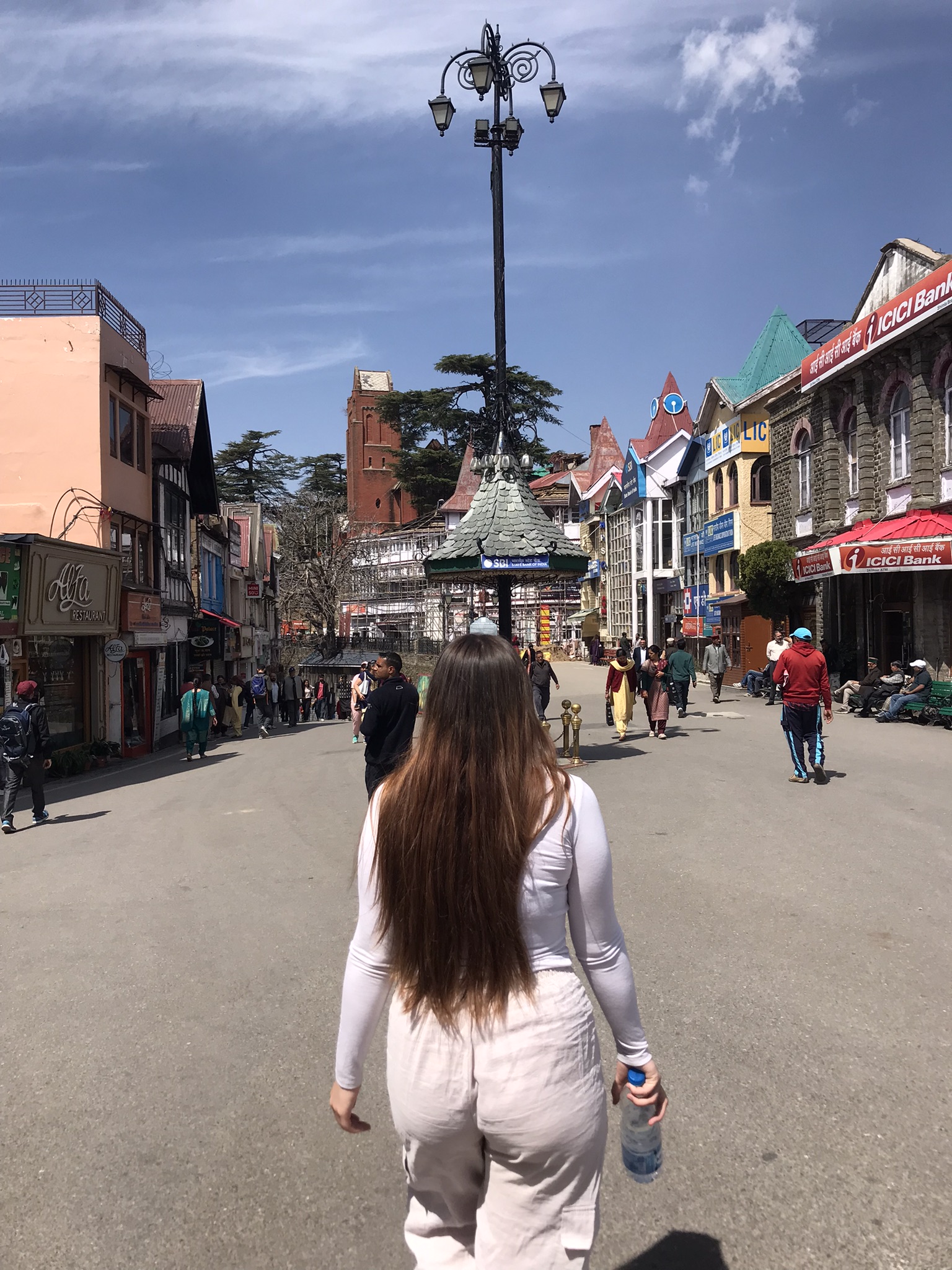
Originally developed by the British during the 1800s as the summer capital of the British Raj, Shimla’s cool mountainous climate meant that it became a popular retreat from the oppressive heat of the lowlands for many British officers, enlisted personnel, administrators and their wives during the sweltering summer months. With a mix of high-ranking government officials and aspiring colonial officers, the city also began to attract younger single women looking for marriage and developed a reputation as a hub of upper-class social life within British India. Following India’s independence, the British left and Shimla today is the capital of modern Himachal Pradesh state and a popular hill station which is filled with unique colonial architecture and faded tales of scandal and frivolity within a picturesque mountain setting. Two pedestrianised routes, The Mall and The Ridge, run parallel from east to west in the heart of the city and are lined with historic and notable buildings. Check out this walking tour for some of the highlights!
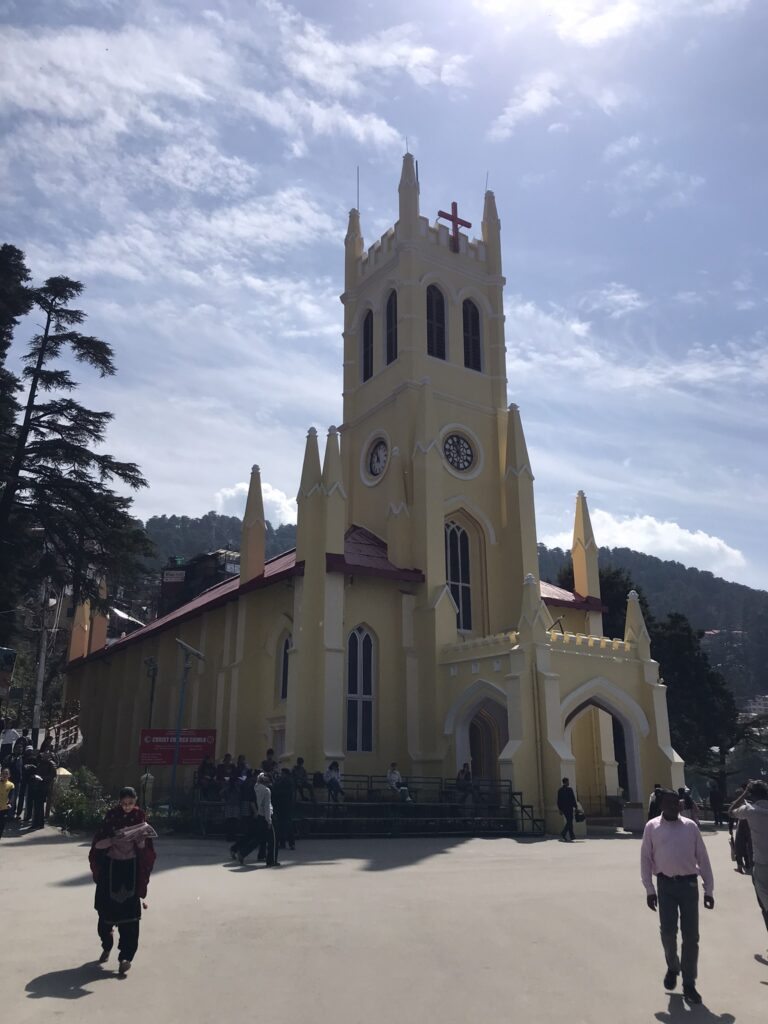
Start at Christ Church. Inaugurated in 1857, this striking yellow church is considered to be the second oldest church in northern India and a major landmark within the city of Shimla. The pipe organ within the church dates back to 1899 and is one of the largest in South Asia. Outside the church is a large open promenade, The Ridge – a bustling area often featuring cultural activities, amusements and great views across the surrounding hills and valleys.
Head west along The Ridge and you will see the back of the Gaiety Theatre. Opened in 1887, this theatre was the centre of chivalry and culture during the time of the British Raj. Colonialists would frequently take part in amateur dramatics here, while many renowned actors have performed on the famous stage over the years. A large, multi-storey building, the main entrance to the historic theatre section is off the lower Mall Road, while there is a secondary entrance on The Ridge that leads to a multi-purpose function room which often hosts cultural performances and workshops. It’s possible to take a tour of the old theatre for a small fee – just ask at the main reception from the entrance off Mall Road. Don’t miss the photo gallery featuring slightly-comical pictures of the British-era performances!
Next to the Gaiety Theatre on The Mall is Shimla Town Hall – a grand municipal building dating back to 1908.
Head west from the Gaiety Theatre to Scandal Point. The Ridge and the Mall join at this point, which is so named after a scandal which supposedly occurred here when a local Maharaja eloped with the daughter of the British viceroy. Today, Scandal Point is a notable meeting point within the city. The square today contains a statue of Lala Lajpat Rai, an anti-colonial activist from Punjab who was killed while resisting the British during the 1920s. This statue was initially erected in Lahore, but was moved to Shimla in 1948 following the Partition of India.
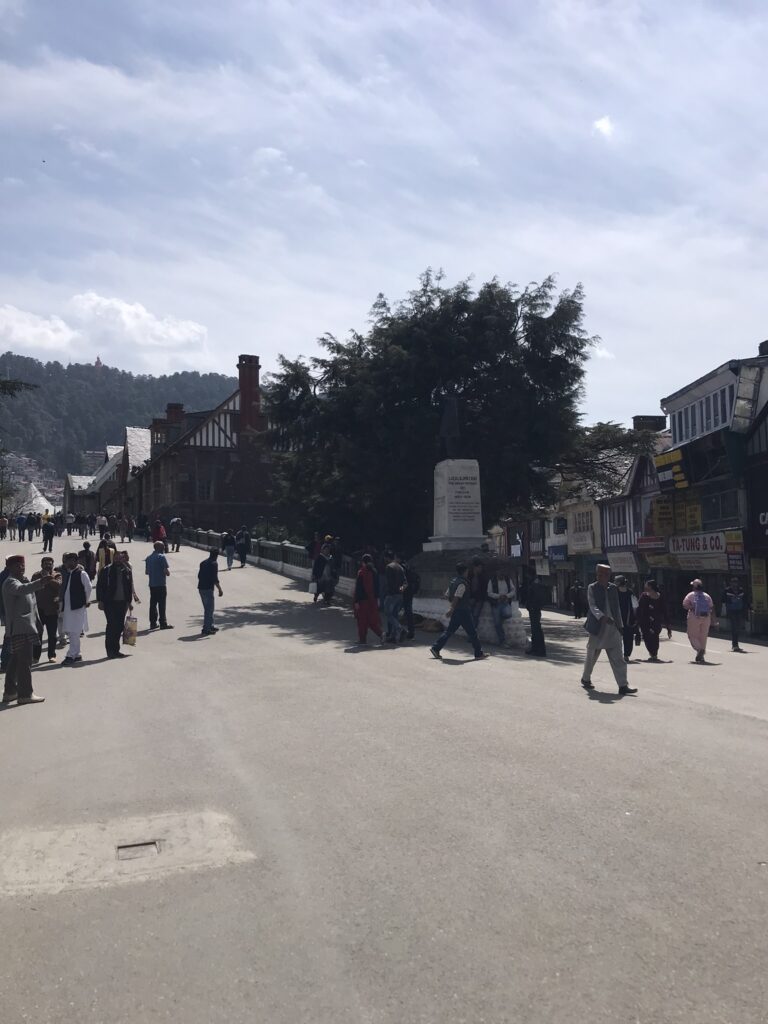
Scandal Point – now relatively scandal-free!
Take the high road to the right and continue west past the General Post Office building. This large British-era post office has been functioning since 1883, when mail was delivered by pony and citizens were alerted to new deliveries by the waving of a large red flag. Considered to be the oldest post office in northern India, this building was constructed in a unique blend of traditional British, Alpine and Gothic architecture and is still functioning under the auspices of the Shimla General Post Office today.
Continue along Kali Bari Road and you will come to Bantony Castle. Formerly a summer residence of the Maharaja of the nearby princely state of Sirmaur, Bantony Castle was built in a British architectural style in the 1880s. Today, it houses a museum featuring lots of information about the city of Shimla and its role as the summer capital of the British Raj, as well as displays about wider Himachal Pradesh and the state’s tribal areas. There is even a section on Gandhi’s travels to Shimla.
Continue further west and you will reach Kali Bari Temple. One of the most prominent Hindu temples in Shimla, this temple is dedicated to the Hindu goddess Kali. Here, Kali is worshipped as her form Shyamala – from which the name of the city of Shimla is said to be derived.
Head west and rejoin Mall Road. Eventually you will pass the Railway Board Building. This imposing building was built by the British in the late 1890s with a structure made from iron and steel, which was intended to make it resistant to fire. One of the most striking colonial buildings in the city, it served as the headquarters of several public services and local government departments during the colonial period, including the railway board after which it is named. The building presently houses government offices and is not open to the public.
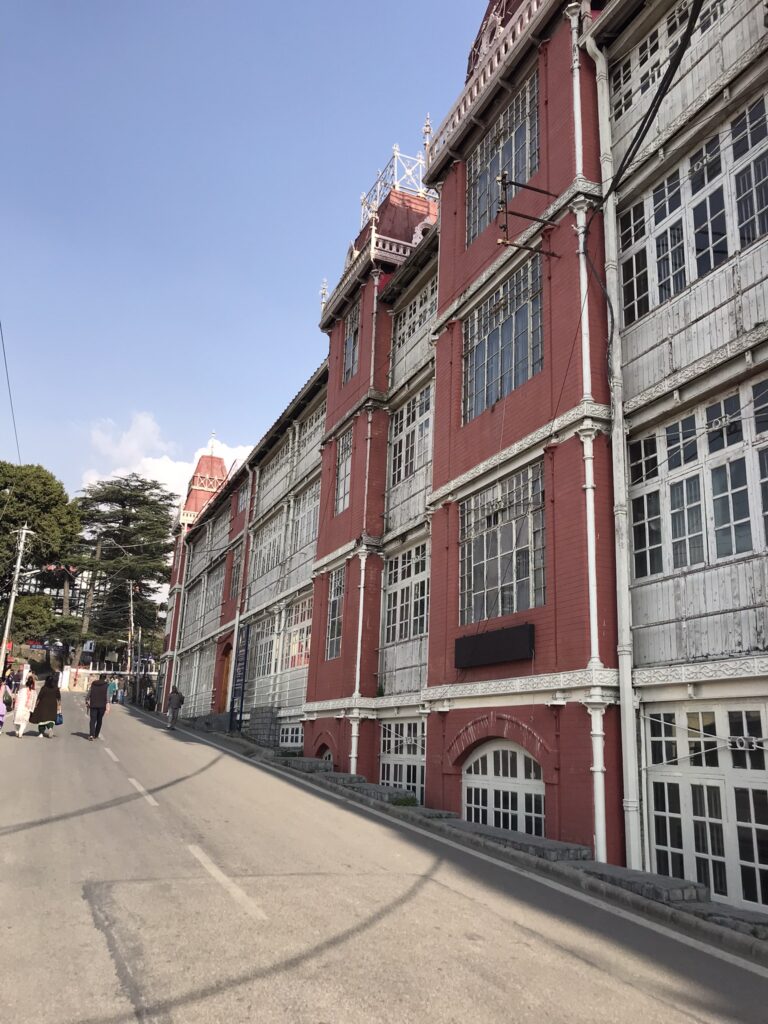
The imposing Railway Board Building
Further along from the Railway Board Building is Gorton Castle. Another of Shimla’s colonial-era heritage buildings, this grand structure was built in the early 1900s to house the administrative offices of the British colonial government. Today, it is the office of the Accountant General of Himachal Pradesh state. While the building itself is private and not accessible to the public, the guards may allow visitors to walk up the path and get a quick look from the outside.
Continue west along Mall Road, passing the Vidhan Sabha (the state legislative assembly of Himachal Pradesh) as well as an area of colonial houses known as ‘Knockdrin’, which are now under possession of the Indian Army.
Further west along Chaura Maidan Road you’ll pass the grand Oberoi Cecil. Originally The Cecil Hotel, this property started life as a bed-and-breakfast cottage which was said to have been frequented by the famous author Rudyard Kipling and provided an inspiration for his work ‘Plain Tales from the Hills’. The Cecil grew to become one of the largest luxury hotels in the city during the colonial era. Opened in 1884, the hotel was later taken over by one of its employees, Mohan Singh Oberoi, who went on to found the Oberoi hotel chain.
Just beyond the Oberoi Cecil, take State Museum Road to get to the Himachal State Museum. Situated in a large Victorian colonial house which was originally used to accommodate guests of the Viceroy of India, this building was converted into the Himachal State Museum in 1973. The museum contains a wide variety of artefacts and information about the people, culture and heritage of the state.
Further along from the State Museum is the Peterhoff Hotel. Now a luxury hotel, the original Peterhoff building was constructed in 1863 and was initially used as the summer residence of the Viceroy of India prior to the opening of the Viceregal Lodge in 1888. It later served as the Punjab High Court – in this capacity it was the location of the trial of Nathuram Godse, the assassin who shot Mahatma Gandhi in Delhi in 1948. The Peterhoff later served as the seat of the governor of Himachal Pradesh before being destroyed by fire in the 1980s. The current hotel was built in 1991.
Continue west past the Peterhoff and through the gate which marks the entrance to the Viceregal Lodge – the former official summer residence of the Viceroy of India. This grand, Scottish baronial style castle was built between 1884 and 1888. As well as housing the viceroy, the lodge was notable as the location of the Simla Conference in 1945, at which the All India Muslim League led by Muhammad Ali Jinnah demanded autonomous representation in a future independent Indian state – one of the major steps towards the Partition of India. Today, the former Viceregal Lodge houses the Indian Institute of Advanced Study, a higher education campus. It’s possible to enter the grounds of the estate for a small entry fee, and also to take a guided tour of the building for a slightly higher fee.
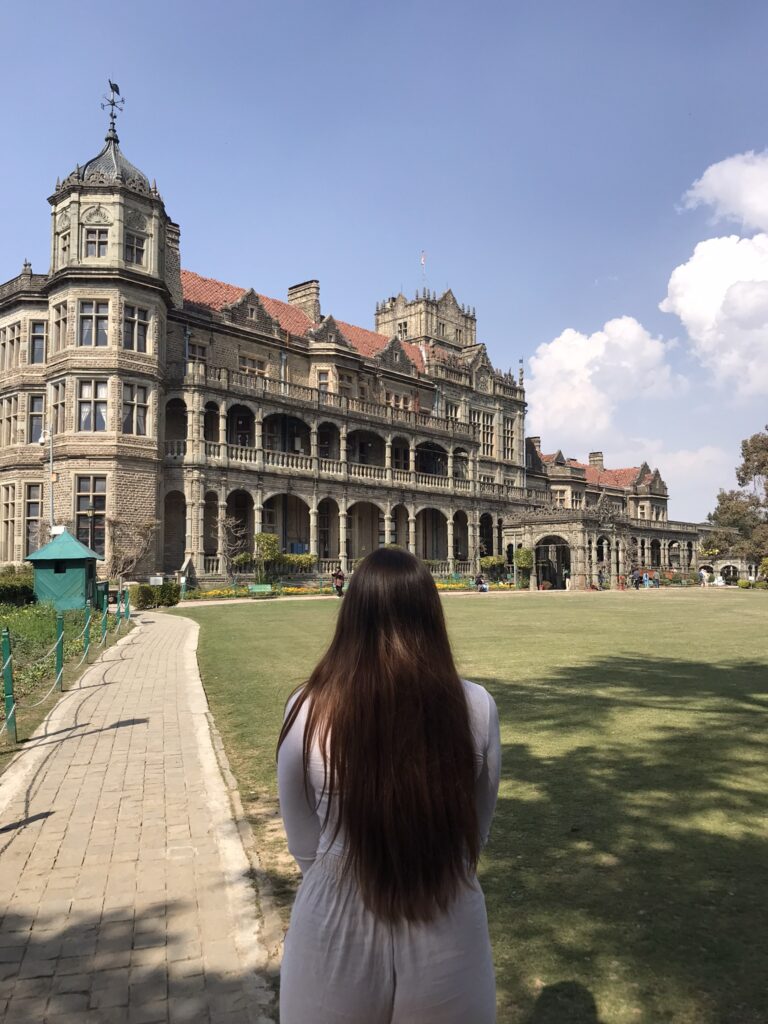
The former Viceregal Lodge looks like something straight out of the Scottish countryside
Finish! For more India and Shimla content, click here!
This article is also featured on GPSmyCity. To download this article for offline reading or create a self-guided walking tour to visit the attractions highlighted in this article, go to Walking Tours and Articles in Shimla.